
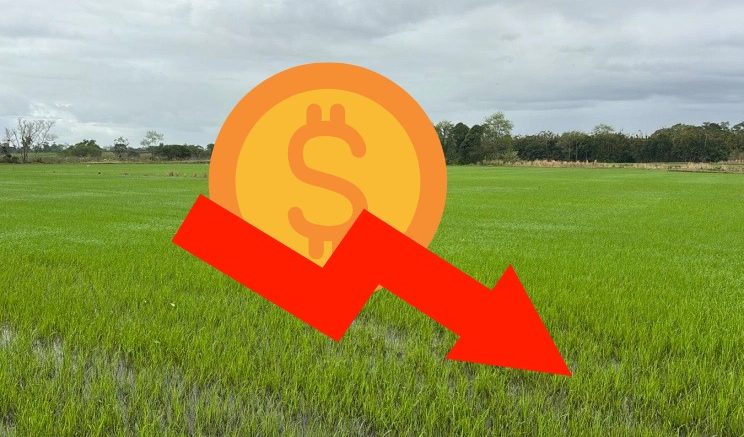
“Farmers will harvest and deliver their output, but it will not be enough to cover their costs…”
Walmir Rampinelli is the president of the Rice Industries Union of the State of Santa Catarina (SindArroz-SC), managing partner of Rampinelli Alimentos and holds a degree in Civil Engineering from the Federal University of Santa Catarina.

Walmir Rampinelli, president at SindArroz-SC
AgriBrasilis – Why is the rice production chain in crisis?
Walmir Rampinelli – In 2025, Brazil experienced a rice oversupply. Because prices had previously peaked, the crop came into focus and Farmers across the country, including in the Center-West, chose to plant rice, even with high production costs, because it was still economically viable at the time. Favorable weather conditions boosted yields and overall production.
At the global level, there was also oversupply: India reopened its borders, and the United States, China, Uruguay and Paraguay all recorded large harvests. As a result, prices fell, but Brazil’s high production costs make the current price levels economically unviable.
AgriBrasilis – What are the outlooks for 2026?
Walmir Rampinelli – Production in 2026 will also be large, but not as high as in 2025, as we expect a slight pullback. Our production costs remain high: US$ 14.47 per sack of 50kg in the State of Santa Catarina, while rice prices are around US$ 9.65. That means a deficit of US$ 4.82 per sack of 50kg.
I still believe that in the first half of the year there will be no real prospects, as rice prices are declining. We will see price pressure starting mainly in March, when the harvest intensifies in the State of Rio Grande do Sul.
In my view, when the 2026 plantings begin or end, referring to the 2026–2027 crop, there will be a very sharp reduction, because farmers will not be capitalized to carry out planting. Financial institutions are not willing to support this planting, especially because there will be significant farmer default due to the current deficit, with farmers spending UUS$ 14.47 and harvesting at US$ 9.65.
From that point on, I believe rice prices may start to move somewhat, because expectations for the 2026–2027 crop are for a disappointing, smaller harvest. As a result, there may be some price movement, reaching a level that at least covers production costs.
AgriBrasilis – What is the risk of default among rice farmers?
Walmir Rampinelli – There is a high risk of default. This is evident in our meetings, where farmers’ demands focus on having their debts rescheduled by financing agents. So yes, there will be defaults with financial institutions. Even the industries that support farmers, those that have partnership-based production financing arrangements, are concerned. Farmers will harvest and deliver their output, but it will not be enough to cover their costs.
AgriBrasilis – What measures are the sector and the government taking to address the current situation?
Walmir Rampinelli – We are holding meetings with representative entities, such as the Rice Sector Chamber of the State of Santa Catarina, trade unions and the sector’s own operators. The state government has already signaled some measures to be adopted, such as financing rice seeds for farmers, as well as introducing the State of Santa Catarina produced rice as mandatory in school meals and in food programs for penitentiaries.
We have a meeting pre-scheduled for early March with the Vice President of the Republic, Geraldo Alckmin and all representative bodies Nationwide, especially from the States of Santa Catarina and Rio Grande do Sul, to seek ways to encourage exports, open export channels, and enable long-term planning so that there is no shift away to other crops.
At times, everyone rushes to plant rice when prices are high and abandons corn and soybeans or the opposite. As happened now, everyone planted rice because it was very attractive, and then prices fell. Therefore, there is a request for coordinated planning with the National Supply Company, together with representative bodies, federations and unions, so that production can be kept balanced with consumption.
AgriBrasilis – Are high rice stocks putting pressure on the sector to export?
Walmir Rampinelli – We expect a production reduction of around 10% to 15%, but we have carryover stocks that are far greater than that, so there will be no shortage of rice. There will still be surplus rice this year.
With the weaker U.S. dollar, exporting becomes more difficult, but there has been demand. We are even being pressured to increase exports. In addition, some countries are making it harder to import Brazilian rice.
We are also trying to access the African market, which is a major rice consumer, and Brazil has a very close relationship with the continente, so much so that Brazilian Agricultural Research Corporation is conducting research there.
Another concern is Paraguay. When the Mercosur agreement was signed, Paraguay did not produce rice, but today it produces as much rice as the State of Santa Catarina and it will certainly surpass our state significantly over the next five years. Therefore, I believe we need to operate in a more globalized manner.
AgriBrasilis – What are the expected effects on the consumer market in the short and medium terms?
Walmir Rampinelli – Today, consumers are finding a product on store shelves that is being sold below production costs. The concern is that this could disrupt the supply chain, as production needs to remain balanced with consumption.
Read More: