
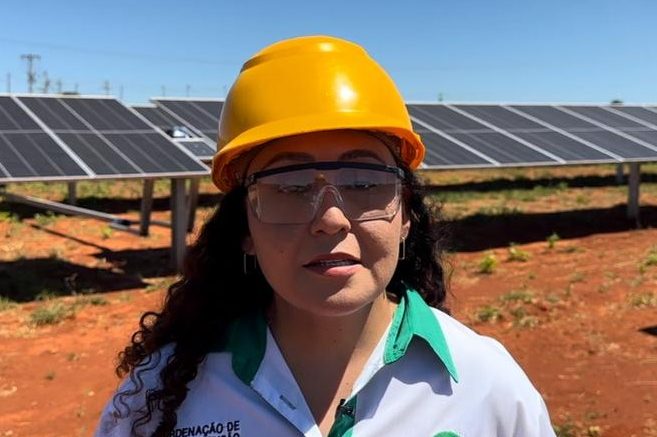
“The proposal is to make better use of the land and seek an integration that makes rural production more resilient, enabling the expansion of solar energy…”
Polyanna Mara de Oliveira is a researcher at the Agricultural Research Corporation of Minas Gerais – EPAMIG; she holds a degree in Agricultural Engineering and M.Sc. and Ph.D. degrees from the Federal University of Lavras.
Oliveira works in Soil and Water Engineering, with experience in irrigated crop management and water resources, and coordinates EPAMIG research on agrivoltaic systems in the State of Minas Gerais.
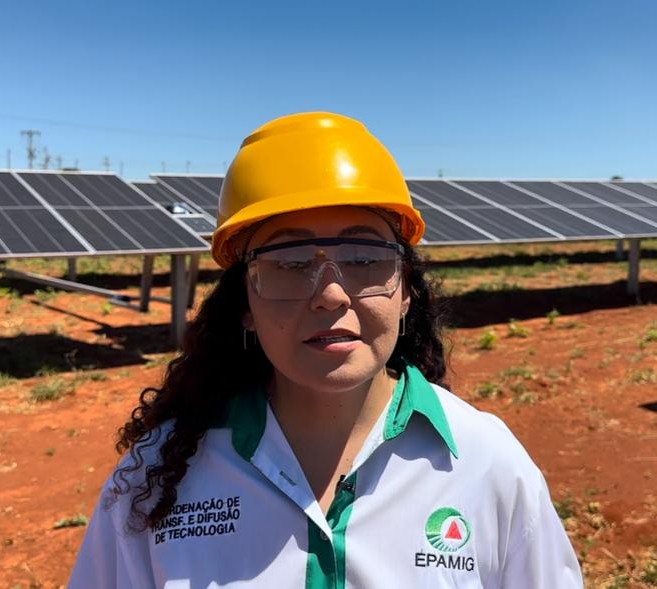
Polyanna Mara de Oliveira, researcher at Epamig
AgriBrasilis – What is agrivoltaics?
Polyanna de Oliveira – An agrivoltaic, or agro-photovoltaic, system involves the dual use of land to simultaneously produce food and generate solar energy. Solar panels are installed in a way that allows agricultural activities to continue. The aim is to make better use of the land and seek an integration that enhances the resilience of rural production while enabling the expansion of solar energy.
AgriBrasilis – How are the EPAMIG field experiments progressing?
Polyanna de Oliveira – EPAMIG, in partnership with the CPQD Foundation (Center for Research and Development in Telecommunications) and the Minas Gerais Energy Company (CEMIG), and with financial support from the National Electric Energy Agency (ANEEL) and the Minas Gerais State Research Support Foundation (FAPEMIG), is implementing research projects in two regions of the State of Minas Gerais: the Central region, focusing on integration with livestock farming, and northern Minas Gerais, where the focus is on agriculture.
So far, cover crops such as sorghum and Crotalaria have been planted to improve soil conditions. Other crops of economic interest, such as lettuce, strawberries, melons and beans, are scheduled to be planted starting in November.
Throughout the research, crop development, productivity and post-harvest quality will be evaluated. For livestock, the study will assess the behavior of dairy calves within the system, weight gain and thermal comfort, among other parameters. In both systems, the impact of agricultural and livestock production beneath the panels on energy generation will also be evaluated.
AgriBrasilis – How does panel shading affect productivity and water use?
Polyanna de Oliveira – The effect depends on the crop and the intensity of shading. International research indicates that panel shading can reduce evapotranspiration and, therefore, reduce crop water demand by up to 30%. Regarding productivity, the result can be positive or negative: some crops tolerate shade better or can benefit from it, while others require more light. This is precisely what the EPAMIG experiments will evaluate under the conditions of the State of Minas Gerais.
AgriBrasilis – Which crops have yielded the best results in agrivoltaic systems?
Polyanna de Oliveira – We cannot yet identify which crops yield the best results in the experiments in the State of Minas Gerais. Results vary in other countries: some crops maintain or increase productivity under shade, while others produce less. The response depends on the light requirements of each species and local conditions.
AgriBrasilis – Is the technology already ready for commercial use in Brazil?
Polyanna de Oliveira – We still need to advance our research before recommending commercial models for Brazil. EPAMIG is studying different system models in two contexts: northern Minas Gerais, which has semi-arid conditions, and the Central region, to evaluate production aspects and develop business models. The goal is to generate information that helps producers and society assess the conditions under which the technology may be viable.
AgriBrasilis – Can agrivoltaics scale up in Brazilian agriculture?
Polyanna de Oliveira – Agrivoltaic systems have potential, but expansion depends on studies across different regions, crops and production models. Beyond agricultural productivity and energy generation, it is necessary to evaluate the costs and economic viability of each system. In some situations, a possible reduction in agricultural output may be offset by revenue from energy generation; this needs to be demonstrated on a case-by-case basis.
There may also be synergy between the systems: crop evapotranspiration can contribute to a microclimate that enhances panel efficiency. Research will help determine when these benefits are realized in the field.
LEIA MAIS: