
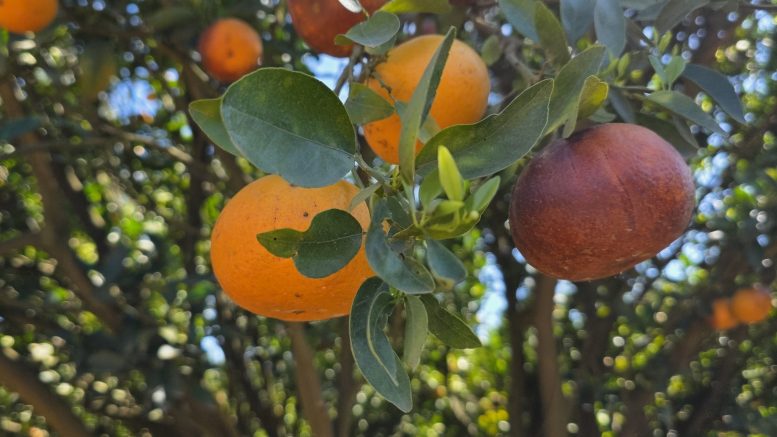
“Citrus production in Brazil has undergone profound changes in recent decades…”
Daniel Junior de Andrade is an associate professor and researcher at São Paulo State University – Unesp, in the Department of Plant Protection at the School of Agricultural and Veterinary Sciences in Jaboticabal, State of São Paulo, Brazil, where he coordinates the Laboratory of Acarology – AcaroLab.
Andrade is an agronomist with a Ph.D. in Agronomy (Agricultural Entomology) from Unesp, as well as an associate professor and a research productivity fellow at the National Council for Scientific and Technological Development – CNPq, working in agricultural acarology and integrated pest management, with research focused on agriculturally important mites, acaricide resistance and citrus leprosis control.

Daniel de Andrade, researcher at Unesp
Citrus production in Brazil has undergone profound changes in recent decades, mainly due to the spread of greening and the need to increase productivity. Among these changes are higher-density orchards and the systematic use of insecticides. This new scenario has contributed to significant changes in the profile of pests and diseases affecting citrus crops. For example, some pests, such as certain scale insects and leafhoppers, have lost their status as primary pests, while others have become more important. Interestingly, in the case of pest mites, the situation has remained relatively stable, without major changes. The citrus leprosis mite (Brevipalpus yothersi) and citrus rust mite (Phyllocoptruta oleivora) continue to be considered key pests, while spider mites (Panonychus citri, Eutetranychus banksi and Tetranychus mexicanus) and the broad mite (Polyphagotarsonemus latus) generally remain secondary or occasional pests.
However, management of the citrus leprosis mite has become particularly difficult in some areas of Brazil’s citrus belt, mainly because of the limited availability of acaricides and changes in citrus production practices, which have favored the spread of the mite and made control more difficult. Higher-density orchards facilitate mite dispersal from plant to plant while also making it harder for acaricide sprays to penetrate the inner canopy, where mites may remain sheltered. There have also been recent cases of mite populations resistant to acaricides. Under these conditions, management should be based on monitoring through efficient sampling, sound decision-making and high-quality acaricide applications.
Because of higher planting densities, it is recommended that at least 2% of the plants in a plot or orchard be sampled. Intervention should occur as soon as the action threshold is reached, using effective control methods. The action threshold is determined by the presence of one or more mites on sampled fruit and/or branches and, under current conditions, should not exceed 3% of infested fruit and/or branches. Once the action threshold is detected, control measures should be taken as quickly as possible, with chemical acaricides currently being the predominant option. Acaricides selected for application should have proven efficacy and different modes of action to support resistance management.
Management of the citrus rust mite has also become challenging in some citrus-producing regions of Brazil, particularly in areas producing fruit for the fresh market. By feeding on fruit, this pest causes peel darkening and cracking that can make the fruit unsuitable for sale. It is one of the most common and damaging pests in citrus-growing regions worldwide. Likewise, the limited availability of acaricides, denser and more shaded orchards, multiple flowering periods and climate change have favored populations of this pest mite. Monitoring is also essential for its management, together with application quality and the use of products with proven efficacy.
Spider mites, also known as defoliating mites, can sometimes become particularly troublesome. Successive insecticide applications can cause major imbalances in spider mite populations, either by eliminating natural enemies or through hormesis — a biological response in which low doses of a stressor stimulate an organism, while higher doses cause toxic effects. As a result, spider mites currently have greater economic importance as pests than they did in the past. Management should also be based on monitoring, with control beginning at the early stages of infestation to prevent sharp population increases in production areas.
Finally, the broad mite is a species that can cause losses mainly by damaging the appearance of fruit. It is more common during periods of high relative humidity and high temperatures. Population outbreaks can occur, with numbers increasing very rapidly under favorable conditions. This is due to its extremely short biological cycle, which can take only three days from egg to adult. Monitoring of this species should therefore be even more frequent during favorable periods, and interventions should be carried out as quickly as possible once the action threshold is detected.
In summary, recent changes in citrus production in Brazil have created major challenges for growers in the integrated management of mites. Increasingly rigorous strategies are required, based on monitoring, timely decision-making, application quality and the rational use of acaricides. Investment in research is also necessary to develop new management tools, evaluate alternative control methods and generate information to track changes in the population dynamics and economic importance of these pests.
READ MORE: