
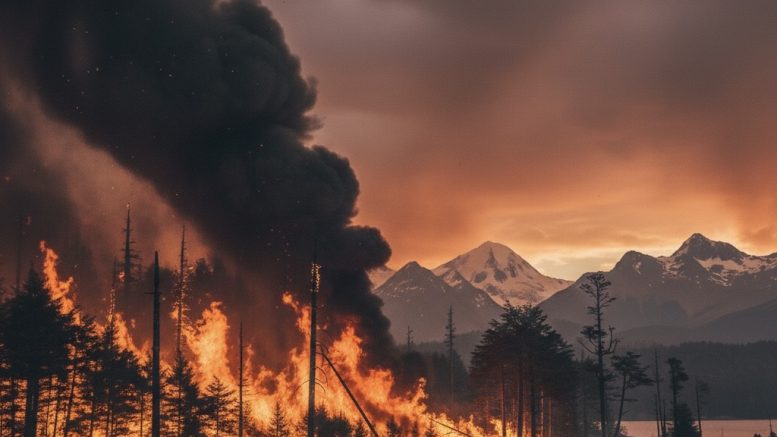
The Argentine Government Expanded the Wildfire Emergency, Including the Province of Santa Cruz in the National Plan
Brazil
The State of São Paulo has extended the public consultation for the implementation of the reverse logistics policy until February 27. The initiative, led by the Secretariat of Environment, Infrastructure and Logistics, aims to regulate post-consumer product return systems, defining the responsibilities of manufacturers, retailers, municipalities and the state, with a focus on reuse and environmentally appropriate waste disposal. (Semil)
The Amazon Environmental Research Institute (IPAM) warns the 17% budget cut for 2026 in forest fire monitoring and prevention is concerning. Science Director Ane Alencar states that fire management must be continuous, with permanent investments in prevention. According to IPAM, emergency government funds (US$ 10.19 million) help with firefighting but do not replace the regular budget. (IPAM)
The Federal Public Prosecutor’s Office requested the freeze of US$ 190.1 million from Vale, a Brazilian mining company and the suspension of the sale of the Fábrica mine in the city of Ouro Preto, State of Minas Gerais, following the spill of 262,000 m³ of water and sediment. The company must carry out repair works, contamination analyses and cannot operate until the structure is deemed safe. (MPF)
The Brazilian Biodiversity Fund launched a call for proposals allocating US$ 612 thousand for projects focused on environmental impact assessment, environmental licensing and the monitoring of developments along the coast of the State of Paraná, under the Paraná Coastal Biodiversity Program. The call is open to civil society organizations, universities and research institutions, with projects of up to US$ 306 thousand and an implementation period of up to 36 months. (FUNBIO)
An operation carried out by Ibama, intercepted the illegal flow of native timber in the municipality of Aripuanã, State of Mato Grosso. Agents identified a clandestine yard used to hide and process the wood before it was sold on the illegal market. In total, 837 m³ of timber were seized, with an estimated value of more than US$ 47.8 thousand. The material was donated to the municipality for social works, such as the rehabilitation of bridges, in accordance with Instruction Normative No. 19/2023. (Ibama)
The Federal Government launched a US$ 25.22 million public call to expand land tenure regularization and support for family farmers in the Legal Amazon. The initiative, executed by the National Agency for Technical Assistance and Rural Extension with resources from the Amazon Fund, will assist over 7,300 families across five states, providing technical assistance, regularization of productive areas and guidance on agroecological practices and agroforestry systems. (MMA/MDA)
The State of Mato Grosso do Sul will host the COP15 on Migratory Species, attended by more than 2,000 specialists from more than 100 countries to discuss the protection of migratory species, with a focus on the Pantanal biome. (Semadesc/MS)
The government of the State of Rio Grande do Sul has signed a contract to build a green hydrogen plant integrated with urban solid waste management in the city of Vacaria, with a state subsidy of US$ 5.7 million and a private counterpart of US$ 2.93 million. The project aims to produce low-carbon hydrogen, contributing to decarbonization and the circular economy. (Government of Rio Grande do Sul)
The Federal Court of Accounts reported most of the soy used for biodiesel still lacks proof of environmental origin compatible with RenovaBio rules, the national policy promoting biofuels. The audit also identified gaps in emissions measurement, limitations in biomass traceability and weaknesses in the governance of the CBios market. (TCU)
The Amazon Fund will allocate US$ 15.3 million to strengthen the sustainable production by Indigenous peoples, traditional communities and family farmers in the Legal Amazon, supporting projects that improve logistics, processing, storage and market access. (BNDES)
The Ministry of Environment and Climate Change has opened a public consultation for the Clean Air and Climate Plan, which aims to reduce short-lived climate pollutants (methane, black carbon, and HFCs). The plan combines science and sectoral actions, with impacts on the climate, health and agricultural productivity. (MMA)
Paru Forest, in the State of Pará, was the second most threatened state conservation unit by deforestation in the last quarter of 2025, according to Imazon, a Brazilian research institute that promotes forest conservation. In the same period, the Chico Mendes Extractive Reserve, in the State of Acre, topped the ranking of protected areas under the greatest pressure from forest clearing. (Imazon)
An inspection operation in the south of the State of Minas Gerais identified illegal deforestation in seven municipalities and issued approximately US$ 247.6 thousand in environmental fines. About 45 hectares of illegal native vegetation clearing were recorded, including in legally protected reserve areas and machinery used in the activity was seized. (Semad)
The Environment Institute of the State of Santa Catarina issued the first Early Land Use Authorization in the southern region of the state, linked to the Coal Public Civil Action, inaugurating a new environmental licensing model for areas with historical environmental liabilities. The measure seeks to ensure legal certainty and prior technical assessment of interventions. (IMA)
The Civil Police of The State of Mato Grosso launched Operation Essência to dismantle a group involved in environmental crimes and money laundering linked to the illegal timber trade. The operation carried out search and seizure warrants, froze up to US$ 1.16 million in assets, suspended the activities of seven companies and identified the issuance of hundreds of fraudulent forest permits used to transport protected species such as Brazil nut trees. (Mato Grosso Civil Police)
Government of the State of Rondônia sanctioned Law No. 6,329/2026, which establishes the State Program for the Recovery of Environmental Credits and Fines, allowing the regularization of non-tax environmental debts incurred until December 31, 2024. The program provides significant discounts for lump-sum or installment payments, with reductions of up to 35% on the principal amount and up to 95% on fines and the possibility of payment in up to 120 months. (Official Gazette of the State of Rondônia, Law No. 6329/2026 of Feb. 4, 2026)
Fundo Vale, a non-profit foundation maintained by the mining company Vale, Microsoft and Imazon, a non-profit institute that monitors and promotes sustainable development in the Amazon, launch PrevisIA, an artificial intelligence tool that predicts areas at risk of deforestation and fires in the Amazon. The platform analyzes topography, land cover, roads, and socioeconomic data, providing public information that can be used by government agencies for preventive actions. (Fundo Vale / Microsoft / Imazon)

Latin America
The Argentine government expanded the wildfire emergency, including the province of Santa Cruz in the national plan. The measure, issued by decree, responds to fire outbreaks, especially in Los Glaciares National Park and provides for immediate state intervention to protect high-value ecological areas, communities and property, amid dry conditions and above-average temperature. (Argentine Government)
The National Forestry Corporation of Chile published a digital book with updated 2025 data on the country’s vegetated areas, covering the regions of Maule, Ñuble, Biobío, La Araucanía, Los Ríos and Aysén. The document details land use and the different natural vegetation formations, highlighting that grasslands cover 38.7% of the territory, forests 24.9% (including 15.5 million hectares of native forests) and areas without vegetation 22.7%. (Conaf)
The Chapingo Autonomous University, in Mexico, in partnership with the State Water Secretariat, has launched initiatives for the sanitation and ecohydrological restoration of the Lerma River, including engineering studies, planning of marginal collectors and sustainable treatment systems. The project is part of the National Development Plan 2024–2030 and is expected to benefit around 2 million residents in municipalities vulnerable to flooding. (Government of Mexico)
Mexico and the USA have signed a technical plan for water management in the Rio Bravo basin, under the 1944 Water Treaty, in response to the extreme drought affecting the region. The agreement ensures a minimum annual water delivery according to hydrological conditions, prioritizing human consumption and agricultural production, while also strengthening infrastructure and long-term adaptation measures for shared management of the water resource. (Government of Mexico)
The National Forest Corporation of Chile, an agency responsible for forest management and fire prevention, warns of an increased risk of wildfires this weekend, especially on Saturday, February 7, when nearly 100 communes and over 2.2 million hectares will be under high-risk conditions. (Conaf)
The Ministry of Environment and Natural Resources of the Dominican Republic rejected a court ruling that ordered changes to the boundaries of Jaragua National Park for tourism development and announced it will take legal action to overturn the decision, warning that the precedent threatens the national system of protected areas and the country’s natural heritage. (Mimarn)
The government of the province of Río Negro, in Argentina, warned of a high risk of wildfires in several regions due to adverse weather conditions. Cities such as Bariloche, El Bolsón, General Conesa and Luis Beltrán are at an elevated danger level. Authorities reinforced compliance with Fire Emergency restrictions and urged the population to avoid any activity that could generate fire outbreaks. (Government of Río Negro)

READ MORE: