
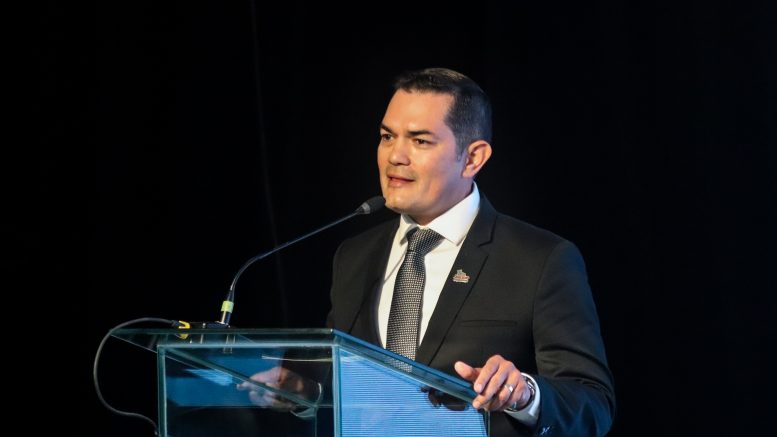
“Bolivian farmers are not asking for privileges, but for minimum conditions to farm…”
Abraham Nogales Antelo has served as president of the Association of Oilseed and Wheat Farmers (Anapo) since June 2025. He holds a degree in Business Administration, has worked as a farmer since 2010 and comes from a family with a farming and livestock background. He has served on the Anapo board several times, was vice president of the Beni Livestock Farmers Federation (Fegabeni) from 2009 to 2011 and has participated in technical and economic committees in the agricultural sector. His administration prioritizes unrestricted exports, access to biotechnology, diesel supplies and legal certainty over land, with an emphasis on innovation and sustainability. Anapo represents more than 14 K grain farmers in Santa Cruz, 80% of whom are smallholders.
AgriBrasilis – What are the main demands and challenges facing Bolivian farmers?
Abraham Nogales – Bolivian farmers are not asking for privileges, but for minimum conditions to farm. Our priorities are unrestricted exports, timely access to diesel, biotechnology, logistics infrastructure and legal certainty over land ownership.
Grain production now costs 20% to 30% more than a year ago due to the removal of diesel subsidies and higher prices for imported inputs. Farmers also face encroachment on productive farmland and a technological lag of more than 20 years, during which neighboring countries have adopted biotechnology to increase yields. Soybean yields in Bolivia currently average approximately 2 tonnes per hectare, compared with 3 tonnes in neighboring countries.
AgriBrasilis – How severe is the diesel crisis for agriculture, and what must change to prevent it from recurring each harvest?
Abraham Nogales – Its impact is enormous. Diesel powers planting, harvesting, all crop management operations (applications for pest and weed control, crop nutrition and other activities) and transportation. It accounts for approximately 20% of our direct costs.
Diesel supplies are now more readily available, but higher prices following the removal of subsidies will directly affect planting prospects. Based on forecasts already shared by several farmers, planted area is expected to decline in the summer crop season beginning in late October.
That is why we argue that, if diesel prices have been liberalized, the government should also lift export restrictions and authorize the use of biotechnology, particularly in corn and soybeans, so that farmers can improve yields and obtain fair prices for their crops.
AgriBrasilis – Why is Bolivia still unable to export grain competitively?
Abraham Nogales – A combination of factors puts us at a disadvantage compared with Brazil, Argentina and Paraguay.
- First, productivity. Only two biotechnology events have been approved, compared with more than 30 in some neighboring countries. It is important to note that RR is currently the only event that can be used. Although Intacta has been approved for soybean production intended for biofuels, the technology rights holder has not yet authorized its use. Similarly, HB4 has been approved for soybeans and wheat, but both applications remain under development, with the technology being incorporated into varieties adapted to different production regions. Authorization for use is expected in approximately one year.
- Second, logistics. Bolivia is landlocked, and transportation accounts for approximately 18% of the value of a Bolivian product. This underscores the importance of sustained investment in and development of the Paraguay–Paraná Waterway through Puerto Busch.
- Third, a lack of predictability. Export quotas and permits set at the discretion of the previous government created uncertainty among potential international buyers and weakened the ability of farmers to negotiate prices.
- Fourth, the cost of diesel and imported inputs, which we pay for in US dollars.
AgriBrasilis – How can grain production increase from 5 million to 12 million tonnes, according to Anapo?
Abraham Nogales – Bolivia produced 5.65 million tonnes of grain in 2025, representing a 91% recovery in production following the drought in 2024. Reaching 12 million tonnes is possible, starting with higher output on existing farmland. Sustainable soil management is essential, including no-till farming, crop rotation, cover crops, biological inputs and balanced crop nutrition. These practices help conserve resources and substantially improve productivity.
Modern biotechnology could also increase soybean yields by up to 30% and corn yields by up to 80%. Approval of the HB4 event for soybeans and wheat is a first step, but more events must be approved, along with modern biotechnology for corn.
Agricultural land could subsequently expand into areas identified as suitable for farming. According to the Land Use Plan, Santa Cruz covers 33.5 million hectares, of which approximately 2 million hectares are currently used for agricultural production. At least 3.2 million hectares have been identified as suitable for agricultural use.
Achieving this will require adequate conditions for greater agricultural investment, including unrestricted exports, access to biotechnology, legal certainty over productive land and improvements to export infrastructure and logistics. Puerto Busch is an urgent priority for improving the competitiveness of the sector.
AgriBrasilis – Why does Bolivia maintain restrictions on grain exports, and what are their impacts?
Abraham Nogales – Since 2008, the government has made exports subject to quotas and domestic supply certificates, arguing that these measures guarantee supplies for the domestic market and contain prices. That reasoning does not reflect reality. Domestic demand is approximately 800 K tonnes, equivalent, for example, to 25% of the more than 3.2 million tonnes of soybeans harvested in 2025. Domestic supplies are guaranteed, so there is no valid justification for restricting grain exports.
Partial relaxations help, but are insufficient because international buyers need predictable, clear and permanent rules. The result is lower prices for farmers, who cannot negotiate with domestic buyers based on export-parity prices. This limits their marketing options and their ability to obtain fair prices.
AgriBrasilis – To what extent can agriculture offset declining natural gas revenue?
Abraham Nogales – Agriculture can take over that role if the right conditions are in place. Natural gas generated more than US$ 6.1 billion in 2013, but revenue only slightly exceeded US$ 498 million in the first half of 2026. In contrast, oilseed complex exports reached US$ 1.145 billion in 2025, surpassing hydrocarbon exports of US$ 1.110 billion. The soybean value chain contributed more than US$ 12 billion to the economy over the past decade, supported by more than 14 K farmers, 80% of whom are smallholders, and generates approximately 120 K direct and indirect jobs.
Agriculture will not replace overnight what natural gas contributed at its peak, but in the medium term it offers Bolivia one of its fastest and most renewable sources of foreign exchange. Exporting means producing for Bolivia.
READ MORE: