
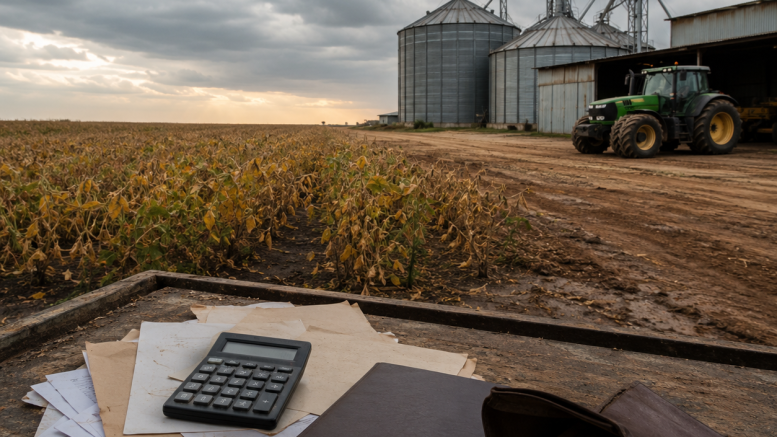
Default Rates in Brazilian Agribusiness Reached 8.2% of the Rural Population

Argentina’s economy showed renewed signs of recovery in 2026, while the country faces a deterioration in the international evaluation of labor rights. According to the National Institute of Statistics and Censuses, the country’s economic activity grew 5.5% in March compared with the same month of 2025 and accumulated a 1.7% increase in the 1Q26. The Central Bank reported annual inflation of 32.4% in April, below the levels recorded in 2025. At the same time, the International Trade Union Confederation included Argentina among the ten worst countries for workers in 2026, after downgrading the country to category 5 in the Global Rights Index. (Indec; BCRA; CSI)
Soybean harvest reached 84.6% of the suitable area, advancing 10 percentage points in one week, according to the Buenos Aires Grain Exchange. The national average yield reached 3.23 tonnes/ha, the second-best historical record and the production forecast was maintained at 50.1 million tonnes. Corn harvest reached 34.7% of the area, with an average yield of 8.44 tonnes/ha and production estimated at 64 million tonnes. Wheat sowing for 2026/27 reached 14.2% of the projected 6.5 million hectares. (BCBA)
Banco de la Nación announced new financing lines for the agricultural sector with rates starting at 12% per year in pesos and 0% in dollars for the purchase of new machinery. The offer includes credit for new and used nationally made machinery, trucks, trailers, working capital, export pre-financing, etc. (BNA)

The Executive Management Committee of Brazil’s Foreign Trade Chamber approved the application of definitive anti dumping duties on Brazilian imports of powdered milk from Argentina and Uruguay, but immediately suspended collection on public interest grounds. The decision also opened a specific process to assess the potential impacts of the measure. The Brazilian Confederation of Agriculture and Livestock criticized the suspension of the antidumping effects and said the decision recognizes the unfair practice but postpones the application of tariffs. The Agricultural Parliamentary Front called for the measures to be enforced, citing losses to Brazil’s dairy chain. (Camex; CNA; FPA)
Brazil’s second corn harvest in 2025/26 is expected to reach 106 million tonnes, with a slight downward adjustment from the previous estimate. The StoneX consulting firm said that yield gains in the States of Mato Grosso and Mato Grosso do Sul offset part of the losses caused by drought in Goiás, where production was revised to 10.8 million tonnes, down 19.3% from the May projection. Considering all three crops, Brazil’s corn production was estimated at 136.8 million tonnes. (StoneX)
Official forecasts indicate a higher probability of El Niño formation during 2026, with potential impacts on rainfall and temperatures in Brazil in the second half of the year. The National Institute of Meteorology said El Niño formation may alter rainfall and temperature patterns, requiring attention to drought, heat, storms and impacts on crops, livestock and water availability. (NOAA; INMET)
Heavy rains accompanied by hail hit coffee-farming areas in the south of the State of Minas Gerais, as harvesting of the 2026 crop gains pace. According to the Federation of Agriculture and Livestock of the State of Minas Gerais and the National Rural Learning Service system, damage was reported in crops in the municipalities of Boa Esperança, Campos Gerais and Campo do Meio, with coffee cherries knocked down at harvest stage and losses in coffee already drying on patios. The Boa Esperança Agricultural Cooperative said it is still gathering information from members to evaluate losses. The National Institute of Meteorology had issued storm warnings with a possibility of hail for areas of southeastern Brazil. (FAEMG SENAR; Capebe; INMET)
The 25% tariff proposed by the Office of the USA Trade Representative is expected to have an uneven impact on Brazilian agribusiness. The official annex to the Section 301 investigation excludes products such as beef, coffee, orange juice, fertilizers and certain fruits from the surcharge, but the Federation of Agriculture of Rio Grande do Sul estimates that 36.8% of Brazilian agribusiness exports to the United States could be affected. In Rio Grande do Sul, exposure rises to 74.9% of the state’s agribusiness exports to the United States, with greater risk for tobacco, wood, forest products and beef tallow. (USTR; Farsul; FAEP)
Default rates in Brazilian agribusiness reached 8.2% of the rural population in the 4Q25, up 1 percentage point from the same period in 2024. The indicator considers debts of rural individuals more than 180 days overdue and contracted with companies in sectors related to agribusiness. The increase reflects tight margins, pressured cash flow, high costs, volatile prices and more selective credit. Defaults were concentrated mainly in debts with financial institutions, while farmers without rural registration information and large landowners recorded the highest rates. (Serasa Experian)
The US’ proposed 25% tariff on Brazilian products raised concerns in the instant coffee industry, which was left out of the exemption list published by the Office of the US Trade Representative. Green and roasted coffees are among the exempted items, but instant coffee may face a total tariff of up to 35% to enter the United States market, considering the existing rate. The Brazil Specialty Coffee Association said it is monitoring the case and warned of possible impacts on Brazil’s instant coffee industry, represented by the Brazilian Instant Coffee Industry Association and on the national coffee chain. (USTR; BSCA; ABICS)
Cattle feedlot activity in Brazil is expected to grow 5.7% in 2026, to 9.78 million head. In 2025, the volume had reached 9.25 million animals, up 16% from the previous year. The 2026 survey covers 2,466 properties in 1,103 municipalities, with Mato Grosso maintaining national leadership, estimated at 2.4 million confined cattle. The expansion reflects the intensification of beef cattle production and competition for land with agriculture. (dsm-firmenich)
Be8 plans to launch its wheat-based ethanol in 2027 as part of its renewable energy diversification strategy. The industrial unit under construction in Passo Fundo, State of Rio Grande do Sul, will produce ethanol, vital gluten and dried distillers grains with solubles, with capacity to process 525 thousand tonnes of grains per year and produce 209 million L of ethanol. The company is also investing in BeVant, a biofuel developed to fully replace diesel in conventional engines. (Be8; BNDES)
The Minister of Agriculture, André de Paula, said the government is working for the 2026/27 Harvest Plan [Government’s agricultural financing plan] to reach US$ 108.13 billion and be announced on July 1st, 2026. The amount would represent an increase of about 6.5% compared with the US$ 101.48 billion allocated to business agriculture in the 2025/26 Harvest Plan. According to the minister, the priority is to ensure more affordable interest rates for farmers. The Ministry of Agriculture has already received proposals from the Brazilian Confederation of Agriculture and Livestock for the new plan, including requests to expand resources, rural insurance, storage credit and lower financial costs. (MAPA; CNA)


Hass avocado production reached 265 thousand tonnes in the 2025/26 season, exceeding initial estimates and renewing the best result in 15 years, according to Paltas de Chile, the Chilean avocado industry association. Of the total produced, 160,500 tonnes were exported, equivalent to 61% of the crop. Europe was the main destination, with 99 thousand tonnes, followed by Latin America, Asia and North America. The domestic market absorbed approximately 104,500 tonnes. (Paltas de Chile)

Colombia may reach a record production of 2 million tonnes of crude palm oil in 2026, according to the National Federation of Oil Palm Farmers. The entity said the sector produced 1.93 million tonnes in 2025 and expanded planted area by more than 5%, to 641,000 hectares. The sector is also seeking to diversify exports, after an increase in shipments of palm oil and derivatives in 2025, with opportunities in markets such as the USA, Africa and Asia. (Fedepalma)
The agricultural sector accounted for nearly 10% of Colombia’s GDP in 2025, according to data from the National Administrative Department of Statistics. Crop production was the sector’s main component, followed by livestock, coffee, fishing, aquaculture and forestry. In the 1Q26, however, the value added by agriculture, livestock, hunting, forestry and fishing fell 1.4% compared with the same period in 2025, amid a decline in coffee activity and climate impacts on some production chains. (DANE)
Colombia had 14.9 million rural residents in the 1Q26, equivalent to 28.5% of the national population, according to the National Administrative Department of Statistics. Of this total, 6.61 million were employed and 562 thousand were unemployed. Most employed campesino workers were active in agriculture, livestock, hunting, forestry and fishing, but there was also significant participation in trade, manufacturing, construction and artistic activities. The Colombian Farmers Society said informality remains one of the main obstacles to productivity and income in rural areas. (DANE; SAC)

The Mexican federal government and private sector signed, on June 3rd, the National Agreement for the Management of Production, Supply, Commercialization and Fair Price of Tomatoes, aimed at stabilizing domestic prices. The voluntary agreement will benefit more than 12 thousand farmers responsible for at least 3.7 million tonnes across 50 thousand hectares, half of which is destined for export. Agriculture Minister Columba López attributed the price spike to frosts in the United States, hailstorms in Mexican producing areas and pest outbreaks. The agreement also includes a digital platform to connect supply with domestic demand. (Ministry of Agriculture; Profeco; FIRA; Senasica)
The US International Trade Commission is evaluating the elimination of the 17.09% anti-dumping tariff on Mexican tomatoes, with a final comment deadline of June 25th, 2026. The review was triggered after three companies challenged the duty under the Tariff Act of 1930. At a May 19th hearing, specialist Timothy Richards of Arizona State University argued that Mexican tomatoes — mostly cherry and grape varieties grown in greenhouses — do not directly compete with open-field tomatoes produced in the United States. The tariff has been in force since July 2025 and was based on price data from three decades ago. (ITC)


Associations expressed concern over a regulation being promoted by the European Union that would classify soybean oil as a non-sustainable biofuel. Representatives of the Paraguayan Chamber of Exporters and Traders of Cereals and Oilseeds, the Union of Production Guilds, the Paraguayan Chamber of Oilseed and Cereal Processors and the Federation of Production Cooperatives met with the Ministry of Foreign Affairs to assess the potential impact of the rule on the soybean complex, the country’s main export sector. The entities said the measure could create uncertainty and affect the predictability of Paraguayan trade. (MRE; Capeco; UGP; CAPPRO; Fecoprod)
The agroclimate advisor of the Paraguayan Chamber of Exporters and Traders of Cereals and Oilseeds, Eduardo Sierra, said it is still premature to confirm the occurrence of a “Super El Niño” during the 2026/27 season. If the phenomenon develops, impacts are expected to begin at the start of spring, with risks of drought and heat in western Paraguay and excessive rainfall in eastern Paraguay. (Capeco)

Exports of potatoes grew 19% in 2025 and surpassed 11,000 tonnes, with access to 13 international markets, according to Peru’s Ministry of Agrarian Development and Irrigation. Demand is led by Bolivia, Brazil and the United States, as well as European countries. The growth is attributed to the adoption of certified seeds and the work of Peru’s National Agrarian Health Service. (Midagri)
Paraguay and Peru began exchanging electronic phytosanitary certificates on June 1st between their respective plant health authorities, aiming to digitize processes and reduce bureaucracy. The measure, implemented by Paraguay’s National Service for Plant and Seed Quality and Health and Peru’s National Agrarian Health Service, enables the digital validation of documents, increases operational security and reduces the risk of fraud. (Senave; Senasa)
Peru completed the final step for the entry into force of its free trade agreement with Guatemala by delivering the diplomatic note confirming the ratification of the treaty, signed in 2011 and pending implementation for 15 years. The agreement is expected to strengthen bilateral trade, provide greater legal certainty for economic operators and expand opportunities for exports, investment and cooperation between the two countries. (Ministry of Foreign Affairs of Peru)

VerdeAgua, a Uruguayan hydroponic horticulture company, plans to invest US$ 4.5 million in technology and infrastructure to double its lettuce production by 2028. The company inaugurated a new technological greenhouse in Melilla, in the Montevideo region, using a Danish automated system and plans to add new production robots in 2026. According to the company, the new structure could add 2 million lettuces per year to installed capacity. (VerdeAgua)
Uruguay delivered nearly 11.5 million doses of foot-and-mouth disease vaccines in the first 15 days of the national campaign, equivalent to approximately 89% of the total expected. According to the Ministry of Agriculture, the campaign covers all cattle over two months old, in an estimated population of 13.4 million animals. The ministry also implemented an electronic system to record dose delivery in real time and reinforced the use of the sanitary form to track veterinary treatments and ensure the safety of Uruguayan beef. (MGAP)

READ MORE: