
“Agricultural concerns led the European Parliament to refer the agreement to the EU Court of Justice…”
Marian Schuegraf is the European Union ambassador to Brazil. A lawyer by training, she studied at the University of Erlangen-Nuremberg and the Université de Rennes. She served as Germany’s ambassador to Colombia, deputy head of mission at the German Embassy in Tehran and director for Latin America and the Caribbean at Germany’s Foreign Office.

Marian Schuegraf, European Union ambassador to Brazil
AgriBrasilis – What changes in practice with the provisional application of the Mercosur-European Union agreement?
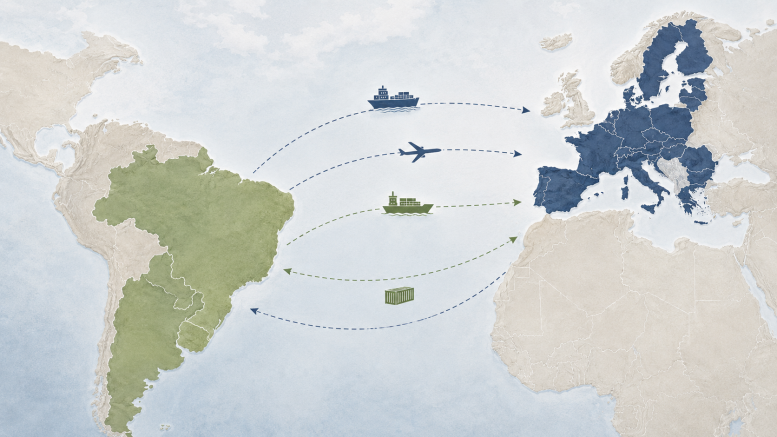
Marian Schuegraf – The Mercosur-European Union trade agreement provisionally entered into force on May 1st, representing a historic moment in our relations and bringing concrete benefits to companies, workers and consumers. Since then, the EU has started granting even more favorable conditions for Mercosur’s industrial and agricultural exports, eliminating most tariffs and gradually reducing many others.
The agreement deepens our strategic partnership and demonstrates that, even in a global context marked by protectionism and coercion, it is possible to advance concrete solutions based on dialogue and cooperation. It is now up to all of us to ensure that the opportunities created by the agreement become reality as quickly as possible.
The EU is already implementing the agreement. Brazilian goods arriving at European ports are already benefiting from zero or reduced tariffs. Together with Mercosur, we are establishing the joint committees foreseen in the agreement, which will monitor its implementation and facilitate dialogue, with important participation from civil society.
Our goal is to encourage structured cooperation among professional associations, decision-makers and opinion leaders, facilitating dialogue in defined areas. One example is helping small and medium-sized enterprises make the best possible use of the agreement’s opportunities.
AgriBrasilis – Why did the European Parliament refer the agreement to the Court of Justice of the European Union?
Marian Schuegraf – Agricultural concerns led the European Parliament to refer the agreement to the EU Court of Justice for an opinion that could take up to two years. We are confident that, during this period, the provisional application will demonstrate the many benefits of the agreement, including for European farmers. For example, the agreement promotes geographical indications and facilitates exports of European cheeses, sausages, wines and spirits.
AgriBrasilis – What was the role of the EU Delegation in Brazil throughout this process?
Marian Schuegraf – Supporting the conclusion of the negotiation process and now ensuring the implementation of the agreement has been a priority. Our role is to convey and contextualize important messages between the EU and Brazil, allowing everyone to benefit from the opportunities created by the agreement.
The second EU-Brazil Investment Forum, in Brasília on June 23rd, 2026, organized by the EU Delegation in partnership with ApexBrasil and the Brazilian Center for International Relations (CEBRI), will highlight positive trends. Last year’s inaugural edition, held in São Paulo, brought together nearly 200 participants to discuss strategic opportunities in sustainable energy, critical raw materials, digital infrastructure and green mobility.
AgriBrasilis – What concrete benefits does the agreement bring to both blocs?
Marian Schuegraf – The reduction or elimination of import tariffs on European machinery, equipment and chemicals is expected to lower production costs in Brazil. The agreement will encourage the integration of Brazilian industry into global value chains, diversifying Brazilian exports beyond commodities and generating quality jobs in the country. At the same time, Brazilian consumers will gain access to European products at more competitive prices and with greater variety.
The agreement also creates a more predictable and transparent trade framework, reducing uncertainties and operational costs. Small and medium-sized enterprises, in particular, will gain better opportunities to enter new markets. Service providers, such as those in maritime transport, will also benefit from greater predictability and legal certainty.
The agreement will foster the development of the bioeconomy in Brazil, encouraging green innovation and opening European markets to sustainable products from the Amazon and other regions.
In the field of public procurement, the agreement expands competition in a large share of bidding processes, helping reduce expenses for governments and taxpayers.
In addition, more stable rules and preferential access to the European market make Mercosur even more attractive to EU investors, in line with our Global Gateway strategy. The EU is already the leading foreign investor in Brazil and the agreement is expected to stimulate new investments in infrastructure, technology and energy, generating lasting positive impacts on socioeconomic development.
AgriBrasilis – How can environmental rules be prevented from becoming trade barriers?
Marian Schuegraf – EU environmental rules are transparent, science-based and respond to legitimate public concerns. Ongoing dialogue with our partners is essential to ensuring free and sustainable trade. That is precisely why the Mercosur-EU agreement includes commitments from both sides regarding environmental protection and the fight against climate change. Environmental rules may create costs for a highly developed sector such as Brazilian agribusiness, but they also offer many new opportunities.
READ MORE:
CropLife Calls for Stronger Dialogue Between Agribusiness and Society in Brazil