
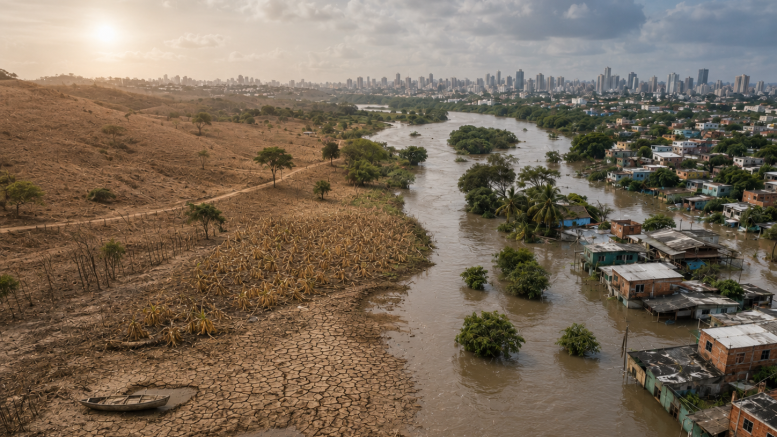
85% of Brazilians Already Feel Climate Change Impacts
Brazil
The Brazilian government held the first 2026 meeting of the Wildfire Situation Room, coordinated by the Chief of Staff Office and the Ministry of the Environment and Climate Change. The meeting brought together more than 20 agencies to align preventive actions ahead of the climate scenario expected for the second half of the year. Christopher Cunningham Castro, head of the Fire Studies Group at the National Center for Monitoring and Early Warning of Natural Disasters, highlighted the importance of advance planning to position teams and structure coordinated responses during the period of heightened risk. (Cemaden; Government of Brazil)
Promip hired Claudia Quaglierini as leader of sustainability to expand the MipExperience program to large-scale crops such as soybean, corn, cotton and vegetables. The initiative combines integrated pest management, use of bioinputs, farm management and technical training, amid the growth of biological products in Brazil. Promip is also preparing the “More Sustainable Corn Route” and “More Sustainable Soybean Route” programs. (Promip)
Brazil’s Lower House of Congress approved Bill 5900/2025, which requires prior input from the Ministry of Agriculture and Livestock or the Ministry of Fisheries before federal rules affecting plant, animal, aquaculture or forest species, or organisms used in productive activities, are issued. The bill amends the Agricultural Policy Law and will now be analyzed by the Senate. According to rapporteur Pezenti, the proposal seeks to prevent sectoral rules from being issued without prior assessment of economic, productive and social impacts. (Agência Câmara)
The Ministry of the Environment and Climate Change, the Brazilian Institute of Environment and Renewable Natural Resources and the Chico Mendes Institute for Biodiversity Conservation warned that environmental bills under discussion in Congress could weaken Brazil’s environmental legislation. According to the agencies, the proposals could increase risks of deforestation and biodiversity loss, interfere with environmental competencies and generate negative impacts even for agribusiness. (Ministry of the Environment and Climate Change; Ibama; Chico Mendes Institute for Biodiversity Conservation)
Casa dos Ventos acquired grid access rights at the Pecém Complex, in the State of Ceará, to develop new data center projects. The transaction involves 650 MW of access to the transmission grid and was submitted to Brazil’s antitrust authority. With the acquisition, Casa dos Ventos will hold 2,100 MW in connection rights at Pecém for data centers, in addition to 600 MW allocated to a green hydrogen project. Casa dos Ventos also said that the Paraíso Project, in the State of Mato Grosso do Sul, will have 640 MW of solar capacity and will be the first utility-scale project in Brazil to use low-carbon solar trackers, a technology that can reduce emissions by up to 42% compared with conventional models. (Casa dos Ventos)
The Ministry of the Environment signed agreements to strengthen trails in conservation units during the 9th Meeting of the National System of Conservation Units Forum. The measures aim to expand public use, ecological connectivity and sustainable development in protected natural areas, focusing on conservation, nature tourism and territorial development. (MMA)
Bioeconomy has returned to the center of the public and private sectors, combining financing, biodiversity, science and productive inclusion. In the State of Mato Grosso, the government opened US$ 3.68 million in calls under the REM Mato Grosso Program to support family farming, Indigenous peoples and traditional communities, focusing on income generation, environmental conservation and strengthening sociobiodiversity value chains. The family farming and traditional peoples subprogram supports chains such as cumbaru, babassu, pequi, Brazil nut, forest seeds, fruit production, palm heart and beekeeping. (Mato Grosso Government)
Brazil presented progress on the Climate Adaptation Plan and the Belém Adaptation Indicators during NAP Expo 2026, an international event focused on climate adaptation. The agenda discussed climate resilience through 2030 and implementation of the Global Goal on Adaptation, focusing on metrics to monitor adaptation actions and climate risks. (MMA)
Fourth Eco Invest Brasil auction mobilized US$ 2.61 billion for bioeconomy, sustainable tourism and green infrastructure projects focused on the Legal Amazon. Approximately 70% of investments will be directed to the region, mainly for low-carbon logistics, sanitation, energy and connectivity projects. The round was the first aligned with the National Bioeconomy Development Plan. (MMA)
Ministry of the Environment participated in the second pilot phase of Brazil’s 12th Agricultural, Forestry and Aquaculture Census, which will include, for the first time, production systems of traditional peoples and communities in the country’s official statistics. The tests were carried out in six municipalities across different regions of Brazil. Official census data collection is scheduled to take place between March and September 2027. (MMA; IBGE)
The Brazilian Supreme Federal Court resumed the judgment on the rule requiring insurance companies and pension entities to allocate at least 0.5% of their technical reserves to carbon credits. The measure is part of Law No. 15,042/2024, which created the Brazilian Emissions Trading System. (STF)
Regenerative agriculture will be a topic at the 17th Brasil AgrochemShow, which will take place on August 3rd and 4th at Centro de Eventos São Luís, in the State of São Paulo. The lecture “Regenerative Agriculture and Sustainability” will be presented by Eliana Maria Gouveia Fontes, researcher at Embrapa Genetic Resources and Biotechnology and scientific coordinator of the Regenera Cerrado project. The topic is gaining relevance as Brazil advances its regulated carbon market, which is expected to increase demand for agricultural practices with measurable, auditable environmental results connected to value creation. (AllierBrasil)
Survey by Aurora Lab and More in Common found that 85% of Brazilians already perceive the impacts of climate change in their daily lives, mainly through higher living costs, health problems and difficulties commuting to work. The study also shows that 67% believe the government should lead the protection of workers during the energy transition. The survey interviewed 2,630 people across nine Brazilian capitals between May and September 2025. (Aurora Lab; More in Common)
Brazil and Italy signed a scientific cooperation agreement between ICMBio and Italy’s National Research Council to strengthen biodiversity conservation and environmental protection efforts. The partnership includes knowledge exchange, joint research and technical cooperation on terrestrial and marine ecosystems. The agreement was signed during the International CNR-ICMBio Seminar held in Brasília. (CNR; ICMBio)
Pro Verde Piauí State program has distributed 3.7 million seedlings across 192 municipalities since 2023, supporting reforestation, urban tree planting and environmental restoration efforts. Coordinated by the State Secretariat for Environment and Water Resources, the initiative aims to reach 4 million seedlings delivered by the end of 2026. The program currently distributes an average of one million seedlings per year across different regions of the state. (Piauí Government)
Flying Rivers Capital, an asset manager focused on decarbonization and climate solutions, is preparing new investments linked to agribusiness. The manager has US$ 197.6 million in assets under management and is structuring a new fund targeting up to US$ 350 million, with a US$ 98.8 million commitment from the Brazilian Development Bank. According to Ricardo Mussa, the firm’s new partner and former CEO of Raízen, biomethane and biofertilizers are among the sectors being analyzed for potential investments. (Flying Rivers Capital)
Bosch is testing in Brazil a retrofit system to convert diesel-powered sugarcane harvesters into flex machines capable of running on diesel and ethanol simultaneously. The technology is being tested at six sugarcane mills and can replace up to 60% of diesel with ethanol without compromising engine power. The initiative is part of Bosch’s research and development package in Brazil, which raised US$ 103 million from Finep and the Brazilian Development Bank, of which US$ 1.82 million was allocated to the diesel-ethanol project. (Bosch)
Rede Terra do Meio joined the Amazon Bioinnovation Challenge, an initiative that seeks to connect Amazon communities, researchers and markets to develop solutions based on sociobiodiversity. The challenge offers awards of up to US$ 88 thousand and focuses on innovation, traditional knowledge, bioeconomy, standing forests and income generation in Amazon territories. (ISA)
The trinational Agroecological Roots project advanced in Brazil with agroecological corridors and conservation of local varieties. The initiative brings together actions in Argentina, Bolivia and Brazil to strengthen agroecology, local genetic resources and participatory breeding. The project aims to reach 5 thousand farming families in the three countries, including approximately 2,600 in Brazil, across 15 municipalities in the States of Sergipe and Bahia. (UN Brazil)
Agraer participated in the 2026 Annual Campaign to Promote Organic Products in Campo Grande, State of Mato Grosso do Sul, focusing on agroecology, organic production and sustainability. The initiative is part of a national mobilization aimed at changing food habits, strengthening family farming and valuing production systems with lower environmental impact. (Agraer)
Acelen Renewables announced US$ 1.5 billion to begin construction of a renewable fuels biorefinery in Bahia State. The project will be financed by a consortium led by HSBC and IFC, with participation from institutions such as IDB Invest, BNDES, AIIB, KfW IPEX-Bank, Bradesco, BBVA and Bank of China. The facility will have capacity to produce 1 billion liters per year of sustainable aviation fuel and green diesel, with operations expected to start in 2029. (Acelen; Reuters; S&P Global)
Gerdau was recognized as a Steel Sustainability Champion by the World Steel Association, amid the advance of low-carbon certifications in Latin America’s steel industry. The recognition considers more than 20 criteria linked to environmental, social, governance and economic indicators, including life-cycle inventories and participation in global sustainability initiatives. (Gerdau; worldsteel; Fastmarkets)
Imaflora published a bulletin on forest data transparency in Brazil and the challenges of the timber value chain. The document highlights the importance of open data for environmental governance, traceability and timber origin control, in a sector sensitive to legality, forest management and Amazon conservation. The publication is part of Timberflow, an initiative focused on monitoring and transparency in timber production and circulation in the country. (Imaflora; Timberflow)
Brazil approved nine additional projects in the transition from the former Clean Development Mechanism, created under the Kyoto Protocol, to the new Paris Agreement Crediting Mechanism, established under Article 6.4. The projects include reforestation, small hydropower plants and wind farms. The process is coordinated by the Ministry of the Environment and Climate Change and is part of the adaptation of Brazil’s carbon market to the rules of the Paris Agreement. According to the ministry, the approved projects will proceed to final review by the United Nations Framework Convention on Climate Change. (MMA)
ICLEI Brazil, the International Council for Local Environmental Initiatives, will hold the 5th Northeast Meeting on May 28th and 29th in Salvador, State of Bahia, focusing on the restoration of the Caatinga biome as a nature-based solution to combat desertification and land degradation in Brazil’s semi-arid region. The event will bring together state governments, experts, civil society and United Nations representatives to discuss climate adaptation, Caatinga Biome restoration and the post-COP30 agenda. (ICLEI)

Latin America
Argentine startup Agrosintex is developing a feed additive capable of reducing enteric methane emissions from cattle by up to 90% while improving feed efficiency by up to 12%. The technology acts on methanogenic bacteria in the rumen and is currently undergoing field trials in livestock systems. According to the company, the solution aims to combine lower emissions, higher meat and milk productivity and improved animal health amid growing discussions on livestock decarbonization. (Agrosintex)
IDB Invest held the virtual Knowledge Center session of Sustainability Week 2026, focusing on companies, sustainable finance, capital mobilization and environmental and social management in Latin America and the Caribbean. The agenda included sessions on sustainable supply chains, transparency for investment decisions, blue finance, sustainability reporting, territorial intelligence for the Amazon Biome and project preparation to make initiatives bankable. (IDB Invest)
In Colombia, the Corporate Social and Environmental Investment Index resumed the national ranking that measures the social and environmental impact of private companies. According to the methodology, the country’s 1,000 largest companies mobilized approximately US$ 5.13 billion in social and environmental transformation initiatives in 2024. The 2026 edition will assess dimensions such as management, financial effort, territorial impact and the capacity to build partnerships between the private sector, social organizations and territories. (IISAE; Arteaga Latam)
Proforest participated in LARIS 2026, the Latin American Regenerative Investment Summit, held in Bogotá, Colombia. The meeting brought together impact investors, companies, funds, organizations and climate finance actors to discuss capital mobilization for regenerative agriculture, sustainable supply chains and production models capable of combining conservation, profitability and producer inclusion. (Proforest; LARIS)
In Chile, CONAF is promoting the restoration of more than 40 hectares with native species in Lonquimay, in La Araucanía Region. The initiative strengthens forest recovery, ecosystem conservation and restoration of degraded areas, focusing on native vegetation and environmental resilience. (CONAF)
In Ecuador, the Amazon Biocorridor Fund is keeping a call open for projects focused on conservation, restoration, bioeconomy and sustainable forest management, with funding of up to US$ 500 thousand. The initiative seeks to support solutions related to biodiversity, ecological corridors and sustainable development in Amazon territories, connecting environmental conservation and local income generation. (Amazon Biocorridor Fund)

READ MORE:
Even Amid Challenges in Europe, the Mercosur-EU Agreement Already Reduces Tariffs on Brazilian Goods