
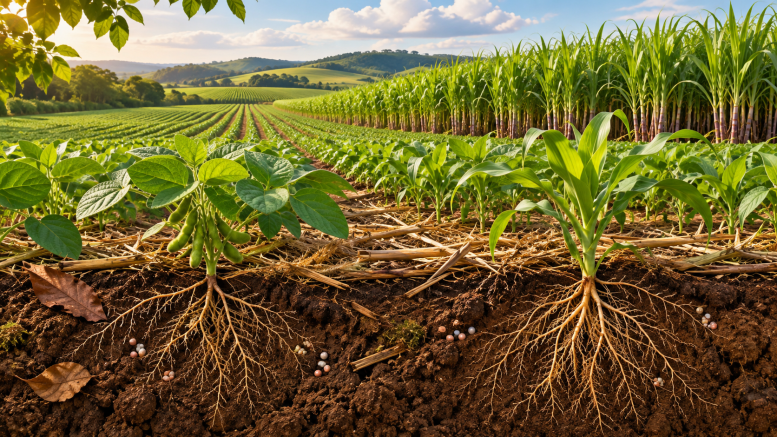
With fertilizer deliveries down 10.4% through August 2026, soil fertility management is becoming increasingly important amid financial constraints and dependence on imports.
Sandro Roberto Brancalião is a research scientist at the Agronomic Institute – IAC, in the Sugarcane Division in Ribeirão Preto, São Paulo. An agronomist, M.Sc and Ph.D in agriculture from Unesp.
Denizart Bolonhezi is a research scientist at the IAC Sugarcane Division in Ribeirão Preto, São Paulo. An agronomist, M.Sc and Ph.D in agronomy from Unesp.
André Luiz de Souza Lacerda is a consultant at Agrolacerda and agronomist who graduated from the Federal University of Lavras. M.Sc in agronomy from Unesp, Ph.D in crop science from USP, and has completed postdoctoral research in crop science at the Biological Institute of São Paulo – IB/SP and in chemistry at Unicamp.
Antônio Lúcio Mello Martins is a researcher at the São Paulo Agency for Agribusiness Technology – APTA at the Pindorama, São Paulo, regional unit, where he served as technical director from 2000 to 2021. An agronomist graduated from Esalq/USP, Ph.D from Unesp, he works in the fields of crop science, soil science, water resources, and environmental education.
Márcio Aurélio Pitta Bidóia is an agronomist, M.Sc in Agronomy, with a specialization in Crop Production, from Unesp. Since 1997, he has worked with the Sugarcane Breeding Program at the IAC in Ribeirão Preto, São Paulo.
High fertilizer costs, credit constraints and difficulties in international supply have intensified the challenges facing agricultural production in Brazil in 2026. According to the Brazilian National Fertilizer Association (ANDA), fertilizer deliveries to the Brazilian market totalled 27.31 million tonnes from January to August, down 10.4% from the same period in 2025. Under these conditions, maintaining soil fertility and crop productivity requires greater attention to nutrient use efficiency.
Agricultural production continuously seeks growth and higher productivity, requiring appropriate amounts of soil amendments and fertilizers while balancing economic performance with environmental protection and the conservation of natural resources.
Efforts to correct nutrient deficiencies and raise productivity are often constrained by one or more limitations in soil fertility. Proper management, including the use of soil amendments and fertilizers, plays a fundamental role in increasing crop production and yields. Efficient fertilizer use is undoubtedly among the most important contributors to productivity gains in Brazilian agriculture, particularly in export-oriented crops. However, amid pressure on production costs, reducing fertilizer applications without considering crop nutritional requirements can compromise yield potential.
Proper nutrient management is directly related to the soil’s physical, chemical, physicochemical, mineralogical and microbiological characteristics. Plant nutrition and soil fertility management are broad, interconnected processes that are essential to meeting crop requirements. For technologically advanced and competitive agriculture, the appropriate use of nutrients is indispensable for plant growth and development.
In recent years, innovation in more sustainable fertilizers has gained environmental and economic importance, highlighting the need to develop and use alternative nutrient sources. Improvements in nutrient management involve both mineral fertilizers and the recycling of organic residues, such as manure, compost, treated sewage sludge, vinasse and filter cake, provided technical and environmental requirements for their use are met. However, these alternatives do not eliminate the need to replace nutrients removed at harvest. The challenge is to supply the necessary amounts more efficiently and with fewer losses. In this respect, new formulations and cultivation techniques are supporting advances in research into plant mineral nutrition and nutrient delivery to roots.
Historically, early agricultural settlement in Brazil frequently followed the removal of natural vegetation, when the original fertility of soils was considered one of the main factors enabling good yields without intensive input use. However, maintaining production over time requires replacing the nutrients removed by crops. Agricultural inputs, combined with improved management technologies, have enabled substantial productivity gains, provided they are accompanied by appropriate soil and water conservation practices.
The success of Brazilian agribusiness is associated with skilled labor and the adoption of technology. The expansion of agriculture across the Cerrado, for example, was made possible by correcting soil acidity with lime and applying fertilizers to supply and replenish essential crop nutrients. Without these practices, naturally acidic soils with fertility limitations would impose greater constraints on the development of productive agricultural systems.
Dependence on foreign supplies increases risks
Despite the importance of fertilizers to agricultural production, Brazil remains heavily dependent on international markets. According to the Ministry of Agriculture and Livestock, approximately 93% of the fertilizers used in the country are imported. Although Brazil has domestic reserves of minerals used to manufacture these inputs, their extraction and industrial processing still fall short of the needs of Brazilian agriculture.
Nitrogen, phosphate and potash fertilizers have distinct production and supply chains. Major countries and regions supplying raw materials and fertilizers include Russia, China, Canada, Morocco and the Middle East, depending on the product. This dependence exposes the agricultural sector to fluctuations in international prices, geopolitical tensions, transport costs and logistical disruptions.
These factors became even more significant in 2026. According to the National Supply Company (Conab), Brazilian fertilizer imports accumulated through September fell by approximately 15.7% compared with the same period in 2025. Rabobank estimates that fertilizer deliveries will reach 44.4 million tonnes for the whole of 2026, down 9.6% from the previous year. The combination of high costs and financial constraints makes fertilizer application decisions even more important to farmer profitability.
Nutrient use efficiency becomes decisive
Against this backdrop, achieving higher yields depends not only on increasing the amount of fertilizer applied but also on making more efficient use of nutrients already available in the soil. Understanding the soil’s chemical, physical and biological characteristics, together with acidity correction, organic matter maintenance and fertilizer planning, can improve the economic return on applied inputs.
Expanding domestic fertilizer production, developing alternative nutrient sources and improving management technologies are also important ways to reduce the vulnerability of Brazilian agriculture. However, these initiatives must be accompanied by practices that preserve soil fertility and ensure adequate nutrient supplies throughout crop cycles.
With fertilizer prices rising and pressure on farm margins increasing, cutting fertilizer use without a sound technical basis may result in even higher costs in subsequent growing seasons. The challenge for Brazilian agriculture will be to maintain and increase productivity while using inputs efficiently, conserving natural resources and remaining competitive.

Sandro Brancalião, researcher at IAC

André Lacerda, consultant at Agrolacerda

Denizart Bolonhezi, researcher at IAC

Márcio Bidóia, assistant technical researcher at IAC

Antônio Martins, researcher at APTA
READ MORE: