
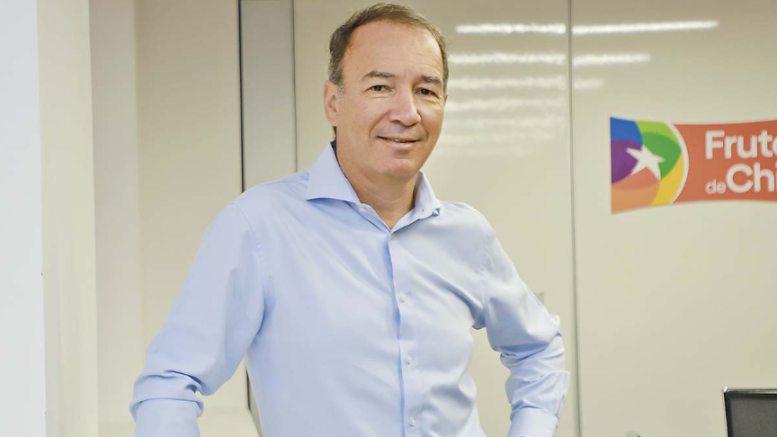
“Our industry is focused on quality rather than volume…”
Iván Marambio is the president of Frutas de Chile, the organization representing the country’s fresh fruit export sector. A law graduate of Universidad Diego Portales, he has a long track record in the fruit industry and international trade.
AgriBrasilis – Why does Chile stand out in fruit production and export?
Iván Marambio – Chile is a world leader in fruit growing, thanks to a combination of natural, institutional, and commercial advantages built up over decades.
We have a Mediterranean climate that allows for the production of a wide variety of fruits across the country, as well as natural phytosanitary barriers that provide greater protection against pests and diseases.
We also produce during the off-season, enabling us to supply Northern Hemisphere countries once their local production ends. Added to this is a network of over 30 trade agreements, providing preferential tariff access to key markets and a highly professionalized logistics and packaging chain capable of delivering premium-quality fruit to destinations as far away as China and the United States.
Another distinguishing factor is our industry’s experience compared to other countries in the Southern Hemisphere. We are one of the region’s longest-standing fruit-exporting industries, which affords us greater resilience, integration between the private sector and public agencies, and the ability to forge a shared vision for addressing challenges.
Today, we are focused on producing and exporting fresh fruit of higher quality and better condition, with greater competitiveness in international markets.
AgriBrasilis – What factors have been putting pressure on the competitiveness of Chilean fruit?
Iván Marambio – In recent years, we have faced a combination of internal and global challenges. The climate crisis and prolonged drought have compelled us to reorganize production areas and make significant investments in production technology and water efficiency.
There has also been a continuous rise in operating and logistics costs including freight, inputs, and labor, alongside increasingly stringent sustainability requirements. This compels us to become ever more efficient.
Port and transport supply chain costs and transit times also put pressure on margins when facing competitors from the Southern Hemisphere that have lower operating costs or shorter transit times.
Tariffs also pose a challenge. We have managed to handle them so far, but we need to continue negotiating, especially since our fruit reaches markets during periods when there is no local production, thereby complementing the supply of healthy food.
AgriBrasilis – Why is Peru gaining ground in markets traditionally dominated by Chile?
Iván Marambio – Peru has developed an aggressive agricultural policy, largely supported by legislation favorable to the export sector. Nevertheless, Chile remains one of the Southern Hemisphere’s leading suppliers of quality fruit.
The Peruvian industry developed later and was able to leverage previously accumulated knowledge, including the participation of Chilean consultants and insights from Chile’s successes and failures. This enabled the launch of sectors such as table grapes and blueberries using newer genetics, for example.
We began our varietal renewal later, and this became increasingly evident. Today, however, more than 70% of our grapes are already new varieties.
Our industry is also focused on quality rather than volume. In the 2025/26 season, we exported over 3 million tonnes of fresh fruit, valued at more than US$ 8 billion.
There are fruits that saw a drop in export volume but, thanks to their quality, achieved better prices. In an increasingly competitive market, this is crucial.
Although Peru and Chile are viewed as competitors, there are also areas where we see opportunities for coordination and complementarity. One example is the supply windows for table grapes to the United States.
This work is being carried out through the Global Grape Group (GGG), in which Mexico also participates. The goal is to conduct joint promotional campaigns to boost fresh grape consumption and to provide statistical data that enables faster and more informed commercial decision-making.
AgriBrasilis – What is the impact of United States tariffs on the sector?
Iván Marambio – The United States is a long-standing, strategic market for Chilean fruit. Tariffs pose a challenge by putting pressure on the supply chain’s bottom line. For this reason, we support the negotiations led by Chilean authorities to secure exemptions for certain fruits, as is already the case with oranges, kiwis, and avocados.
In addition to tariffs, we are also working on phytosanitary agreements. Following the suspension of the “Systems Approach” implementation for Chilean table grapes, we are collaborating with Chile’s Agricultural and Livestock Service (SAG) and the USDA’s Animal and Plant Health Inspection Service (APHIS) to resume the system and explore alternatives such as eFume.
AgriBrasilis – The United States and China are the destinations for more than 50% of Chilean fruit exports. How can this dependence be reduced?
Iván Marambio – Currently, approximately 30% of Chilean fresh fruit exports are destined for the United States. Nevertheless, expanding market diversification is a strategy for Frutas de Chile, aimed both at reducing concentration risk and enabling more people around the world to consume our fruit.
We are making headway in countries such as India, Vietnam, Indonesia, and Thailand, where there is enormous consumption potential for cherries, apples, and grapes.
We are also strengthening our position in Latin America by increasing our presence in markets like Brazil, Mexico, and Colombia, which offer shorter transit times and stable demand.
These efforts to open markets and improve access conditions are accompanied by promotional campaigns designed to strengthen the recognition of Chilean products, highlight their quality, and stimulate consumption. In China and the United States, for example, we carry out promotional activities every season.
AgriBrasilis – What needs to change in the Chilean export model for the sector to continue growing?
Iván Marambio – We are already on this path: we need to move from a model based primarily on volume to one centered on quality, sustainability, and differentiation. This is a fundamental part of our strategy.
We also need to accelerate certain processes, such as the varietal renewal of grapes and blueberries. Another point is to make port infrastructure more modern and efficient, digitize export processes, and optimize the cold chain to reduce transit times.
We continue to advance in sustainability as both an industry and a country. Moving toward more efficient and environmentally sustainable processes regarding water and energy use is fundamental to our production.
Desalination can be a viable solution to water-related challenges, and we are working on this issue, as well as on renewable energy production, particularly wind and solar, areas in which Chile holds a leading position.
An increasing number of companies are also publishing reports on this work. As an industry, we are moving in the same direction and are about to launch our second Chilean Fresh Fruit Industry Sustainability Report.
Finally, it is essential to promote Chile and its fruit as a strong brand capable of conveying identity, trust, food safety, and excellence. This is also what we aim to achieve through the evolution of our institutional brand to “Frutas de Chile.”
READ MORE: