
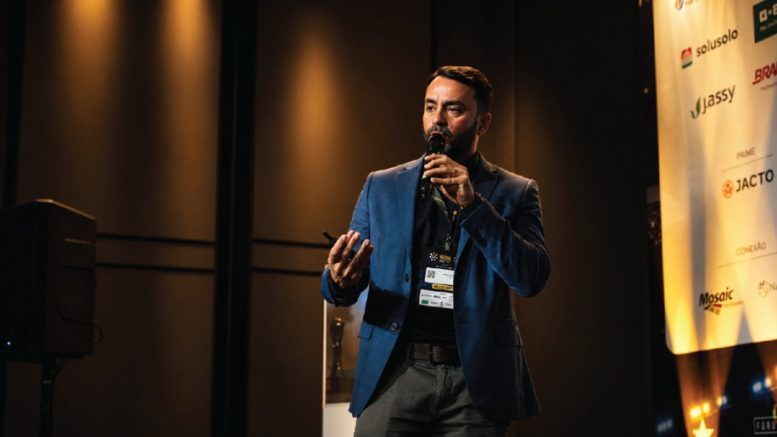
“Through a gene-editing process, changes were made that allowed the bacterium to maintain its nitrogen-fixing capacity…”
Artur Soares Pinto Junior is Research & Development Director at Ecossistema Cogny, a Brazilian group focused on bioinputs, biotechnology and applied research for agriculture.
A biologist with an emphasis in Biotechnology from Universidade Paranaense, Soares holds an M.Sc. and a Ph.D. in Agronomy from the State University of Western Paraná and is also Technical and Regulatory Affairs Director at the Brazilian Association of Bioinput Industries.
AgriBrasilis – What limitations of bioinputs can genetic engineering help overcome?
Artur Soares – The use of genetic engineering techniques in microorganisms has been growing continuously, particularly in the pharmaceutical industry. In agriculture, these techniques were initially used mainly for plant breeding. More recently, however, researchers have increasingly focused on the development and genetic improvement of fungi, bacteria and actinomycetes of agricultural interest.
This approach has significant potential for agriculture, as it can contribute to the development of more efficient biological products and the introduction of new traits into microorganisms used as bioinputs. Desired characteristics can therefore be improved, increasing the efficiency and stability of these products under different environmental conditions.
One example is Flow N, a product recently registered in Brazil. In this case, the nitrogen-fixing bacterium had a limitation related to biological nitrogen fixation in the presence of nitrogen sources such as ammonia, which is a common condition in agricultural systems. Through a gene-editing process, changes were made that allowed the bacterium to maintain its nitrogen-fixing capacity even in the presence of ammonia, increasing its performance potential.
This example demonstrates how genetic engineering and gene-editing tools can be used to overcome physiological limitations of microorganisms of agricultural interest. In addition to improving existing characteristics, these technologies can also enable the introduction or modification of specific traits, contributing to the development of microbial products with greater efficiency and potential for field application.
Genetic engineering applied to microorganisms therefore represents an important frontier for the evolution of agricultural bioinputs, potentially expanding the use of bacteria, fungi and other microorganisms in the pursuit of more efficient and sustainable production systems.
AgriBrasilis – When does it make more sense to use isolated molecules instead of living microorganisms?
Artur Soares – It depends largely on the purpose of the technology.
In the case of bionematicides, phosphorus solubilizers, seed treatment fungicides or nitrogen-fixing inoculants, it is essential for cells to remain viable and be present at high concentrations in the product, ensuring their effectiveness and establishment in the field. In other words, these are products designed to protect or nourish the plant through the root system.
Biomolecules, on the other hand, are more targeted at controlling diseases affecting aboveground plant parts and directly stimulating plant physiology through the application of hormones, essential amino acids and other bioactive molecules.
In addition, technologies formulated from molecules of microbial origin provide farmers with new tools for crop management. These technologies do not necessarily compete with one another, but can be used at different stages or even in combination, depending on the objective and crop requirements. Both are therefore likely to be present in the field, as they offer distinct and complementary modes of action and benefits.
AgriBrasilis – In which situations does this approach still lag behind chemical products?
Artur Soares – Technologies obtained through genetic engineering of microorganisms can, in certain situations, offer advantages over chemically synthesized products, particularly when applied to molecules that act on plant physiology, such as hormones and essential amino acids.
For pest and disease control, however, farmers need to integrate chemical, microbial and microbial-derived products. This integration is important for increasing control efficiency and contributing to resistance management in field populations. The combined use of different modes of action can reduce selection pressure on pest and pathogen populations, helping extend the effectiveness of the molecules used and maintain good control performance over time.
AgriBrasilis – What are currently the main limitations regarding stability and tank-mix compatibility?
Artur Soares – This is an area that still requires more in-depth studies, given the wide range of products and formulations available on the market, which contain different components and concentrations and have different physicochemical and biological characteristics.
However, results obtained so far in our studies indicate that products formulated with molecules of microbial origin, particularly metabolites produced by microorganisms, show high compatibility when mixed with chemical and biological products. These results are promising and indicate potential for the use of these products in integrated strategies. However, compatibility must be assessed individually for each formulation and product combination, considering the specific characteristics of each component and the application conditions.
AgriBrasilis – What still makes it difficult to produce these molecules at scale and at a competitive cost?
Artur Soares – Because this is a highly innovative segment, adapting factories and industrial processes is essential. Brazil still has few industrial facilities equipped with the technologies and certifications required both for the multiplication of genetically modified microorganisms and for the extraction and purification of molecules of interest.
Regarding price competitiveness, based on our experience in our industrial operations, we do not believe this will be a limiting factor for the introduction and expansion of these innovations in the market.
AgriBrasilis – Is Brazilian regulation prepared for this type of technology?
Artur Soares – So far, we have been using the conventional registration pathways applicable to this type of technology. However, in the case of edited or genetically modified microorganisms, any company intending to develop this type of technology must submit it for evaluation by the National Technical Commission on Biosafety – CTNBio, the body responsible for evaluating and granting the authorizations and certifications required for the handling, research and production of these organisms.
Finally, it is important for companies to continue investing in the development of new solutions and innovations, whether based on microorganisms or not. Agriculture increasingly requires new tools and technologies given the growing challenges farmers face each season.
READ MORE: