
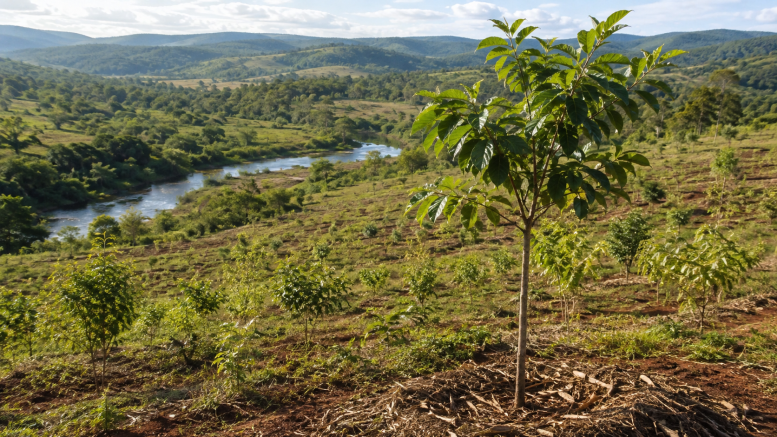
Brazil Aims to Restore Over 163 K km² of Degraded Land by 2030
Brazil
Brazil presented a target to recover or restore more than 163 K km² of degraded land by 2030, including native vegetation, agroforestry systems, permanent preservation areas and watersheds. Another 3.51 million km² are covered by prevention, conservation and sustainable land-management measures. Approximately 28% of Brazilian territory shows some level of degradation. (MMA)
The Restaura Rio Doce call provides up to approximately US$ 119 million for ecological and productive restoration of 12.5 K hectares in the Rio Doce Basin. Applications were extended through September 30th. (MMA; BNDES)
The Brazilian Forest Service held an auction for the concession of approximately 267 K hectares of the Balata-Tufari National Forest in the State of Amazonas for sustainable forest management. B2 Comércio e Exportação de Madeiras won two of the three units and Madeirantes won the third, totaling approximately US$ 3.7 million in initial concession payments. The 37-year contracts foresee approximately US$ 57.7 million in private investment and 1.7 K jobs. (SFB; B3)
The National Council for Export Processing Zones approved five projects totaling approximately US$ 39.6 billion in investments in the States of Ceará, Maranhão and Piauí. The package includes an approximately US$ 34.9 billion data center supported by expanded wind and solar generation and recycled water; an approximately US$ 520 million 4Wood Biotech bamboo biorefinery to produce second-generation ethanol and bioproducts; and projects involving green hydrogen, e-methanol, green HBI and green pig iron. (MDIC)
Global Reporting Initiative – GRI launched a sustainability capacity-building program in Brazil, supported by Switzerland’s State Secretariat for Economic Affairs – SECO. The initiative includes tools for SMEs and sustainability-reporting training. Currently, 71% of the 194 large companies headquartered in Brazil assessed by GRI use the reporting standards. (GRI)
Ibama considered the climate study submitted by Âmbar Energia for renewal of the operating license of the 350-MW coal-fired Candiota III power plant in the State of Rio Grande do Sul insufficient. The agency identified a lack of emission-reduction targets and structured mitigation strategies and required additional information before deciding on the license. (Ibama)
Nexus survey found that 85% of Brazilians perceived significant changes in the climate of their region over the past year. Heat waves were the most frequently reported event, cited by 52% of respondents, while 71% associated extreme climate events fully or partly with human activity. (Nexus)
The Corporate Sustainability Index – ISE B3 questionnaire for the 2026/27 cycle incorporated recommendations from the Brazilian Institute of Corporate Governance – IBGC on independent whistleblowing mechanisms, diversity and ESG management of suppliers. The criteria are part of the evaluation of listed companies participating in the index. (IBGC)
The Permanent Interministerial Commission for the Prevention and Control of Deforestation began a new stage of consolidating information to monitor action plans covering the six Brazilian biomes. Plans for the Amazon, Cerrado, Atlantic Forest, Caatinga, Pampa and Pantanal contain more than 300 actions to prevent and control deforestation. (MMA)
Brazilian National Water and Basic Sanitation Agency – ANA said El Niño has a 100% probability of persisting at least through early 2027, with a high chance of becoming a very strong episode. On August 26th, reservoirs in the National Interconnected System were at 69.5% of useful storage, 5.7 percentage points below July but at the second-highest level recorded for the date since 2015. (ANA; Inmet)
MAPA received 163 measures from Embrapa to manage agricultural climate risks associated with the potential impacts of El Niño on the 2026/27 crop season and other recurring climate events. They include 14 cross-sector measures, 139 measures specific to production segments and ten actions supporting public policies, covering prevention, adaptation and risk reduction. (MAPA; Embrapa; Inmet)
Federal Senate approved the Special Tax Regime for Data Center Services – Redata, which now awaits presidential approval. Beneficiaries will be required to meet sustainability criteria, contract or self-produce all electricity demand from clean or renewable sources and limit cooling-water consumption to 0.05 liter/kWh. The government estimates approximately US$ 1 billion in tax expenditures in 2026. (Federal Senate, Bill No. 278/2026)
Federal Senate authorized two external credit operations of up to US$ 1 billion each. A loan from the Asian Infrastructure Investment Bank will support a reform program linked to Eco Invest Brasil, aimed at mobilizing private capital for sustainable and ecological-transition investments. A World Bank operation will provide budget support for fiscal, environmental and social measures under the Productive, Sustainable and Inclusive Growth Reform Program in Brazil. (Federal Senate, PRS No. 52/2026 and No. 53/2026)
JBS reported that Cowbot, a tool for checking the social and environmental compliance of rural properties, accumulated 71 K analyses over two years. From January through July 2026, it recorded 23.6 K checks. The system verifies criteria including deforestation, environmental embargoes and overlaps with Indigenous lands, Quilombola territories and protected areas and can also be used for properties supplying grains and other agricultural commodities. (JBS)
Embrapa opened calls for participation in the Low-Carbon Corn and Low-Carbon Sorghum programs. The initiatives will develop and validate voluntary certification protocols using measurable, reportable and verifiable indicators for practices and technologies aimed at reducing greenhouse gas emissions per tonne of grain produced. (Embrapa)
Embrapa reviewed evidence on the use of biochar, a material produced through biomass pyrolysis, to sequester soil carbon, reduce emissions and improve agricultural productivity. Studies analyzed showed reductions of 20% to 51% in methane emissions from irrigated rice and 38% to 54% in nitrous oxide emissions. In field experiments in Brazil, biochar applied with mineral fertilizers increased yields by approximately 24% on average. (Embrapa)
The European Union Deforestation Regulation takes effect on December 30ᵗʰ, 2026, for large and medium-sized companies and on June 30ᵗʰ, 2027, for micro and small companies. The regulation covers soybeans, cattle, coffee, cocoa, palm oil, rubber and wood and requires proof that products are not associated with deforestation. Brazil remains classified as a standard-risk country. (European Commission)
A Carbonn Nature study estimates that Brazilian agribusiness could generate up to 314.3 million carbon credits from 2025 through 2035, mainly through improved agricultural land management, restoration of degraded areas and reductions in methane emissions from animal waste management. (Carbonn Nature; Instituto Equilíbrio; IEAg/ABAG)

Latin America
Compensation received by the government of Argentina from penalties imposed on foreign vessels for illegal fishing within the Exclusive Economic Zone exceeded approximately US$ 3.6 million in 2026. Three vessels flagged in Vanuatu and one in Portugal were sanctioned. (Secretariat of Agriculture)
The National Agricultural Technology Institute – INTA found that systems including alfalfa in the central semiarid region of Argentina accumulated 25% more soil organic carbon than areas under continuous cropping. Preliminary results indicate that roots from the perennial forage can increase carbon sequestration and resilience of production systems under water-limited conditions. (INTA)
The National Food Safety and Quality Service – Senasa in Argentina eliminated the requirement for feedlots to submit land-use and environmental-suitability certificates when registering with the National Feedlot Registry. Permits related to location, land use, environmental suitability and operating conditions remain under provincial or municipal jurisdiction. (Official Gazette of Argentina, DNSA Provision No. 26/2026; Senasa)
The National Parks Administration in Argentina began a prescribed-burning calendar in protected areas in the central and northern regions of the country. Burns have been conducted in Iberá, Campo San Juan and Ciervo de los Pantanos national parks to manage vegetation, conserve ecosystems and reduce the risk of larger wildfires. (National Parks Administration)
Argentina, Bolivia, Chile and
The Plurinational Authority of Mother Earth in Bolivia participated in developing a roadmap to incorporate a just transition and green jobs into implementation of the 2026–2035 NDC 3.0. The document establishes priority actions, responsible institutions, cooperation needs, milestones and indicators to connect climate commitments with productive and labor policies. (APMT; ILO)
The Ministry of Mining and Metallurgy of Bolivia began developing an emergency plan for the Huanuni sub-basin, an area affected by mining activities. The document is expected to define responsibilities, priority actions, coordination mechanisms, financing and responses to potential environmental emergencies. (Ministry of Mining and Metallurgy)
The Infrastructure Policy Council estimates that Chile will require approximately US$ 300 billion in energy-infrastructure investments over the next 25 years to support the energy transition. The study points to the need to expand transmission and distribution networks, electrification, storage and gas infrastructure for activities that are difficult to electrify; electricity demand could reach 140–180 K GWh by 2050. (CPI)
The Committee of Ministers in Chile maintained environmental approvals for two projects totaling US$ 5.81 billion in investments. Aguas Marítimas, in Antofagasta, involves US$ 5 billion and planned capacity to produce 700 K m³ of desalinated water per day for human and industrial consumption; a rail extension in Valparaíso involves US$ 811 million. (SEA)
The Ministry of Environment in Colombia issued guidance to safeguard traditional and sustainable use of bitter palm by Indigenous, Afro-descendant and rural communities in the Caribbean region for housing, food, traditional medicine and ancestral practices, subject to environmental regulations. (Ministry of Environment and Sustainable Development)
The Oceanographic and Antarctic Institute of the Navy in Ecuador began an approximately six-week campaign to monitor El Niño in the Southeast Pacific, covering 59 oceanographic stations along the continental coast, the Galápagos Islands and the Hermandad Marine Reserve. The survey will measure temperature, salinity, currents, nutrients, chlorophyll and plankton. (Inocar)
The Secretariat of Environment and Natural Resources in Mexico launched Alianzas por la Naturaleza [Alliance for Nature], a platform bringing together government, companies and organizations to expand resources, innovation and private-sector participation in ecosystem-restoration projects. Participants include Conanp, Conabio, WWF Mexico, Salesforce and Grupo Bimbo. (Semarnat)
The government of Panama declared a national state of emergency due to El Niño through June 30th, 2027. At least 15.6 K people have been affected by flooding since January, while forecasts indicate water-deficit risks for agriculture, water resources, hydropower generation and Canal operations. (Presidency of Panama, Resolution No. 102-26)
ReValora and the National Development Agency in Uruguay opened a call for demonstration projects involving circular-economy solutions in the food value chain. Companies can receive non-repayable funding of up to US$ 100 K per project, covering up to 70% of investment or 75% for initiatives with a gender focus. Applications are open through October 19th. (MIEM; ANDE)
The government of Uruguay presented a 30-MW solar photovoltaic project in Fray Bentos involving approximately US$ 20 million in investment. The project is part of a national plan to add 500 MW of solar capacity during the current government term and is expected to create between 80 and 100 jobs during development. (MIEM; UTE)

READ MORE: