
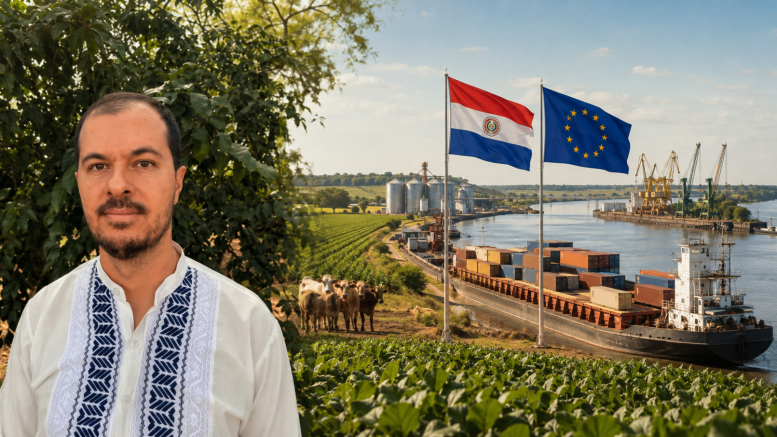
“Defining the criteria for the internal allocation of Mercosur quotas is currently the main subject of debate and disagreement among the member states…”
Gustavo Rojas de Cerqueira César is an associate researcher at the Center for Analysis and Dissemination of the Paraguayan Economy – Cadep and a visiting research fellow at the United Nations University Institute on Comparative Regional Integration Studies. Rojas has a bachelor’s degree in International Relations from the Pontifical Catholic University of Minas Gerais and a M.Sc. in International Economic Relations and International Relations and Negotiations from a joint program offered by FLACSO Argentina and the University of Barcelona. He is currently pursuing a M.Sc. in International Development at SOAS University of London.
Rojas previously served as a Social Protection Officer for UNICEF in Paraguay, an Economic Sector Advisor at the Brazilian Embassy in Buenos Aires and a Research Fellow at Brazil’s Institute for Applied Economic Research. He was also a guest lecturer at Universidad Católica Nuestra Señora de la Asunción in Paraguay and an adjunct professor at Universidad de Belgrano in Argentina.
AgriBrasilis – What benefits does the European Union–Mercosur agreement offer Paraguay?
Gustavo Rojas – The agreement gives Paraguay preferential, stable and legally binding access to a market with a per capita GDP of more than US$ 38,000, replacing unilateral and revocable arrangements such as the Generalised Scheme of Preferences. Estimates indicate that at least 95% of Paraguay’s current and potential exports will receive duty-free or preferential access. Exports could increase by up to 27%, while GDP could rise by nearly 1% over the long term and real wages by approximately 1.5%.
As a landlocked country, Paraguay received special and differential treatment, including exclusive quotas: 10,000 tonnes of organic sugar annually at a 0% in-quota tariff, 50,000 tonnes of duty-free biodiesel and an additional allocation of 1,500 tonnes of pork within the Mercosur quota.
Paraguay will also not automatically be covered by safeguard measures applied to Mercosur as a whole. Such measures may be extended to the country only if a specific investigation establishes that Paraguayan exports cause or threaten to cause serious injury.
Other provisions include longer transition periods for compliance with sanitary and phytosanitary standards, special rules of origin, differentiated treatment for small and medium-sized enterprises and the preservation of policy space for domestic suppliers in government procurement.
Finally, the agreement increases Paraguay’s potential to attract European foreign direct investment. The European Union is the country’s second-largest source of foreign investment stock after Mercosur. The agreement also strengthens the institutional framework for economic integration among Mercosur countries, which collectively remain the leading destination for Paraguayan exports.
AgriBrasilis – What quotas are established under the agreement, and how were they determined?
Gustavo Rojas – The agreement fully liberalizes 82% of agricultural trade between Mercosur and the European Union. The remaining 18% is covered by preferential tariff-rate quotas for sensitive products such as beef, pork and poultry, sugar, ethanol, rice, corn, dairy products and honey.
The principal quotas negotiated by Mercosur include 99,000 tonnes, in carcass-weight equivalent, of fresh and frozen beef. Fresh or chilled beef accounts for 55% of this volume and frozen beef for 45%. The in-quota tariff is 7.5%, with the volume phased in over five years.
The agreement also immediately eliminates the 20% tariff applied within the existing World Trade Organization Hilton quota allocations for premium beef. It provides 650,000 tonnes of ethanol, comprising 450,000 tonnes for chemical use duty-free and 200,000 tonnes for any use at one-third of the Most-Favored-Nation tariff. It also establishes a duty-free quota of 1 million tonnes of corn and sorghum.
Most of these volumes were negotiated by the European Union and Mercosur on a bloc-to-bloc basis. However, their internal allocation among the four Mercosur partners — Argentina, Brazil, Paraguay and Uruguay — has remained unresolved, with a first-come, first-served system being applied provisionally.
AgriBrasilis – Why does Paraguay question this allocation? What criteria would be more appropriate?
Gustavo Rojas – Defining the criteria for the internal allocation of Mercosur quotas is currently the main subject of debate and disagreement among the member states. Paraguay advocates an equal allocation of 25% to each country, while discussions appear to be converging around two alternative criteria.
Argentina and Uruguay support a formula based on each country’s average exports of the relevant product to the European Union. Brazil favors using each country’s average exports of that product to the rest of the world.
Paraguay argues that an allocation based on export history would perpetuate structural asymmetries. In the case of beef, for example, Brazil would receive between 37% and 41% of the quota, while Paraguay would receive only between 9% and 12%, despite currently accounting for only around 4% of the European market.
The Paraguayan Foreign Ministry argues that, in the absence of an agreed allocation mechanism, the first-come, first-served system favors countries capable of shipping their exports more quickly. This distorts competition by making access to tariff benefits dependent on logistical capacity, structurally disadvantaging smaller economies and landlocked countries such as Paraguay in particular.
Paraguay therefore proposes allocating 25% of the quota to each of the four partners, arguing that Mercosur’s founding treaty calls for the bloc’s benefits to be shared equitably among its members. The objective is to provide greater predictability and a level playing field for Paraguayan exporters.
This would differ from the current arrangement under the Hilton quota, through which Paraguay receives only approximately 1,000 tonnes, compared with the substantially larger volumes allocated to Argentina, Brazil and Uruguay.
Alternatively, formulas could combine different criteria, guaranteeing a minimum equal share while allocating the remainder according to export history. One possibility would be to distribute 40% of the quota equally among the four partners and allocate the remaining 60% based on each country’s export record.
AgriBrasilis – How can Paraguay prevent European requirements from excluding its farmers?
Gustavo Rojas – The main regulatory risk remains the European Union Deforestation Regulation, or EUDR — Regulation (EU) 2023/1115. It requires the geolocation of production areas, traceability to the farm of origin and evidence that no deforestation has occurred since December 31st, 2020, for commodities such as soy, beef and their derivatives.
Paraguay is classified as a standard-risk rather than a low-risk country, alongside most major South American agricultural exporters, including Argentina and Brazil. This classification has important practical consequences.
Because Paraguay is not classified as low risk, its exports do not benefit from the simplified procedures available to low-risk countries. These procedures generally do not require a full risk assessment or risk mitigation measures and are subject to a minimum annual inspection rate of 1%. Paraguay is instead subject to the full due diligence process, including data collection, risk assessment and, where necessary, risk mitigation, along with a minimum annual inspection rate of 3%.
Given this situation, Paraguay’s strategy must operate on two fronts:
- National traceability: In April 2026, the Ministry of Industry and Commerce launched RETSA PY — the Registry of Establishments with Socio-Environmental Traceability — with funding from the European Union’s AL-INVEST Verde program. The platform is already available to businesses and exporters in the beef and leather value chains, enabling them to demonstrate compliance with the 2020 deforestation cut-off date without placing the entire administrative burden on small farmers. In addition to consolidating the progress achieved through RETSA PY, Paraguay must extend the system to other commodities, particularly soy.
- Diplomatic efforts to revise the risk classification: Paraguay and Argentina have formally argued that the current classification fails to consider the European Union–Mercosur agreement itself, which should be viewed favorably when assessing the countries’ risk levels. The first review of the classification list is scheduled for 2026, creating a concrete opportunity for Paraguay to negotiate its reclassification as a low-risk country based on its own indicators of low net deforestation.
Paraguay must also use the instruments provided by the trade agreement, including bilateral technical cooperation, databases accessible to small and medium-sized enterprises and longer transition periods for compliance with sanitary and phytosanitary standards.
These instruments are contractually established and should be used proactively during implementation. Paraguay should not simply wait for flexibilities that do not automatically apply under its current standard-risk classification.
AgriBrasilis – What are the disadvantages of Paraguay’s dependence on agribusiness?
Gustavo Rojas – The Paraguayan economy depends on a limited number of products — soybeans and their derivatives, beef, corn and rice — and a limited number of markets. Approximately 70% of its exports go to Brazil, Argentina and Chile.
This concentration makes Paraguay a price-taker in international markets and creates considerable volatility in agricultural GDP, which spills over into the wider economy.
It also leaves the country highly vulnerable to weather conditions. Average annual losses for major crops amount to US$ 504 million, equivalent to 1.2% of GDP, and can reach US$ 3 billion during rare extreme events. This occurred during the 2021–2022 drought, which caused soybean exports to fall by 54% and sector revenues by 42%.
The agro-industrial model, based on intensive monoculture and extensive livestock farming, has contributed to rapid deforestation. According to the World Resources Institute, Paraguay lost approximately 1.13 million hectares of primary forest between 2001 and 2022, equivalent to 33% of its forest cover. The model has also contributed to soil degradation and the overexploitation of water resources.
Finally, the model generates significant social inequality. Although Paraguay ranks among the world’s leading exporters of soybeans, beef and corn, approximately 26% of its population experienced moderate or severe food insecurity between 2021 and 2023, according to the Food and Agriculture Organization of the United Nations.
Land ownership is also highly concentrated. According to the 2022 Agricultural Census, 1% of agricultural holdings — those exceeding 1,000 hectares — control 77% of the country’s agricultural land. The Gini coefficient for land distribution stands at 0.9738, making Paraguay the country with the highest level of land inequality in Latin America and one of the most unequal in the world. The displacement of peasant and indigenous communities to the margins of the export-oriented model also persists.
A broad set of policies could provide buffers against climate and price volatility. These include integrated water management linking agriculture with hydroelectric power generation, stronger institutions for climate change adaptation and the diversification of agricultural markets beyond the region and the beef sector.
Paraguay should also support its still-nascent but promising pork and poultry industries, which create jobs and generate demand for soy and corn. Other priorities include diversifying production to include staples of the local diet, such as fruits and vegetables, accelerating agrarian reform and expanding technical assistance and rural extension services for family farms.
Together, these measures would strengthen the country’s macroeconomic stability and food sovereignty.
READ MORE: