
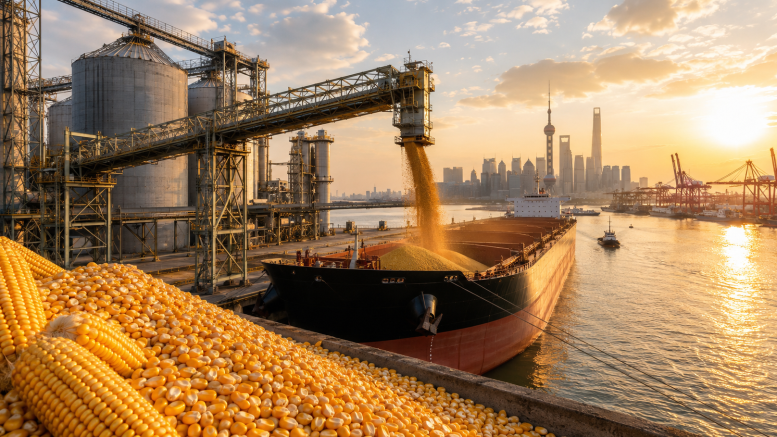
Corn Exports from Argentina to China Have Reached a Record High

Sales of tractors and combine harvesters are falling (-31,2%), while sales of seeders and other implements, which account for 57% of the domestic market, are rising (+4,5%). The sector saw a 17.4% value drop in revenue over the past year, reaching approximately US$ 180 million. (BCRmercados)
In the 1H26, 19 regional economies in Argentina grew more than 20%, with notable contributions from the grain complex (US$ 20.6 billion, 79% of total exports) and the livestock supply chain (US$ 2.3 billion, 7.6% of total exports). (SAGyP)
Corn exports to China have reached a record high in terms of volume. Cofco International accounted for 600 thousand tonnes from April to July. (Cofco)
Record 2025/26 corn harvest, with production reaching 70 million tonnes (+35.4% from 2024/25) and exports estimated at 44 million tonnes. Greater liquidity is allowing farmers to delay soybean sales: only 40% of the crop had been sold by the end of June, the lowest share in a decade, as farmers wait for better exchange-rate and price conditions. (SAGyP; ActivTrades)
Tether, the company behind the world’s largest stablecoin, invested US$ 20 million in the company Ualá, from Argentina, expanding the presence in Latin America. The deal reinforces the diversification beyond cryptoassets after the company took control of Adecoagro in 2025. (Tether)
Monthly inflation slowed for the 3rd consecutive month, reaching 1.9% in June, the lowest level in ten months. Prices increased 16.8% in the 1H26, while annual inflation reached 33.5%. (Indec)

Exports of soybean, soybean meal and corn are expected to exceed initial estimates. Soybean and soybean meal exports are projected to reach 13.76 million tonnes and 2.57 million tonnes, respectively, in July, while corn exports are expected to reach 3.44 million tonnes. (Anec)
Delinquency among Brazilian farmers reached a record of 8.8% in the 1Q26, up 1.2 percentage points year-on-year. The Serasa Experian indicator, which covers agribusiness debts overdue by more than 180 days, increased for the 5th consecutive quarter amid high costs, price volatility and tighter credit. (Serasa Experian)
Olive oil production reached a record 1.434 million L in 2026, up 496.75% from 2025. The State of Rio Grande do Sul accounted for 1.17 million L. (Ibraoliva)
With more than 90% chance of persisting until early 2027, El Niño may bring excessive rainfall to southern Brazil and drought to central-northern regions, increasing the risk of rice blast (disease caused by the fungus Magnaporthe oryzae) in irrigated and upland rice fields. (Sindiveg)
Brazil exported 38.46 million bags of coffee in 2025/26, down 15.7%, while revenue declined 1% to US$ 14.59 billion, supported by a record average price of US$ 379.48 per bag. In 2026/27, exports could rise 17% to 45 million bags, although rainfall during the harvest has reduced the supply of high-quality beans. (Cecafé)
The USA will impose 25% additional tariffs on approximately 3 thousand Brazilian products from July 22nd, affecting more than US$ 11 billion in industrial and agribusiness exports. Further measures could raise tariffs to 37.5%. (Amcham Brasil)


The Port of Coquimbo has finished the citrus season, which runs from May to July, with a record 36,708 tonnes exported, supplied by the Coquimbo and Atacama regions, the main production areas for tangerines, lemons and oranges. Main export destinations are the USA, Mexico, Netherlands and Spain. (TPC)

The probability of a very strong El Niño between October and December has risen to 81%, with a 97% chance of the event persisting into early 2027. The increased risk of drought, heat, wildfires and agricultural losses is driving demand for insurance in Colombia. Colmena Seguros company launched a new policy covering drought, heat waves, fires and winds, while the market expands its traditional and parametric insurance offerings, with options starting at approximately US$ 12. (NOAA/CPC; Colmena Seguros)
Delegation from the General Administration of Customs of China audited four Colombian meat-exporting facilities, as well as the Port of Cartagena and Invima’s official laboratory. Colombia already exports beef to China and is seeking expanded access and sanitary approval for pork and poultry. (Invima)

Agricultural and fisheries exports to the UK reached a record US$ 184 million in 2025, up 15%. Export volume rose 70.3% to 104.4 thousand tonnes, driven mainly by a doubling in sugarcane molasses shipments. (Sader)


Paraguay is expanding trade with Taiwan by making its first shipment of meat and poultry to that destination, reaching 48.5 thousand kg. (Senacsa)

Peru advanced in OECD access process after receiving a favorable assessment from the Committee for Agriculture, marking the sixth technical committee it has successfully cleared. The review recognized gains in productivity and agricultural exports but highlighted smallholders’ limited access to markets, technology, finance, and infrastructure. (OECD)

The Bank of the Oriental Republic of Uruguay will refinance, with a four-year repayment term, the debts of rice-farmer clients that are overdue or were due by June 30th. The bank will also increase credit lines for the 2026/27 season by up to 20%; applications must be submitted by July 31st. (BROU)
The Ministry of Agriculture of Brazil proposed to the Uruguayan government a quota swap that would allow Brazil to use up to 100 thousand tonnes of Uruguay’s beef export quota to China from 2027. In return, Brazil would transfer to Uruguay approximately 7 thousand tonnes of its share of the Mercosur quota for the EU. The arrangement could add more than US$ 500 million to Brazilian export revenue but still requires Uruguay’s approval. The National Meat Institute of Uruguay confirms that the country has a 324 thousand tonnes quota in China in 2026, rising to 331 thousand tonnes in 2027, but has not yet announced its position on the proposal. (MAPA; INAC)

READ MORE: