
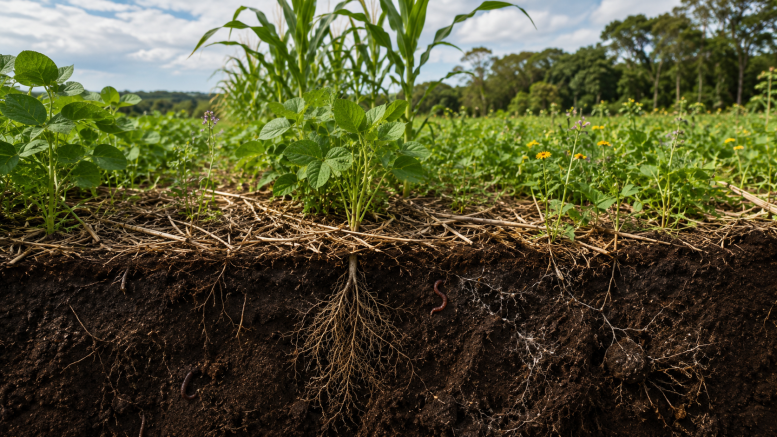
“Soil should be understood as a living and dynamic organism…”
Eliana Fontes is a researcher at Embrapa Genetic Resources and Biotechnology, scientific coordinator of the Regenera Cerrado project, biologist, holder of a master’s degree in ecology and a Ph.D. in entomology.
Fontes previously served as editor-in-chief of the Neotropical Entomology journal, director of the Department of Genetic Heritage at Brazil’s Ministry of the Environment (MMA), general coordinator of Earth and Environmental Sciences at the National Council for Scientific and Technological Development (CNPq), executive secretary of the National Technical Biosafety Commission (CTNBio) at the Ministry of Science, Technology and Innovation (MCTI) and general coordinator of research quality in the R&D Department of Embrapa.

Eliana Fontes, Embrapa Genetic Resources and Biotechnology
AgriBrasilis – How can grains be produced without degrading the soil?
Eliana Fontes – Soil should be understood as a living and dynamic organism. Sustainable grain production depends on a balanced interaction among microorganisms, insects, other invertebrates and plant roots.
These organisms drive essential ecosystem processes, including nutrient cycling and carbon sequestration, which are fundamental to soil health. They also improve soil aeration, promoting root development, facilitating gas exchange and increasing water retention.
This vital balance can be maintained by replacing conventional farming practices with regenerative strategies. Key approaches include consolidating no-till farming, adopting crop rotation, diversifying cropping systems and integrating agroforestry, as well as gradually replacing synthetic chemical inputs with biological inputs. The use of nitrogen-fixing microorganisms, phosphorus-solubilizing microbes, plant growth-promoting microorganisms and beneficial micro- and macro-organisms that act as natural enemies of plant diseases and insect pests helps maintain the systemic vitality of agricultural production.
AgriBrasilis – What results has the Regenera Cerrado program achieved?
Eliana Fontes – The results of this collaborative research conducted by scientists and farmers show that it is entirely possible to produce grains in the Cerrado in a sustainable, economically viable and resilient way.
Carried out through a coalition involving 12 farms and 36 researchers, the project demonstrated that regenerative management preserves soil health while maintaining high productivity without causing degradation.
Today, regenerative agriculture represents a long-term commitment to understanding and working with living systems, generating the knowledge needed to ensure farmers’ profitability while securing the sustainability of Brazilian agriculture for future generations.
AgriBrasilis – What are the benefits of maintaining carbon in agricultural soils?
Eliana Fontes – Organic carbon stocks are at the heart of the regenerative capacity of agricultural soils. According to the technical findings of the Regenera Cerrado Project, preserving soil carbon improves protection and moisture through the production of cover crop biomass, which averaged 190 metric tonnes per hectare, increasing organic matter and enhancing water retention.
Carbon is also directly correlated with the average diameter of soil aggregates, significantly reducing the risk of erosion and improving groundwater recharge potential. In addition, higher carbon levels stimulate the activity of mycorrhizal fungi and increase glomalin concentrations, a glycoprotein that plays a key role in stabilizing soil structure.
AgriBrasilis – Is it possible to reduce fertilizer and pesticide use without sacrificing productivity?
Eliana Fontes – The results of the Regenera Cerrado Project show that reducing the use of synthetic fertilizers and chemical pesticides, combined with the adoption of biological inputs, preserves economic viability while increasing productivity.
The most notable results were observed in the second corn crop (safrinha), where the regenerative system achieved an average yield of 151 bags per hectare, compared with 142 bags per hectare under conventional management. Over the project’s two-year evaluation period, which included both soybean and corn production, the cumulative profit from the regenerative system exceeded that of the conventional system.
At the same time, reducing agrochemical use enhanced natural biological control, leading to significant rates of caterpillar mortality caused by parasitoids and entomopathogenic fungi naturally present in the regenerative production areas.
AgriBrasilis – How does regenerative agriculture change pest management?
Eliana Fontes – It promotes a profound shift in the structure of trophic networks, replacing the logic of chemical eradication with ecological balance.
The gradual and carefully planned replacement of synthetic pesticides and fungicides with bioinsecticides and biofungicides reduces outbreaks of key pests by preserving their natural enemies. This transition lessens the negative ecological impact of agrochemicals and directly benefits beneficial organisms, including natural enemies of pests and pollinators.
The project also showed that areas managed with biological inputs support much more balanced communities of wild bees. Because most of these species nest in the ground, they benefit from protected, undisturbed soils. Pollination by these wild bees increased soybean grain weight by up to 7% in fields located near native vegetation.
AgriBrasilis – Do farmers know how to monitor and preserve natural enemies in their fields?
Eliana Fontes – Farmers are becoming increasingly aware of the value of biodiversity for both sustainability and economic performance. We observed this progress while working with soybean and corn farmers involved in the Regenera Cerrado Project.
However, the practical ability to monitor and quantify beneficial organisms still needs to become more widespread. To scale up this knowledge, continuous training for farmers, farm managers, technical consultants and field workers is essential.
It is also strategic to incorporate courses on regenerative agriculture and biological inputs into the curricula of agricultural schools and agronomy programs, helping prepare the next generation of agricultural professionals.
READ MORE: