
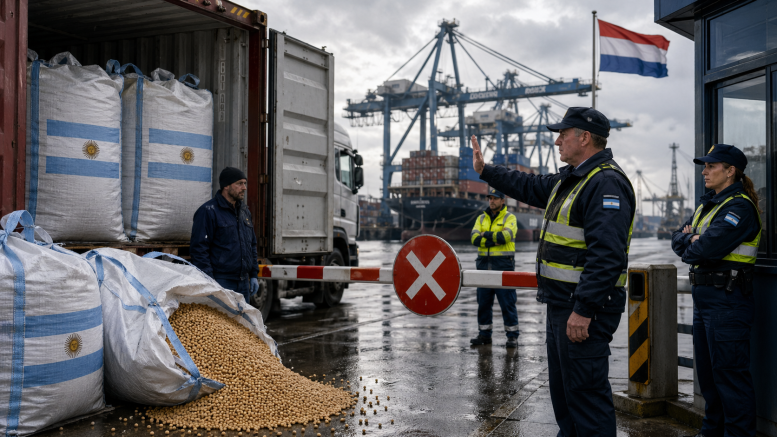
The Netherlands Rejected Soybean Meal Shipments from Argentina

Truck drivers’ protest at Port of Quequén ended after an agreement between carriers, farmers and port authorities. According to the Port of Quequén Management Consortium, the deal includes a 16% increase in freight rates and a 2% cap on administrative charges. The strike lasted more than two weeks, disrupted grain loading and caused estimated losses of approximately US$ 280 million for the agricultural export sector. (Port of Quequén Management Consortium)
The Netherlands rejected soybean meal shipments from Argentina after detection of unauthorized GMOs. The European rapid alert system for food and feed recorded four notifications involving Argentine soybean meal between March 19th and April 27th, with the risk classified as “potentially serious”. The case may increase control and segregation requirements for Argentine shipments bound for the EU. (European Commission)

Raízen creditors with approximately US$ 2.79 billion in bonds hired financial advisory firm Journey Capital and the law firm Felsberg to represent them in the company’s restructuring process. Raízen, a joint venture between Shell and Cosan and one of the world’s largest producers of cane-based sugar and ethanol, is negotiating a debt-for-equity conversion as part of an out-of-court agreement with creditors holding almost US$ 12.94 billion in outstanding debt. (Journey Capital)
Area affected by drought decreased from 54% to 49% of the national territory in March of 2026, equivalent to 4.2 million km², according to the Drought Monitor of the National Water and Basic Sanitation Agency. Drought conditions eased in 19 States, including Bahia, Minas Gerais, São Paulo, Goiás and Mato Grosso, but expanded in the South and North regions. The Northeast remained the most critical region, with 88% of its territory affected, although extreme drought fell from 5% to 2% of the regional area. (National Water and Basic Sanitation Agency)
Brazil has reached 600 new agricultural market openings since 2023, following new announcements for the Philippines, Cuba and South Korea. Exports were approved for chilled beef to the Philippines, bone-in beef and pork to Cuba, Brazilian nuts to South Korea. The move strengthens the diversification of Brazil’s agricultural export portfolio. (MAPA)
Suzano will raise pulp prices by US$ 50 per tonne for Americas’ market starting in May. The increase reinforces Brazil’s role in the global eucalyptus pulp market and signals firmer international prices, with a direct impact on regional buyers. The company also announced an increase for Europe, where prices will reach US$ 1,430 per tonne. (Suzano)
Brazilian Confederation of Agriculture and Livestock submitted ten priority proposals to the Ministry of Agriculture for the 2026/27 Harvest Plan [Brazilian Government official agricultural financing plan]. The entity is calling for US$ 124.01 billion in rural credit, including US$ 20.88 billion for family farming and US$ 103.15 billion for commercial agriculture, as well as US$ 800 million for the Rural Insurance Premium Subsidy Program. (CNA)
Itaú BBA expects agribusiness credit portfolio to grow 10% in 2026. The institution sees financing demand remaining firm despite high interest rates and tighter farm margins. The expected increase reflects the importance of agribusiness in the corporate portfolio and the sector’s need for capital for crop financing, investments and financial management. (Itaú BBA)
Banco do Brasil (Bank of Brazil), the country’s main agribusiness lender, sees signs of improvement in sector loan payments, but continues to monitor agribusiness amid high indebtedness and pressure on farmers’ margins. According to the institution, delinquency still requires caution, although a gradual recovery is expected with the harvest and the financial restructuring of farmers. (Banco do Brasil)
The Brazilian Association of Soybean Farmers is calling for a new round of rural debt securitization to address the liquidity crisis in Brazilian farming. According to Maurício Buffon, the association’s president, high costs, extreme weather, elevated interest rates and tighter margins have increased farmers’ debt and threaten financing for the next crop season. The debate comes as Bill 5122/2023, focused on rural debt renegotiation, is under review in the Senate. (Aprosoja Brasil)

Chile will be the first country in the world to operate 100% digital phytosanitary certification with China for agricultural and forestry exports. According to the Agricultural and Livestock Service, the system came into effect on April 20th at all Chinese ports, eliminating paper documents for shipments. The measure should reduce costs, speed up clearances and strengthen trade with one of the main destinations for Chilean products. (SAG)


Suspension of live cattle exports for animals under two years old and breeding females, amid rising beef prices. According to Agriculture Minister Martha Carvajalino, the measure aims to preserve the national herd and curb meat inflation, after beef prices rose by more than 10% and auction prices for live cattle increased by up to 19%. (Ministry of Agriculture)
Banana exports reached a record in 2025, with US$ 1.309 billion in foreign sales. The country exported 2.5 million tonnes, equivalent to 133 million 20-kg boxes, consolidating the position as the third-largest banana exporter in Latin America and the Caribbean. The EU was the main destination, accounting for 65.8% of shipments. (Augura)
Coffee production fell 29.1% in March of 2026, to 754,000 60-kg bags, the lowest volume for the month since 2013. The contraction happened mainly because of heavy rainfall, which reduced yields. (Fedecafé)

Sugar production is expected to recover in the 2025/26 season, with the National Committee for the Sustainable Development of Sugarcane, the Mexican agency responsible for monitoring the sugarcane sector, estimating 5.58 million tonnes. The improvement is linked to better rainfall and a gradual increase in sugarcane area, although higher fertilizer and input costs continue to pressure yields. A report by the US Department of Agriculture also points to a sector recovery, but with a lower estimate of 5.40 million tonnes for 2025/26. (Datagro; Conadesuca; USDA)


The Panama Canal recorded higher priority transit fees after the blockage in the Strait of Hormuz redirected oil and liquefied natural gas flows to alternative routes. Companies paid up to an additional US$ 4 million at auctions to speed up vessel crossings, while average extra costs rose in recent weeks. (Panama Canal Authority; Panama’s Ministry of Foreign Affairs)

Paraguay exported rice to 22 countries between January and March of 2026. Brazil accounted for 82% of the shipments. The Brazilian market purchased 162,400 tonnes, followed by Chile, Peru, Spain and Belgium. (Caparroz)

Agrobanco disbursed approximately US$ 108 million in credit in the 1Q26, benefiting over 29 thousand small farmers and agricultural organizations in Peru. The funds were used for purchases, commercialization, genetic improvement and working capital. For 2026, the institution expects to finance 166 thousand clients and reach approximately US$ 513 million in total lending, with a maximum delinquency rate of 4%. (Agrobanco)

MBRF inaugurated the expansion of the beef complex in Tacuarembó, after a US$ 70 million investment. The unit will increase hamburger production from 200 to 900 tonnes per month, while slaughter capacity will increase from 900 to 1,400 animals per day. Production will serve the Uruguayan market and destinations such as the USA, China, Japan, South Korea and the EU. (MBFR)

READ MORE: