
“The time required for pesticide registration approval is the greatest disincentive to invest in this market…”
Flavio Hirata, partner at AllierBrasil, founder of look2agro™, agronomist from Esalq/USP, MBA, specialist in pesticide registration.
AllierBrasil is a consulting firm on pesticide registraion with more than 20 years of experience, and promotes Brazilian agribusiness in Brazil, China and India.
On August 3rd and 4th, AllierBrasil will hold the 17th edition of Brasil AgrochemShow at Centro de Eventos São Luís, in São Paulo, Brazil, with more than 1,500 visitors and exhibitors.

Flavio Hirata, partner at AllierBrasil
2025 was a record year for pesticide registration approvals in Brazil, with 912 registrations, including 323 technical products, 427 chemical formulated products, and 162 biological products. This represented a growth of 37.5% when compared to the previous year.
The increase in the number of approvals over the past 20 years has been significant. In the last five years, 3,344 registrations were approved, which is 59.4% more than in the previous five-year period, when 2,098 registrations were granted. Comparing the past two decades, there were 1,454 approvals between 2006 – 2015 and 5,442 approvals between 2016 – 2025, an increase of 274.3%.
This growing number of approvals does not mean the registration process has become simpler or less rigorous. On the contrary, it is bureaucratic, slow and costly, subject to frequent regulatory changes, shifts in interpretation, and revisions of requirements.
It can neither be assumed the market is being adequately supplied with this number of new products. The excessively long approval timeline delays the launch of products most in demand by farmers. In other words, by the time certain products are approved, their efficacy may already be compromised, or the active ingredient maybe to be banned.
The time required for registration approval is the greatest disincentive to invest in this market. In 2025, the average time required for approval of chemical formulated products was 63.4 months (5.28 years) and for equivalent technical products, the average reached 67.4 months (5.61 years), while generic formulated products averaged 64.7 months (5.39 years). These figures represent the overall average for registrations, without excluding the effect of lawsuits.
Registration is the first and biggest barrier to market access in Brazil. According to a survey conducted by AllierBrasil, through the end of 2025 there were approximately 2,830 chemical formulated products in the queue for evaluation. Among these, 397 applications had been filed seven years earlier or more, including 94 that had been waiting for evaluation for ten years or more. These delays help to explain why companies turn to the judiciary.
Between 2019 and 2025, approvals granted in compliance with court decisions increased by 395% against Anvisa and by 2,666% against Ibama. In 2026, according to the report released by AllierBrasil, as of April 23rd, 2026, Anvisa approved 48 toxicological evaluations in accordance with court decisions.
Despite the large number of lawsuits, nine companies accounted for more than half of all lawsuits between 2019 and 2025, representing 54.39% of the total.
Companies with the more approvals through lawsuits to expedite pesticide registrations (2019–2025)
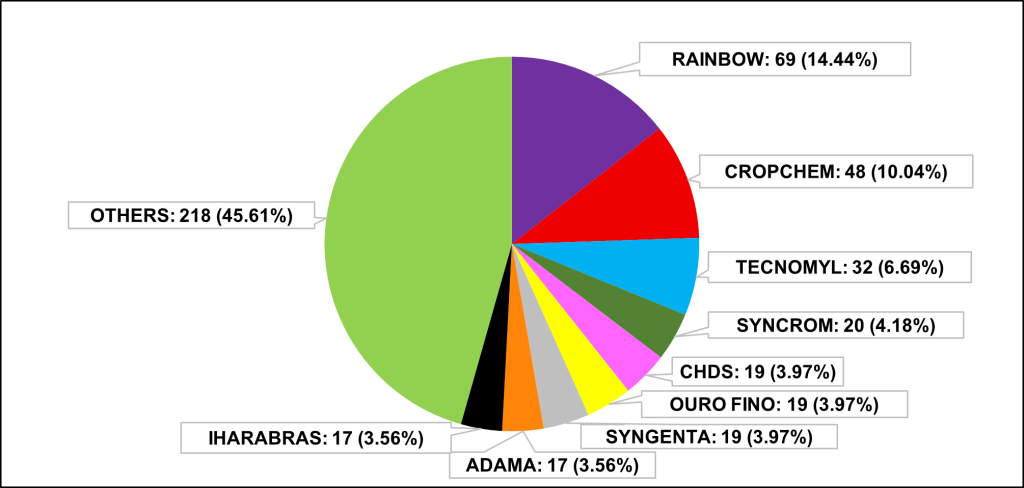
Source: MAPA, Anvisa, Ibama; adapted by AllierBrasil
The data show lawsuits are no longer an exception, but an increasingly regular tool to accelerate market access. The impact of lawsuits is reflected in the total number of approved registrations. According to the same report released by AllierBrasil, 27.45% of generic product registrations between 2022 and 2025 were approved through court action involving at least one of the regulatory agencies (Anvisa or Ibama). In 2025 alone, the figure was 24%.
Given the importance of product registration and market access, these and other topics shall be addressed in lectures at the 17th Brasil AgrochemShow, to be held on August 3rd and 4th, 2026, at Centro de Eventos São Luís, in São Paulo, Brazil.
READ MORE: