
“Biological control should not be considered in isolation but as part of Integrated Pest Management”
José Roberto Postali Parra is the director of SPARCBio (São Paulo Advanced Research Center for Biological Control). He is a retired professor from the Department of Entomology and Acarology at Esalq.
Postali holds a degree in Agronomic Engineering, as well as a M.Sc. and PhD in Entomology from the University of São Paulo, with a postdoctoral fellowship at the University of Illinois.
José Postali, director of SPARCBio
AgriBrasilis – What is the current landscape of biological control in Brazil?
José Postali – Brazilian agriculture has grown over the past 50 years, and now Brazil is a leader in tropical agriculture, with its own technology. However, because it differs from other countries (with very large areas occupied by a single crop, two to three harvests per year, crop succession, as well as soil and climate conditions favorable to pests and diseases) it is not possible to simply copy techniques from other countries. The same applies to biological control, for which we must develop our own technology suited to tropical conditions. This is our challenge.
There were some myths that needed to be dispelled to increase the use of biological control in Brazil. The main one was cultural, as Brazilian farmers were accustomed to chemical insecticides. In 2013, the species Helicoverpa armigera was recorded in Brazil, a pest with more than 100 hosts. At the time, however, there were no registered chemical products for this pest. Trichogramma pretiosum (an egg parasitoid) and a specific baculovirus were used, and the success of biological control was complete. From then on, farmers began to believe in biological control. This marks the turning point for biological control in Brazil, and from that moment, there was an explosion in registered biological products, reaching 953 products today for around 200 targets, with a record average registration time of 13 months (in Europe, it takes 7–8 years).
Today, the terminology of biological control has changed, and it is considered part of what are known as bioinputs. Previously, it included only parasitoids and predators (macroorganisms) and pathogens (microorganisms), as well as semiochemicals (such as pheromones). Today, these are classified as bioagents, alongside biostimulants and biofertilizers within the broader category of bioinputs.
Brazil is increasing the use of biological control by around 25–30% per year, while other countries grow at a pace of 15–20%. In soybeans, for example, 62% of farmers use bioinputs; in corn, 23%; sugarcane, 10%; and cotton, coffee, fruits, and vegetables around 5%. The states of Mato Grosso, Goiás and São Paulo have the highest adoption rates, at 34%, 12% and 10%, respectively.
Total products registered since 2013 (red arrow), the year Helicoverpa armigera was recorded in Brazil.
Total number of products registered since 2013 (red arrow), the year Helicoverpa armigera was recorded in Brazil.
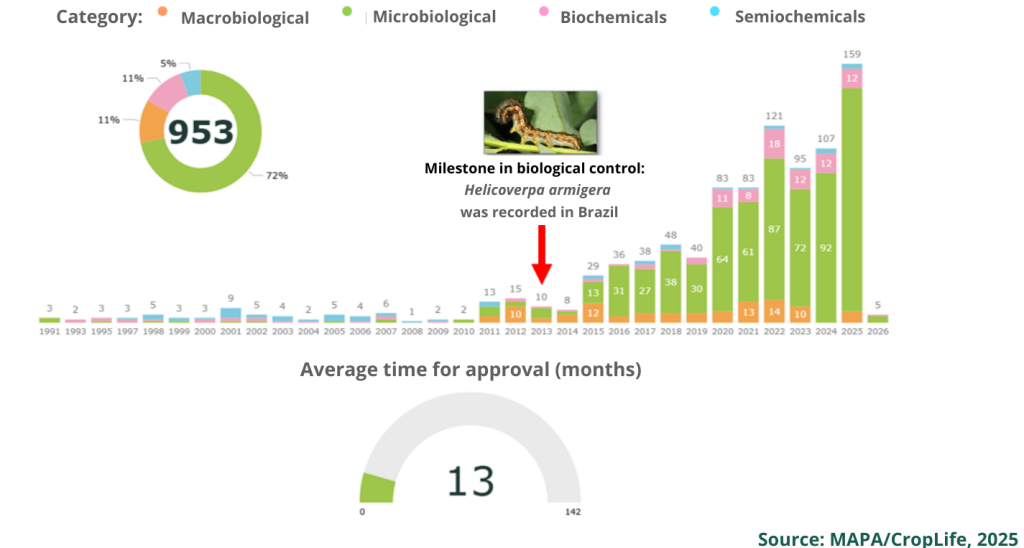
Total number of products registered since 2013 (red arrow), the year Helicoverpa armigera was recorded in Brazil.
AgriBrasilis – What are the main success stories?
José Postali – Among microorganisms: Bacillus spp., Octane, Metarril, Boveril, Trichodermil, Challenger and baculovirus are some examples. Among macroorganisms: Trichogramma galloi, T. pretiosum, Telenomus podisi, Cotesia flavipes, Orius insidiosus, etc.
T. galloi is released over 5 million hectares to control Diatraea saccharalis (sugarcane borer), representing the largest biological control program using macroorganisms in tropical regions worldwide.
AgriBrasilis – In what situations is biological control not recommended? What are the main misconceptions associated with it?
José Postali – Bioinputs are not always available. For example, in soybeans, Euschistus heros (the main pest) is known to be controlled by Telenomus podisi, but this natural enemy is not yet available at scale. Mass production is a challenge for macroorganisms. The quality of inputs is very important for the credibility of biological control.
Biological control should not be considered in isolation but as part of Integrated Pest Management (IPM). Farmers need better training, as biological control is no longer as simple as many believe; it is highly technical, involving sophisticated release techniques such as drones. Even though mass production exists today, biological control should be applied at the early stages of infestations, which is at the control threshold of pest or disease organisms.
AgriBrasilis – To what extent can biological control reduce the use of pesticides? How can these products be combined without compromising IPM?
José Postali – We should not think about eliminating insecticides. They will still have their place under certain conditions, always avoiding irrational use. Biological products should not necessarily be used alone but as part of IPM and they can even be integrated with chemicals, provided those products are selective.
AgriBrasilis – Why has the microorganism market advanced faster than that of parasitoids and predators?
José Postali – The reasons are very simple:
1 – Microorganisms are applied similarly to chemicals, which farmers were already accustomed to;
2 – Microorganisms have a shelf life, whereas macroorganisms must be released immediately after emergence.
In addition, logistics for macroorganisms is more complex over long distances, as they must arrive alive and ready for release (often they arrive dead). Today, usage is 72% for microorganisms versus 12% for macroorganisms (parasitoids and predators). Thus, of the more than 170 companies selling bioinputs, the vast majority focus on microorganisms.
AgriBrasilis – What has changed in biological control in recent years? What advances will shape the future of this market?
José Postali – To surpass the current 156 million hectares treated in Brazil (potential treated area) and a global market of US$ 14 billion, we must advance research and professional training, improve the quality of produced organisms (as many unprepared companies are entering the market), increase input availability (since areas are very large, especially for commodities), refine legislation for bioinputs (which has improved in recent years), expand mass rearing of macroorganisms along with logistics and distribution, increase awareness of biological control among society and farmers, and, of course, invest in large-scale projects, encouraging funding from major companies.
READ MORE: