
“The main driving factor for the adoption of ABC+ technologies by producers is not credit, but the improvement in productive efficiency…”
AgriBrasilis – What is the ABC+ Plan?
MAPA – It is a state policy aimed at promoting production practices that combine:
- Higher productivity and income for rural producers (this being the main motivating factor for adopting these practices);
- Better adaptation of production systems to climate effects (lower vulnerability and greater resilience);
- Lower greenhouse gas emissions.
AgriBrasilis – What are the main technologies included?
MAPA – There are eight technologies monitored under the ABC+ Plan, two of which are further divided into two additional technologies (Integrated Systems: Crop-Livestock-Forest Integration Systems + Agroforestry Systems; and No-Till System (SPD): Grain No-Till System (SPDG) + Vegetable No-Till System (SPDH)), resulting in 10 monitored technologies in practice:
- DEGRADED PASTURE RECOVERY PRACTICES (PRPD);
- GRAIN NO-TILL SYSTEM (SPDG);
- VEGETABLE NO-TILL SYSTEM (SPDH);
- CROP-LIVESTOCK INTEGRATION, WITH OR WITHOUT FORESTRY COMPONENT (ILPF);
- AGROFORESTRY SYSTEMS (SAF);
- INTENSIVE FINISHING OF CATTLE (TI);
- ANIMAL PRODUCTION WASTE MANAGEMENT (MRPA);
- PLANTED FORESTS (FP);
- IRRIGATED SYSTEMS (SI);
- BIOINPUTS (BI).
It is also important to highlight that these practices have been developed over more than five decades for the national context, are well established among producers, and have strong scientific evidence proving they are both adaptive and mitigating practices. Therefore, their effectiveness for public policy purposes is evident.
However, their broader adoption and effectiveness will depend on several factors, ranging from operational management to the use of supporting technologies such as conservation practices, improved genetic material, proper soil sampling, analysis and fertilization, as well as sanitary and nutritional management of herds in the case of livestock.
AgriBrasilis – How has the adoption of these technologies evolved?
MAPA – The adoption of these practices has been well received by producers, given improvements in operational costs and productivity, with a direct effect on profit margins. However, it is necessary for producers to seek technical guidance, and for advisory services to be prepared to guide them according to their specific reality. Producers are not always ready to adopt a given technology immediately, whether due to financial constraints or because it requires a change in mindset so that past mistakes do not interfere with results, potentially making operations—or even the activity itself—technically and financially unfeasible.
AgriBrasilis – What limits the adoption of technologies such as Animal Waste Management, Planted Forests, and Vegetable No-Till Systems?
MAPA – The decision to adopt any ABC+ technology is a matter of “management.”
More than changing people’s production culture, it is necessary to consider where one wants to go and what path is required to get there.
In the case of MRPA, for example, a swine producer with 30 breeding sows planning to build a biodigester must be aware that, to dilute the investment, they may need to expand to more than 500 sows, considering costs can range from R$250,000 to R$700,000 or even R$2 million.
In the case of Planted Forests, especially when focused on commercializing timber (rather than just on-farm use), the decision depends on logistics, market feasibility, and legal aspects, which often require small and medium producers to deal with high levels of bureaucracy.
For SPDH, the main limitation is the lack of awareness of this technology for vegetables, despite its significant benefits, such as reduced fertilizer use—mainly due to improved soil microbiological quality—and reduced pesticide use due to the positive effects of biological pest control, which often occurs naturally with the adoption of the technique.
AgriBrasilis – What is the role of rural credit within the ABC+ Plan?
MAPA – The main motivating factor for adopting ABC+ technologies is not credit, but the improvement in productive efficiency achieved through their adoption, since these practices can allow producers to increase productivity by up to 4 to 5 times compared to conventional production.
Historically, credit usage ranges from 20% to 30% of gross production value, and about 15% of producers (individuals) use credit in their operations, indicating that most producers implement ABC+ practices using their own resources.
However, it is undeniable that credit, when used to leverage the activity based on a well-structured business plan, can be an excellent tool for enabling operations and fostering producers’ prosperity.
AgriBrasilis – What is needed for the Plan to meet its 2030 targets?
MAPA – In addition to maintaining engagement in plan management at the state level through State ABC+ Management Groups, the main strategy has been to demystify the plan within the private sector, as many institutions already adopt ABC practices but do not recognize them as such.
From this, it has been possible to scale the process and, through the development of the ABC Platform—available on the Ministry’s website—identify that several technologies are already well advanced, with some targets already achieved or even exceeded, as shown in the overview below:
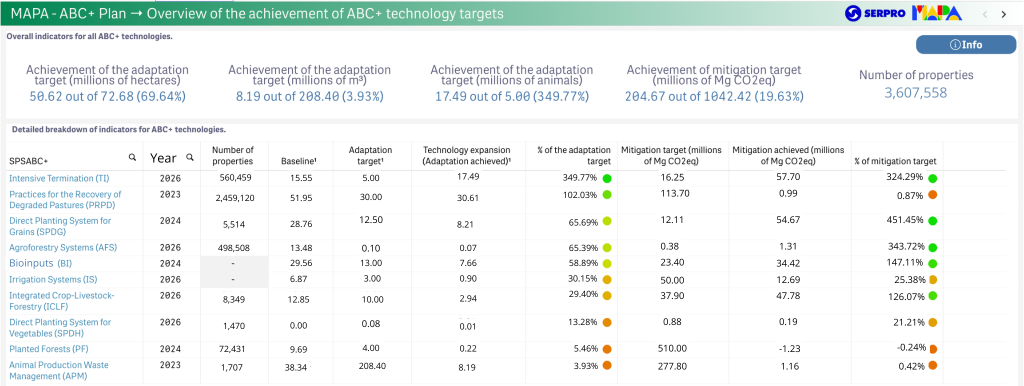
Overview of the achievement of ABC+ technology targets.
This dashboard is available on the Ministry of Agriculture’s website:
https://www.gov.br/agricultura/pt-br/assuntos/sustentabilidade/planoabc-abcmais/abc/sinabc/plataforma-abc
Read more: