
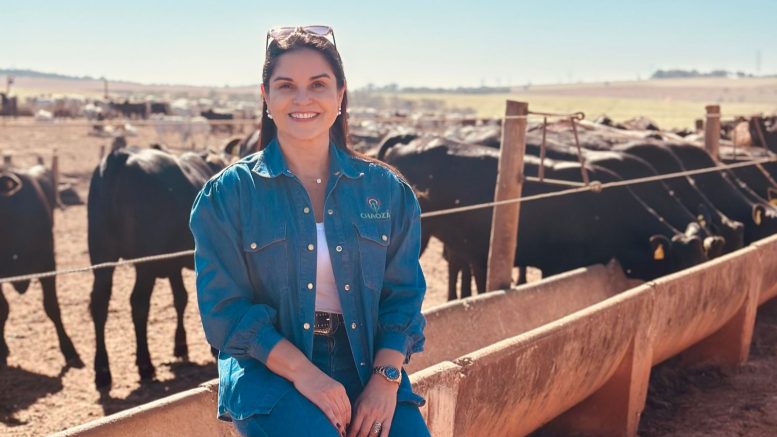
“The agricultural land market in Brazil is undergoing a clear process of maturation and professionalization…”
Georgia Oliveira worked for 17 years at large multinational corporations and for more than 14 years in the real estate market as a commercial executive and entrepreneur, founding the Chãozão platform. Throughout her career, she has built important alliances and successful partnerships, which were fundamental to the significant results achieved in the real estate market (both urban and rural), totaling more than BRL 1 billion in gross development value (GDV) across developed projects and completed sales. A native of Tocantins, the daughter of cattle ranchers, she holds a degree in Marketing and an MBA in Business Management from FGV (Fundação Getulio Vargas).
AgriBrasilis – What are the main transformations in the agricultural land market?
Georgia Oliveira – The agricultural land market in Brazil is undergoing a clear process of maturation and professionalization. Previously, it was largely based on informal relationships, subjective perceptions, and poorly structured negotiations; today, the sector is beginning to operate with greater rationality, access to information, and a long-term perspective. Land has ceased to be viewed merely as a reserve asset and has come to be understood as a strategic, productive, and financial asset. This movement has been driven by factors such as the consolidation of Brazilian agribusiness, the increased interest of investors—both domestic and foreign—and, above all, the digitalization of access to information.
Today, buyers and sellers seek comparable data, price history, regional liquidity, and a clearer understanding of the productive aptitudes of each area. Transparency has become a competitive differentiator in the market.
AgriBrasilis – Which regions are on the rise or in decline? Why?
Georgia Oliveira – What is currently observed is not exactly a division between “good” or “bad” regions, but rather between regions with solid fundamentals and those facing cyclical challenges.
Regions in the Midwest, Matopiba, and parts of the Southeast remain in the spotlight, mainly due to the combination of productive scale, evolving logistics, and well-defined agricultural or livestock aptitude. At the same time, traditionally consolidated areas maintain liquidity, albeit with more stable prices.
On the other hand, regions that experienced very rapid growth, leveraged by abundant credit, are now undergoing a natural adjustment. This movement is healthy and necessary, as it corrects excesses and reinforces the importance of fundamentals such as productivity, operating costs, access to markets, and legal certainty.
AgriBrasilis – How have defaults and judicial reorganization proceedings affected the market?
Georgia Oliveira – Defaults and judicial reorganization processes have brought significant impacts, but they also function as an important filter for the market. The end of cheap credit has exposed the fragilities of overly leveraged operations and forced the sector to reassess its financial structures.
In the short term, this leads to caution, the postponement of decisions, and greater selectivity on the part of buyers and financiers. In the medium and long term, however, it strengthens the market by channeling capital toward more efficient, sustainable, and well-structured operations.
Land, as a real asset, continues to be viewed as a means of wealth preservation. What changes is the investor profile, which now demands more information, more data, and greater predictability before making decisions.
AgriBrasilis – How do you envision the rural real estate market in the future?
Georgia Oliveira – I see a market increasingly guided by data, technology, and territorial intelligence. The trend is for buying and selling decisions to be more strongly based on objective indicators: liquidity, productive aptitude, price history, climate risk, and infrastructure.
In addition, I believe there will be greater integration between the land market and the financial market, with new credit, investment, and securitization instruments backed by rural assets.
The future of the market necessarily involves greater transparency, governance, and access to qualified information. Those who understand this early on will have a clear competitive advantage.
AgriBrasilis – What is the purpose of the Chãozão price index and how does it work?
Georgia Oliveira – The ICVH (Chãozão Hectare Value Index) was created to address a historical gap in the market: the lack of structured, reliable, and comparable data on average land values in Brazil.
It operates through the consolidation of active listings on the platform, organized by municipality. It is important to emphasize that this is a dynamic index, reflecting real market behavior rather than a fixed or speculative table.
Its purpose is to provide benchmarks, market intelligence, and decision-making support for those who sell, buy, or invest.
AgriBrasilis – How can the platform’s data assist producers and investors?
Georgia Oliveira – The primary function of the data provided by Chãozão is to enhance decision-making. By structuring exactly the information that buyers and investors analyze before acquiring a rural property, the platform reduces the information asymmetry that has historically characterized Brazil’s land market.
We are the first platform to offer this level of detail on rural properties, covering aspects such as productive aptitude and sub-aptitude, rainfall index, topography, soil type, water availability, improvements, percentage of legal reserve, among other technical criteria that are fundamental to evaluating an area. For producers and sellers, these data allow the asset to be positioned more precisely and transparently, facilitating value communication and increasing the efficiency of the sales process. For investors, they provide a broader and more objective view, enabling the analysis of risks, productive potential, and the suitability of the land to their investment profile.
More broadly, the organization and standardization of this information contribute to a more rational, efficient, and secure market, raising the level of negotiations and strengthening trust among all parties involved.
Ultimately, high-quality information reduces asymmetry, increases trust, and professionalizes the entire land market ecosystem.
READ MORE: