
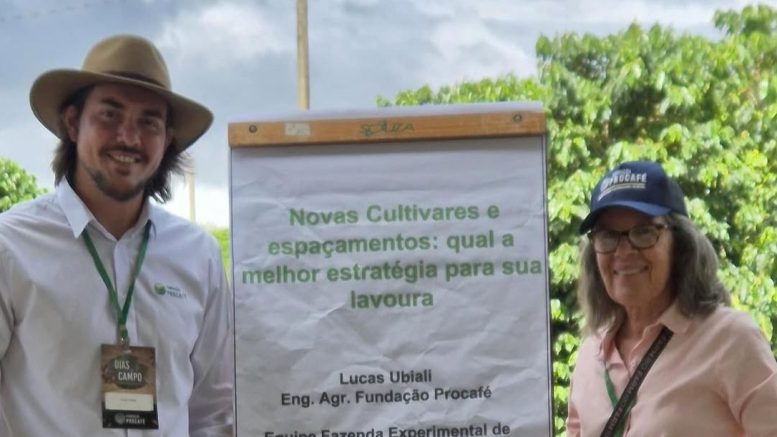
“You need to be very efficient, manage operations carefully and achieve above-average productivity in some areas to make the numbers work…”
Lucas Ubiali is an agricultural engineer, a researcher at Fundação Procafé and the manager of the Intelligence Center for Strengthening Coffee Production. He is also a coffee farmer in Pedregulho, in the State of São Paulo, in the Alta Mogiana region, where he runs a 100-hectare farm certified internationally and awarded for its specialty coffee production, in partnership with Fernanda Maciel.
AgriBrasilis – What are the main difficulties and uncertainties for farmers in your region?
Lucas Ubiali – Here in the Alta Mogiana region, specifically around Pedregulho, we face some very clear challenges.
First, the climate issue: dry spells have become more frequent, rainfall is very irregular and temperatures are higher than usual. All of this directly affects flowering, fruit set and bean filling.
Another challange is the high cost of production, especially fertilizers, labor and crop protection products. Labor, in particular, has become increasingly difficult to hire and retain.
And of course, there is market uncertainty: exchange rate volatility, coffee prices fluctuating significantly, which makes any medium-term planning much more complicated.
AgriBrasilis – What is the current situation regarding access to credit?
Lucas Ubiali – Credit is available, but it’s not easily accessible.
Institutions do offer financing lines, but bureaucracy has increased and interest rates have gone up. What used to be a faster approval process now takes longer and requires more guarantees and analysis.
Moderfrota (Program for the Modernization of the Agricultural Tractor Fleet and Associated Implements and Harvesters) and Pronamp (National Program to Support Medium-Sized Rural Producers) remain viable alternatives, but the amount of funding available does not keep up with demand.
So, many times we often end up having to seek commercial credit, which is more expensive, or negotiate payment terms directly with suppliers.
AgriBrasilis – Is it worth producing this year’s harvest? What is the situation with production costs?
Lucas Ubiali – Producing coffee is still worthwhile, but the margins are tight.
Costs are still very high. Fertilizers have improved a bit compared to the post-pandemic peak, but they are still expensive. Labor is a significant cost burden, and while mechanization is a reality in the region, it alone cannot adjust the costs.
Coffee prices are good, but they don’t fully compensate for the rising costs. Since 2021, we’ve been carrying over some adjustments and dealing with less productive fields due to the climate challenges, which have intensified since then.
So we’re operating on very tight margins: we need to be very efficient, manage operations carefully and achieve above-average productivity in certain areas just to break even.
AgriBrasilis – When and how do you decide what to plant, the size of the area and the timing for purchasing inputs?
Lucas Ubiali – We always make these decisions based on three factors: the market, the climate and the farm’s situation.
We plan new plantings at least a year in advance. We analyze water availability, soil conditions, productivity of existing areas and the cost of implementation.
As for purchasing inputs, we try to anticipate it as much as possible. When we can lock in prices before the harvest price rises—usually at the end of the year or the beginning of the next—we do it. But it’s always a gamble: if you wait too long, prices might go up; if you act too early, the market might drop.
The size of the area planted depends on cash flow, access to credit and available labor.
AgriBrasilis – What new technologies and practices have you been adopting?
Lucas Ubiali – Here in the region, we’ve been adopting several new practices, and on the farm we aim to advance and improve every year.
Today we use:
- More split fertilization based on soil and leaf analysis;
- Yield mapping and geolocation of operations;
- Localized irrigation where water is available;
- Biostimulants and soil conditioners, evaluating their return;
- Planting a seed mix with cover crops to improve the soil’s biological conditions;
- We have been working more intensively with integrated management systems, especially to position biological crop protection products and make operations more effective.
The goal is always to pursue sustainable productivity, reduce waste and improve predictability.