
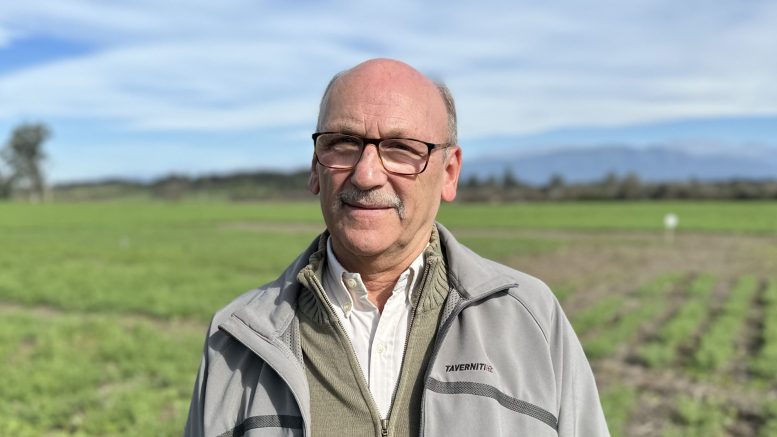
“The time required to develop a new soybean variety generally ranges from eight to ten years…”
Leonardo Daniel Ploper is an emeritus researcher at the Obispo Colombres Agroindustrial Experimental Station – EEAOC and a former principal researcher at Argentina’s National Scientific and Technical Research Council – CONICET. He holds a degree in agricultural engineering from the National University of Tucumán, as well as a master’s degree and a doctorate from Purdue University. He also completed postdoctoral research in plant pathology at Auburn University. He specializes in plant pathology and plant breeding.
AgriBrasilis – How does the development of a new variety begin?
Daniel Ploper – Developing a variety requires generating genetic variation from which superior genotypes can be selected. To achieve this, breeders make sexual crosses between elite parents carrying the main desired traits and germplasm sources containing specific genes for disease and pest resistance, quality and other characteristics. Biotechnology also contributes to this diversity through events carrying specific traits, such as herbicide tolerance or insect resistance.
These crosses generate segregating genetic variation. Over subsequent generations, the work consists of selecting the best genotypes. In soybean, the most commonly used methods are single-seed descent and backcrossing. [Editor’s note: in single-seed descent, one seed from each plant is used to produce the next generation. In backcrossing, the offspring are crossed again with one of the parents to incorporate a specific trait.]
An accelerated process known as speed breeding is also used. It employs artificial methods to produce shorter breeding cycles in growth chambers, combined with the genotyping of the plants obtained in each generation. Although more expensive, this process makes it possible to bring a variety to market more quickly.
Once obtained, advanced breeding lines are evaluated by research teams in comparative trials conducted across different environments. The most promising selections advance to larger-scale trials, which inform decisions on whether to continue developing them or release them commercially. At the same time, the lines are stabilized until the required genetic purity and stability are achieved, after which they are transferred to the seed production team.
AgriBrasilis – How long does plant breeding take, and how much does it cost?
Daniel Ploper – The time required to develop a new soybean variety generally ranges from eight to ten years. However, programs that advance generations at other locations or under controlled conditions can cut this period in half. A total of ten to 12 generations must be considered. Depending on the breeding methodology and the program’s financial capacity, a new variety can reach an advanced stage of seed production in no less than six years.
When biotechnology events are developed and incorporated into varieties, additional years are required for research, development, evaluation and regulatory approval in different countries.
The cost of developing a variety depends on the investment allocated to the program. It varies according to whether the breeder is a public institution or a private company, as well as the organization’s geographic reach and market expectations.
A variety-breeding program requires interdisciplinary teams comprising specialists in genetics, plant breeding, biotechnology, plant pathology, zoology, seed science and other fields. It also requires infrastructure, including breeding nurseries and experimental fields, facilities, machinery, vehicles, laboratories, equipment and greenhouses.
Other requirements include germplasm resources, such as collections of varieties and breeding lines that provide genetic diversity, biotechnology capabilities and facilities for basic seed multiplication.
It is important to emphasize that all of this requires substantial financial resources and effort. Investment must also be sustained and expanded over time for the program to succeed and produce high-impact varieties that provide tangible benefits to farmers and consumers.
The final cost therefore depends on all these factors. Given the considerable variation among programs, costs differ between breeding companies.
AgriBrasilis – What does seed royalty legislation establish, and what rights do farmers have?
Daniel Ploper – Argentina’s Seed and Plant Breeding Law No. 20,247 of 1973 establishes three exceptions to the breeder’s exclusive right: the exception for use as raw material or food; the farmer’s privilege, which allows farmers to save seed from a protected variety for planting on their own holdings and for their own use; and the breeder’s exemption, which allows a protected variety to be used freely as a source of germplasm to breed and commercialize a new plant variety, provided that its repeated use is not required.
The second exception creates difficulties, particularly for self-pollinating and vegetatively propagated species. [Editor’s note: self-pollinating species, such as soybean and wheat, reproduce through self-fertilization. Vegetatively propagated species are multiplied using plant parts such as cuttings or tubers.]
Saving and using farm-saved seed without payment is a long-established practice recognized by law. Efforts are currently underway to amend the legislation and establish mechanisms that recognize breeders’ rights, thereby providing remuneration for the investment in research and development associated with the varieties whose seed farmers save for planting.
AgriBrasilis – What practical impact could varietal identity controls have on the illegal seed market?
Daniel Ploper – Molecular marker-based methods can now identify a variety and distinguish it from other varieties for plant variety protection registration, with or without field observations. These methods can also support market surveillance.
Each variety has its own genetic fingerprint. In addition, every biotechnology event present in a variety can be identified. This makes detection possible throughout the production chain, from the seed and the crop in the field to the harvested grain.
The effectiveness and impact of these controls will depend on the verification system implemented and on the existence of traceability linking the product to the farmer, lot, transportation, storage facility and exporter.
AgriBrasilis – What would change for research, seed prices and farmers if Argentina acceded to the 1991 Act of the International Convention for the Protection of New Varieties of Plants – UPOV 1991?
Daniel Ploper – One of the main issues is that the farm-saved seed provision is optional under the 1991 Act, whereas it was not expressly addressed under the 1978 Act. National legislation may therefore establish exceptions according to the rules adopted by each country.
[Editor’s note: UPOV 1978 and UPOV 1991 are different versions of the International Convention for the Protection of New Varieties of Plants. The 1991 Act expands breeders’ rights and allows each contracting party to authorize farmers to use farm-saved seed within reasonable limits and subject to safeguarding the legitimate interests of the breeder.]
Accession would increase the use of certified seed and strengthen legal oversight of the market. This would provide breeders with a greater return on their investments and consequently support further investment in research and development.
AgriBrasilis – For which soybean diseases can genetic resistance already reduce fungicide use and yield losses?
Daniel Ploper – Genetic resistance is available for several soybean diseases. For some of them, it can replace foliar fungicide applications, as in the case of frogeye leaf spot, caused by the fungus Cercospora sojina.
This pathogen has races or pathotypes capable of overcoming certain resistance genes. However, one of these genes remains effective against all identified races.
Resistance genes are also available for Asian soybean rust, caused by Phakopsora pachyrhizi. However, because this pathogen is highly variable, the effectiveness of these genes tends to be short-lived.
There are also resistance genes for certain root rots that can reduce reliance on fungicide seed treatments and soil-applied fungicides.
READ MORE: