

As of July 29th, Argentina had 7.2 million tonnes of 2025/26 wheat to sell, excluding seed use. As of August 5th, planting of the 2026/27 season was 99% complete, covering almost all the projected area of 6.5 million hectares. Excess moisture delayed completion. On August 10th, the best spot offer for wheat in Rosario was US$ 215/tonne. (Rosario Board of Trade; Buenos Aires Grain Exchange)
The Inter-American Development Bank approved a US$ 80 million loan for investments in irrigation, rural electrification and productive infrastructure in the province of Río Negro. The provincial government will provide US$ 5 million, raising total program funding to US$ 85 million. Nearly 7 K farmers are expected to benefit directly. (IDB)
The Senate approved, with amendments, a Private Property Inviolability Bill that includes changes on rules governing rural land and sent the legislation to the Lower House of Congress. The proposal discussed in the Senate would allow each province to establish possible restrictions on rural land sales to foreigners. The rural land regime created in 2011 established a 15% limit on foreign ownership or possession and a maximum of 1,000 hectares per foreign owner in the core agricultural region. (Senate of Argentina)
The Confederation of Rural Associations of Buenos Aires and La Pampa warned that El Niño conditions could disrupt the upcoming agricultural season because of deteriorating rural infrastructure. The Province of Buenos Aires has approximately 120 thousand km of rural roads, 70% of which are in poor or fair condition. The association identified risks involving machinery access and the transport of inputs, grain and livestock. The August bulletin from the National Meteorological Service indicates a probability close to 100% that El Niño will persist from August through October 2026. (Carbap; SMN)

Rural credit for commercial agriculture reached approximately US$ 5.5 billion in July, the first month of the 2026/27 season. Rural Product Notes accounted for approximately US$ 3.7 billion, or 66.6% of the total. (MAPA)
The National Association of Grain Exporters maintained the soybean exports forecast at 114 million tonnes in 2026, nearly 5% above the record set in 2025. Shipments reached 84.8 million tonnes from January to July, approximately 5 million tonnes more than in the same period of 2025. In the State of Mato Grosso, average production cost was estimated at US$ 423.31 per tonne, above export revenues of US$ 417.01/tonne. (ANEC)
Agribusiness GDP decreased 2.01% in the 1Q26 after growing more than 12% in 2025. All segments declined: primary production (-4.15%), agricultural inputs (-2.15%), services (-1.25%) and agroindustry (-1.03%). The share of agribusiness in the economy is estimated at 22.8% in 2026, compared with 25.2% in 2025. (Cepea; CNA)
The International Olive Council said Brazil was advancing the process to join the organization. Brazil currently has observer status. Accession was discussed in Madrid with Cleber Oliveira Soares, executive secretary at the Ministry of Agriculture and Livestock. Olive oil imports in Brazil increased 40.5% in the first six months of the 2025/26 season compared with the same period of the previous crop year. (IOC; MAPA)
On August 10th, the Brazilian stock exchange B3 reported more than 3 million individual investors held investments related to agribusiness. In the 1H26, issuances of Agribusiness Receivables Certificates (CRAs), securities backed by agribusiness receivables, reached approximately US$ 1.4 billion (-50.4%), while issuances by Agribusiness Investment Funds (Fiagros), investment funds focused on agribusiness assets, reached a record of approximately US$ 1.6 billion (+288.3%). According to Octaciano Neto of Zera.ag, an agribusiness capital solutions company, a comparison showing a 77% decline uses an atypical base because proposed taxation brought issuances forward in the 2H25. (B3; ANBIMA; Octaciano Neto)
Chinese Farmmi signed a framework agreement to acquire 100% of Four Seasons, an ag trading company based in Chapecó, State of Santa Catarina. The company trades soybean, sugar, chicken, beef and other ag products. Price will be set after an independent valuation and paid in shares. According to Farmmi CEO Yefang Zhang, the transaction seeks to connect South American supply with international markets. (Farmmi)
The State of Mato Grosso had harvested 99.10% of the 2025/26 second corn crop by August 8th. Production is expected to reach a record of 57.39 million tonnes (+3.53%), while domestic consumption should increase 9.12%, to 22.10 million tonnes, driven by corn ethanol plants. (IMEA; Aprosoja MT)
São Martinho’s net profit decreased 39.3%, to approximately US$ 7.5 million, in 1Q26/27, while net revenue decreased 17.6%, to approximately US$ 299 million. The average sugar selling price dropped 25.7% and the company reduced ethanol sales by 23.2%, to 224.7 million liters, amid low biofuel prices. (São Martinho)
The State of Paraná is expected to face a record wheat deficit of 1.6 million tonnes in the 2026/27 season. Production is projected at 2.2 million tonnes, compared with annual demand of 3.85 million tonnes from flour mills. Brazilian imports could reach a record of nearly 9 million tonnes. (Abitrigo; Sinditrigo-PR)
Cotton exports reached 155 K tonnes in July 2026 (+21.8%). Revenue increased 27.2%, to US$ 262.4 million, while the average price rose 4.5%, to US$ 1.70/kg. Bangladesh was the leading destination, accounting for 19.3% of shipments. (MDIC/Secex; ANEA)
The use of AI to combat illegal seed trade and gene-editing applications in forage crops will be discussed at CBSementes 2026. The congress will take place from August 25th to 28th in Foz do Iguaçu, State of Paraná. (Abrates)
JBS agreed to create a JV with Danantara Investment Management, a branch of Indonesia’s sovereign wealth fund, which will invest US$ 2.5 billion. The JV will hold JBS’s Australia and New Zealand businesses and may raise an additional US$ 2.5 billion in debt once fully funded. The partners also intend to pursue an IPO. On August 10th, JBS named Wesley Batista Filho as the next global CEO, effective January 2027, and reported a US$ 102 million net loss in 2Q26, compared with a US$ 528 million profit a year earlier. (JBS)
On August 11th, structured-credit management 051 Capital said it is assessing the restructuring of approximately US$ 292 million in soybean farmer debt, mainly in Brazil’s Matopiba, which encompasses parts of the States of Maranhão, Tocantins, Piauí and Bahia. The manager, which oversees approximately US$ 1.07 billion in assets, is evaluating creditor negotiations and bankruptcy protection plans for farming businesses with annual revenue of approximately US$ 9.8–39 million. (051 Capital)
On August 10th, the Brazilian Agribusiness Association held the 25th Brazilian Agribusiness Congress, focusing on integration between agriculture and industry. The association advocated closer links among agricultural production, industry, technology, energy and logistics to improve competitiveness amid geopolitical tensions and changes in global supply chains. Agribusiness exports reached a record US$ 169.2 billion in 2025 (+3%), accounting for 48.5% of total exports. (ABAG; MAPA)


Agricultural exports decreased 6% from January to July, to US$ 7.61 billion. Fresh fruit and nut exports decreased 8.9%, to US$ 4.66 billion, while volume declined 7.5%, to 2.09 million tonnes. (Odepa)
On August 11th, Agrosuper released the 2Q26 results. Revenue reached US$ 1.07 billion (-4.3%), while consolidated EBITDA before fair value adjustments totalled US$ 222 million (-3.7%). Net income before fair value adjustments was US$ 123 million. Investments in fixed assets reached US$ 71 million, US$ 12 million above the 2Q25, while net financial debt fell 33.7%, to US$ 362 million. (Agrosuper)

Exports of agricultural products, food and beverages decreased 10.8% in June, to US$ 1.09 billion. In 1H26, exports declined 2.7%, to US$ 7.43 billion. Unroasted coffee decreased 11.6%, while palm oil increased 28.7%. (DANE)
Colombia invested approximately US$ 690 K to move agricultural export inspections from ports to packing plants and consolidation centers. The model covers 33 facilities in seven departments and has benefited 81 exporters of Hass avocados, blueberries, citrus and flowers. (ICA)
The Ministry of Agriculture announced an approximately US$ 2.4 million parametric agricultural insurance program for 14,402 small farmers exposed to drought and excessive rainfall. The government will finance 90% of the program, implemented with UNDP, Finagro, La Previsora and international partners. Acting Agriculture Minister Andrés Felipe Ocampo said the policies will protect production continuity. (Ministry of Agriculture)
The Colombian Seed and Biotechnology Association and Agriculture Minister Indalecio Dangond agreed to create a Seed and Biotechnology Technical Committee to combat illegal seed trade and expand access to agricultural technology and innovation. (Acosemillas)
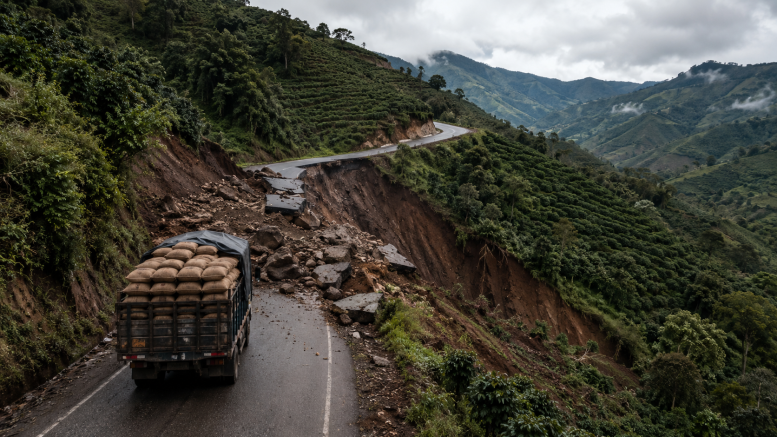
On August 10th, a 7.4-magnitude earthquake disrupted Colombia’s main coffee transportation route to the Port of Buenaventura, which handles approximately 60% of the country’s coffee exports. Port terminals temporarily halted operations for inspections and landslides blocked access roads, prompting cargo to be rerouted through Caribbean ports. Arabica coffee futures reached multi-week highs amid concerns over Colombian supply, which is used by major global buyers including Starbucks. (FNC)
In 2026, Grupo Nutresa is advancing a corporate reorganization to incorporate JGDB Holding and Nugil, vehicles used by Grupo Gilinski in the ownership structure of the company. The reorganization follows the transaction that allowed Grupo Gilinski and the United Arab Emirates-based International Holding Company to take control of Nutresa. The public tender offer carried out during the acquisition process involved approximately US$ 1.23 billion for a 22.48% stake, with 102.9 million shares tendered at US$ 12 each. The transaction also involved the exit from stakes in Grupo Sura. (Grupo Nutresa)

The Federal Government and the State of Sinaloa began incentive payments for 26,800 white corn farmers. The program covers 3.5 million tonnes produced on 348 K hectares and provides approximately US$ 266.4 million. (Government of Mexico)

Panama approved US$ 6.1 million in fiscal incentives for 22 agricultural export companies. Resources cover 136 applications across seven agricultural supply chains. Vice Minister of Agricultural Development José Aníbal Rincón chaired the approval. (MICI)


August will be decisive in determining the intensity of El Niño and the impacts on the 2026/27 season in Paraguay, according to Eduardo Sierra, agroclimatic advisor to Capeco. The temperature anomaly in the Pacific is 1.5°C above normal, indicating a strong or very strong El Niño but still below the level associated with a Super El Niño. The evolution of the phenomenon from August 2026 through April 2027 will depend on developments over the coming weeks. (Capeco)

Agricultural exports reached US$ 5.42 billion in 1H26 (+3.3%). Avocados led shipments at US$ 933.3 million, followed by fresh grapes at US$ 789.3 million. (ADEX)

Goods exports reached US$ 1.22 billion in July (+4%). Soybean shipments decreased 57%, to US$ 86 million, while total sales to China declined 35%, to US$ 235 million. (Uruguay XXI)

READ MORE: