
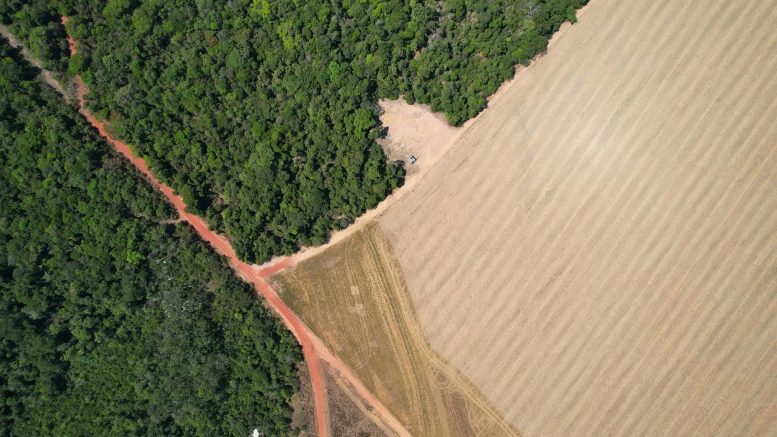
Brazil Structures Project to Restore Degraded Land in the Amazon
Brazil
The Finance and Taxation Committee of the Brazilian Lower House of Congress approved a bill that establishes payments to farmers, traditional communities and indigenous people for wildfire prevention and firefighting actions on rural properties. The proposal seeks to expand the scope of Brazil’s Federal Payment for Environmental Services Program. It still requires approval by the Constitution and Justice Committee and the Senate to become law. (Agência Câmara de Notícias)
Environmental agencies and prosecutors from the State of Mato Grosso do Sul launched a new strategy to prevent and investigate wildfires in the Pantanal, including real-time satellite monitoring and immediate field investigations. Authorities said farms linked to fire outbreaks will face direct investigation, with a focus on criminal accountability and faster enforcement actions. (MPMS)
The Federal Government delivered specialized trucks, 4×4 vehicles and wildfire-fighting equipment acquired through a US$ 30.4 million investment from the Amazon Fund to strengthen prevention and response efforts in the Cerrado and Pantanal biomes. The resources will support fire departments in five States, the Federal District and the National Force, expanding wildfire response capacity. (MMA)
BTG Pactual granted a US$ 300 million loan to Bracell, controlled by Singapore’s Royal Golden Eagle group, to convert 54 thousand hectares of degraded areas into eucalyptus farms in the State of Mato Grosso do Sul. The transaction is part of the second auction of Eco Invest, a blended finance program that combines subsidized public capital and private funding for the productive recovery of degraded areas; the company will have to meet socio-environmental requirements, including proof of degradation, no deforestation since 2023 and soil carbon monitoring. (BTG Pactual)
For the first time, all 224 municipalities in the State of Piauí joined the 2026 Environmental Seal process linked to Brazil’s Ecological ICMS program, a tax revenue-sharing mechanism that rewards local environmental initiatives. The milestone expands the reach of sustainability policies across the state and strengthens actions focused on conservation and waste management. (Semarh-PI)
Brazil’s National Monetary Council approved changes in the environmental rules governing access to rural credit, extending compliance deadlines according to farm sizes. The regulations require banks to verify potential cases of illegal deforestation on rural properties, while also allowing additional documents to prove environmental compliance. (MAPA)
Brazil’s Federal Prosecutor’s Office (MPF) and the Ministry of the Environment and Climate Change advanced discussions on banning the use of mercury in gold mining in the Amazon region. The MPF is pushing to revoke 1989 decrees that still allow the substance, which is considered highly toxic and linked to contamination of rivers, fish and Indigenous and riverside communities. The government is also discussing the creation of a national mercury environmental monitoring network. (MPF)
Study conducted at the Rio de Janeiro Botanical Garden Research Institute identified 94 stingless bee nests belonging to 13 species in urban green areas of the city. The research highlights urban parks and ecological corridors can serve as refuges for pollinators amid the loss of natural habitats. Researchers also observed the bees adapting to urban structures such as walls and monuments, reinforcing the importance of conserving connected green areas in the Atlantic Forest. Available at: https://www.scielo.br/j/rod/a/Mn36zhy96hpp8NGCKfXrWmL/?lang=en. (Rio de Janeiro Botanical Garden)
One-third of Brazilian farmers say they are familiar with the carbon credit market, while 24% of them already participate in related initiatives, according to a survey by the Brazilian Rural Marketing and Agribusiness Association. Conservation of natural areas was identified as the main practice adopted, followed by sustainable farming techniques and reforestation efforts. The survey also showed that 86% of farmers believes climate change will impact agriculture. (ABMRA)
The State of Santa Catarina launched the Mais Verde [More Green] program, which will invest approximately US$ 14.2 million to reward small farmers for conserving native forests. The initiative could benefit up to 20 thousand properties and help protect approximately 100 thousand hectares through payments for environmental services focused on biodiversity conservation, water security and climate change mitigation. (Semae)
The Federal University of the State of Minas Gerais developed organic fertilizers from agro-industrial waste with the aim of reducing greenhouse gas emissions in agriculture. The technology uses materials such as cattle manure and sugarcane industry residues to produce more sustainable granular fertilizers. According to the researchers, the innovation may reduce the release of nitrous oxide (N₂O), a gas linked to global warming with a warming potential about 300 times greater than CO₂. The study resulted in a patent application and is considered a potential alternative to synthetic mineral fertilizers. (UFMG)
Pollination with the native mandaguari bee (Scaptotrigona depilis) can increase arabica coffee production by up to 67%. Research showed coffee plants located near the bee colonies had higher yields, reinforcing the species’ efficiency as a pollinator. The study also showed that the use of pesticides within technical recommendations caused no measurable damage to the monitored colonies. (Embrapa)
Brazil structured a project to recover degraded areas in 3 thousand rural properties in the Amazon, focusing on family farmers in 48 municipalities. The initiative foresees US$ 11.17 million in investments to restore native vegetation, recover forests and generate income. (MMA)
Suzano will invest US$ 5 million to modernize the plant in Três Lagoas, State of Mato Grosso do Sul, with the installation of a new oxidized white liquor unit. The project is expected to reduce input consumption, especially caustic soda, increase efficiency in pulp production and strengthen the sustainability of the operation, which has an annual capacity of 3.25 million tonnes. (Suzano)
Raízen launched campaign to prevent and fight fires in sugarcane farms during the 2026/27 season. The strategy includes monitoring more than 430 thousand hectares, 238 firefighting vehicles, over 600 firefighters, and the use of satellites, sensors, intelligence software and artificial intelligence cameras to anticipate risks. (Raízen)
Belterra Agroflorestas raised US$ 14.96 million in a round led by Bold.t, with participation of the companies MOV, Rise and Ecosia, to accelerate expansion in agroforestry systems. The startup combines forest restoration and cocoa farming, with expected revenue from agricultural sales and carbon credits, and already implements agroforestry systems on almost 2.5 thousand hectares. (Belterra Agroflorestas)

Latin America
The Government of Córdoba, Argentina, signed an agreement with SummaBio, a member of the Argentine Chamber of Bioinputs (CABIO), authorizing the commercial use of local genetic resources for the development of agricultural bioinputs. The initiative enables the creation of biotechnological products based on native microorganisms while establishing rules for access, biodiversity protection and the sharing of economic benefits with the province. (Government of Córdoba)
The regional government of Maule, Chile, declared the first environmental alert of 2026 in the cities of Talca and Maule due to poor air quality caused mainly by the residential use of wood-burning heaters. The measure includes restrictions on visible smoke emissions from homes and reinforces the ban on uncertified wood-heating systems. According to Chile’s Ministry of the Environment, the action aims to reduce levels of respirable particulate matter during the critical winter air pollution period. (MMA Chile)
The new regional secretary of the Environment for Atacama, Chile, David Olivares, said the region’s environmental management priorities will include recycling, circular economy initiatives and climate change adaptation. Among the announced initiatives are the “Un poquito es caleta” campaign, focused on environmental education and recycling, as well as conservation projects for high-Andean ecosystems in Alto del Carmen. According to Chile’s Ministry of the Environment, the region faces challenges related to water scarcity, prolonged droughts, rising temperatures and extreme rainfall events. (MMA Chile)
Colombia approved the first peasant forest concession, granting the sustainable use of approximately 23 thousand hectares of forest in Caquetá for 30 years to the Peasant Association for Forest Development and Amazonian Biodiversity. The measure benefits 423 families and seeks to strengthen bioeconomy, community-based forest management, and efforts to curb deforestation in the Colombian Amazon. (Colombia’s Ministry of Environment)
Colombia declared a Temporary Renewable Natural Resources Reserve Zone in the Almorzadero Páramo, protecting more than 151 thousand hectares between Santander and Norte de Santander. The measure, valid for four years and extendable for another two, bans new mining concessions and the expansion of the agricultural frontier, while preserving traditional activities carried out by peasant communities. (Colombia’s Ministry of Environment)
Peru presented the Joint Declaration of Intent 2026–2030, signed with Norway, Germany and the UK, as well as the Peru Country Package, to strengthen forest protection and climate action in the Amazon biome. The instruments seek to coordinate international cooperation, mobilize climate finance, reduce deforestation and support actions related to conservation, resilient activities and indigenous peoples’ rights. (Peru’s Ministry of Environment)
The International Finance Corporation announced a US$ 40 million financing package for Arboreal, a company based in Tacuarembó, Uruguay, that transforms certified wood into higher value-added industrial products and construction materials. The 2026–2028 project is expected to expand the company’s production capacity, support thermally modified wood and biomass briquette production, increase direct employment by 15%, and create approximately 185 temporary and indirect jobs across Uruguay’s forestry-industrial chain. (IFC)

READ MORE: