
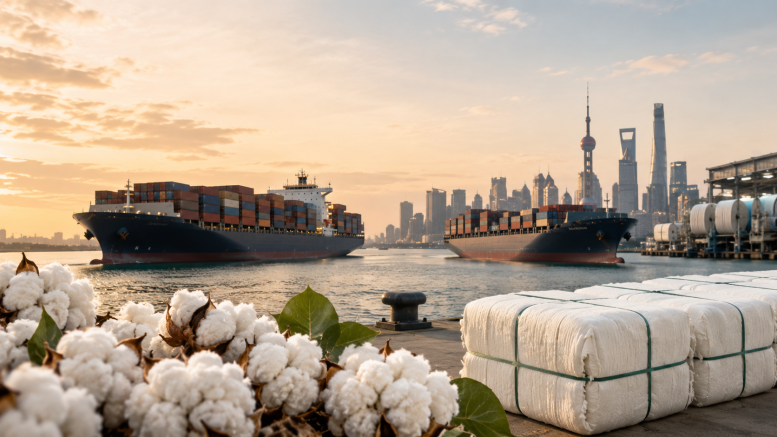
“China remains an important market, but Brazil has made significant progress in diversifying destinations…”
Marcelo Duarte Monteiro is the International Relations Director of the Brazilian Cotton Farmers Association and CEO of Asia-Brazil Agro Alliance. He holds a degree in Business Administration from the Federal University of Mato Grosso and a M.Sc. from FGV.

Marcelo Duarte, International Relations Director at Abrapa
AgriBrasilis – How did Asia become the main market for Brazilian cotton?
Marcelo Duarte – Asia’s consolidation as a destination for Brazilian cotton is the result of a structured movement developed over more than a decade. On one hand, there was the rapid growth of the Asian textile industry, especially in countries such as China, Vietnam, Bangladesh and Indonesia. On the other hand, Brazil made a coordinated effort to position itself as a reliable supplier.
Abrapa, in partnership with the National Cotton Exporters Association and the Brazilian Trade and Investment Promotion Agency, structured the Cotton Brazil program, which intensified the international promotion of Brazilian cotton through initiatives focused on attracting and retaining buyers. This allowed Brazil not only to expand its presence, but also to build direct relationships with spinning mills and trading companies, ensuring predictability and trust in supply.
The establishment of an advanced Cotton Brazil office in Singapore was a milestone in bringing us closer to major buyers and strengthening ties with the world’s largest consumers.
AgriBrasilis – Does Brazil still depend excessively on China, or has it already consolidated other markets?
Marcelo Duarte – China remains an important market, but Brazil has significantly advanced in diversifying destinations. We now have a much more balanced presence in countries across Southeast Asia, South Asia and even the Middle East. Vietnam, India and Bangladesh, for example, have become increasingly relevant.
This diversification reduces commercial and geopolitical risks while providing greater stability for exports. Therefore, although China remains relevant, Brazilian cotton is not excessively dependent on a single market.
AgriBrasilis – How does the Brazilian product compare with those from the U.S. and Australia in terms of quality and price?
Marcelo Duarte – Brazilian cotton is highly competitive in both aspects. In terms of quality, we have a consistent product with good fiber length, strength and uniformity, resulting from investments in technology, crop management and processing. Our HVI (High Volume Instrument) analysis laboratories ensure that customers on the other side of the world receive standardized cotton according to international quality benchmarks.
In terms of price, Brazil is usually competitive due to its large-scale production efficiency. Compared to the United States, we compete directly in quality and scale, while Australia also offers an excellent product, although with lower available volumes. Brazil’s key advantage lies precisely in the combination of quality, reliability and year-round availability.
AgriBrasilis – Is Brazilian logistics prepared to sustain cotton growth in the Asian market?
Marcelo Duarte – Logistics remains one of Brazil’s main challenges, although important progress has been made in recent years. Increased investments in port terminals, such as in Salvador, have contributed to greater efficiency.
The producing regions, especially in Mato Grosso and western Bahia, operate with planning alongside trading companies and ports. In addition, Abrapa implemented ABR-LOG, which extends certification and management practices to retro-port terminals.
There are still bottlenecks, especially in road transportation. To sustain export growth, it will be essential to continue investing in multimodal infrastructure and reducing logistics costs, which still affect competitiveness.
AgriBrasilis – What is the importance of sustainability, traceability and certification for the sector’s value creation?
Marcelo Duarte – These are pillars of Brazilian cotton’s positioning in the international market. Certifications such as the Brazilian Responsible Cotton (ABR) program and the Better Cotton Initiative certify our product according to strict environmental, social and economic sustainability criteria.
Traceability responds to growing demand from brands and consumers for transparency throughout the production chain. This not only adds value to the product, but also opens doors in more demanding markets, especially in Europe and in premium segments of the textile industry.
Circularity and socio-environmental compliance regulations have become commitments adopted by major brands and retailers toward consumers. As a result, certification is no longer just a competitive advantage — it is becoming a requirement for access to high-value markets.
AgriBrasilis – What impacts could the next crop have on exports?
Marcelo Duarte – The next crop is expected to keep Brazil in a prominent position in the international cotton market, with production surpassing 3 million tons and potential export growth compared to the previous year. However, this performance will still depend on factors such as weather conditions, international demand and price dynamics.
If strong productivity is confirmed, Brazil could further expand its share in global trade, especially if it continues advancing in market diversification and adding value through sustainability and product quality.
READ MORE: