
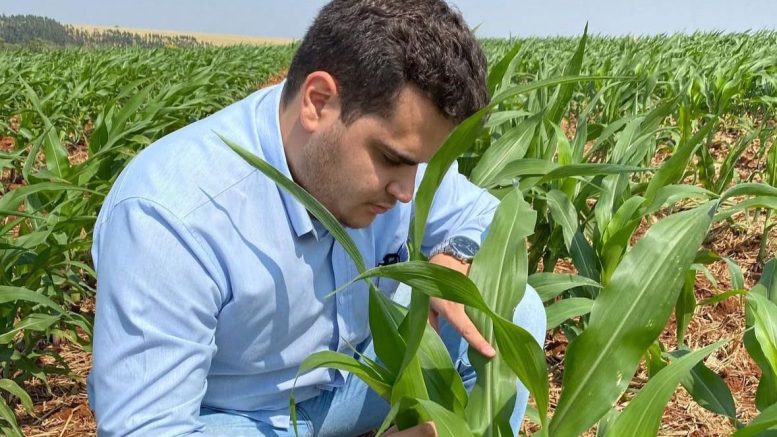
“Since I am a sugarcane farmer, I don’t have the luxury of choosing whether it’s worth producing in the harvest or not…”
Sérgio Santin is an agronomist graduated from São Paulo State University, a sugarcane farmer in the Piracicaba region, in the State of São Paulo, and a partner-owner of Agrícola e Transporte Santin. He works in the administrative and financial management of the Santin Group, which is involved in sugarcane production as well as harvesting and transportation services.
AgriBrasilis – What are the main difficulties and uncertainties for farmers in your region?
Sérgio Santin – The tax system and the upcoming tax reform. Although it is moving forward, no one can offer much certainty because there are several open issues, with clauses that change or are approved as the process moves along.
Labor. Qualified, dedicated, and committed labor for carrying out activities is becoming increasingly scarce in the countryside. Although technological advances are arriving, training in rural areas — except among those with higher education — is not evolving at the necessary pace.
The economic environment has also been a major source of uncertainty. With the current interest rate, it has become difficult for producers to finance their crops — because most work with financed capital. In the case of soybeans and sugarcane, prices are not at levels that guarantee comfortable margins; on the contrary, margins are tight. Next year is an election year, adding yet another layer of uncertainty to the current scenario.
Basically, that’s it: taxation, high interest rates for crop financing, the use of available credit — sometimes subsidized by the government, but insufficient to cover the necessary amount — which forces producers to resort to more expensive financing options.
AgriBrasilis – What is the current situation regarding access to credit?
Sérgio Santin – Access to credit is very difficult. The rules and requirements for obtaining credit are becoming increasingly strict. In the past, it was possible to use an agricultural pledge, in which the crop itself was given as collateral for the operation. Due to the increase in bankruptcy and judicial recovery cases in recent years, banks have faced high levels of default — not only from farmers, but also from major players.
Even with real collateral, the percentage the bank financed used to be higher; now, it is based only on the forced-sale value. So, collateral worth US$ 921 thousand allows you to obtain only around US$ 184 thousand. And I don’t believe this situation will change as long as Brazil remains in its current condition.
AgriBrasilis – Is it worth producing this year’s harvest? What is the situation with production costs?
Sérgio Santin – Since I am a sugarcane producer, I don’t have the luxury of choosing whether it’s worth producing in a given season or not. What I mean by this is that, in the case of soybeans and corn, you harvest in four months and the cycle is over. Sugarcane doesn’t work that way.
Of our current area — around 5 thousand hectares — we renewed between 700 and 800 hectares this year. Because of that, I can say that yes, it is worth producing. However, this is due to the structure we already have. If we didn’t opt for renewal, that entire structure could be compromised. As for area expansion, we had none this year.
Regarding production costs, the price of sugarcane next year should remain at current levels, maybe with a slight drop. At the moment, the ATR kilogram is around R$ 1.10 and may fall to R$ 1.00. In 2027, it should begin to recover, and in 2028, show a slightly higher value — based on the futures market, unless something occurs that strongly impacts the market.
AgriBrasilis – When and how do you decide what to plant, the size of the area and the timing for purchasing inputs?
Sérgio Santin – Since we are sugarcane farmers, we work with longer-term contracts. Thus, instead of making annual decisions, we already set commitments for the next 4 to 7 years. Often we sign contracts within that period — because about 99% of our land is leased. We always choose longer contracts, with the possibility of renewal.
The purchasing window varies considerably. We always try to take advantage of the best conditions at certain times of the year, when we know there will be attractive fairs and special commercial offers. We are served mainly by Coplacana (about 80%), and events like Coplacampo, in February, and Agrishow, in May, often offer good negotiating opportunities.
Since sugarcane requires many inputs, besides those purchases at the start of the year, there are also input-packages negotiated toward the end of the year, as needs arise.
All these purchases are based on studying the crop’s potential and the available conditions — such as payment methods, deadlines, interest rates, and farm size.
AgriBrasilis – What new technologies and practices have you been adopting?
Sérgio Santin – The most significant innovation adopted recently was mechanized planting. Planting used to be entirely manual and was once carried out with seedling distributors, but that model did not evolve. This year, we acquired a specific planter and began operating in a mechanized system.
Another important and innovative change was modifying the ratoon-cutter: previously, we used the 3-row model, and now we have switched to the 2-row model. This adjustment was necessary to align with the furrower and ensure greater parallelism, especially because our fields are not uniform. The change increases operational accuracy, even though it slightly reduces operational efficiency.
In addition, we use field systematization in all our crops and GPS on all harvesting machines and on the furrower, which improves operational precision and field utilization.
We have also hired drone applications — whether for foliar spraying, ripening, or spot treatments — expanding both the quality and reach of operations.
Another practice is applying insecticide together with liquid fertilizer, replacing application through the ratoon-cutter. This technology is still under validation, as it depends on the compatibility of the products used. Liquid fertilization gives us the possibility of incorporating pesticides into the process when technically appropriate.
In the administrative area, we use management software to improve financial control, monitor costs more accurately, and guide investments.
On top of all this, we have intensified the use of biological products — such as nematicides, foliar fungicides, and applications of Beauveria bassiana for controlling the sugarcane weevil (Sphenophorus levis).
READ MORE: