
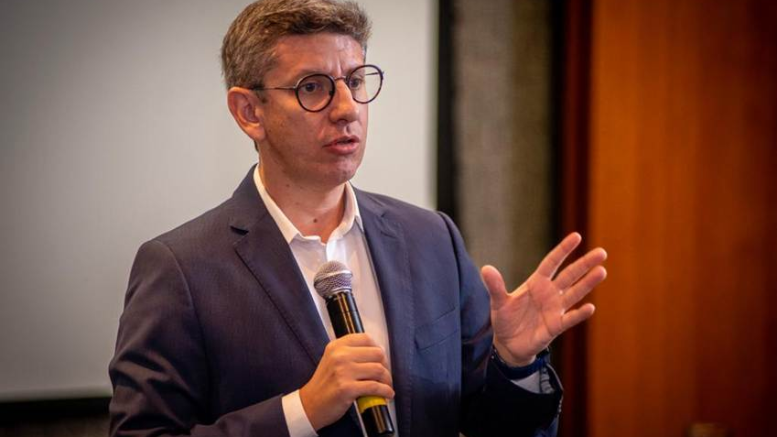
“Around 90% of our customers continue to meet their financial obligations on time…”
Alberto Martinhago has been director of Agribusiness and Family Farming at Banco do Brasil, a state-controlled bank and Brazil’s largest agricultural lender, since October 2024 and is a career employee of the institution. Martinhago holds a degree in Business Administration from Fundação Educacional Barriga Verde, a specialization in Customer Experience Management from ESPM and an MBA in Finance, Auditing and Controllership from FGV. Martinhago also attended the Advanced Management Program at ISE Business School.
AgriBrasilis – Why have farm loan delinquencies increased in Brazil?
Alberto Martinhago – The increase in farm loan delinquencies over the past few years affects the entire financial sector and results from a combination of factors. Between 2020 and 2023, for example, we experienced a very favorable cycle, with rising commodity prices generating high margins for farmers. This encouraged investment in land, machinery, technology and production expansion, leading to higher leverage and debt levels.
When prices returned to normal, some costs remained high, squeezing margins for some farmers. In addition, we faced the impact of weather events and rising interest rates, particularly on loans at market rates.
However, I think it is important to put this situation into perspective. Delinquencies affect only a portion of farmers. Around 90% of our customers continue to meet their financial obligations on time. These farmers continue to borrow and invest to keep producing and contributing to the Brazilian economy.
AgriBrasilis – What are the prospects for recovery in loan portfolio quality? How is debt restructuring progressing?
Alberto Martinhago – Banco do Brasil has been working on two fronts: supporting the financial restructuring of those who genuinely need it and intensifying debt collection efforts among those who have the ability to repay.
In addition to the ongoing options for extending repayment terms under Brazil’s Rural Credit Manual (MCR), which sets out rural lending rules, we had important debt restructuring instruments over the past year, such as Provisional Measures No. 1,314 and No. 1,376 [executive measures with immediate force of law in Brazil].
Through Provisional Measure No. 1,376 alone, which expired on November 12th, 2026, we renegotiated R$ 13.4 billion, serving more than 7.7 K customers. The terms allowed repayment periods of up to ten years, including a two-year grace period, at interest rates ranging from 5% to 12%, depending on the size of the farming operation and the percentage of losses.
We expect the combination of debt restructuring, loan recovery and the results of upcoming crop seasons to gradually improve loan portfolio quality. We always emphasize that farmers experiencing difficulties need to talk to the bank. We have specialized teams and will assess each situation individually to find an alternative that allows farmers to reorganize their cash flow and continue producing. I always say that Banco do Brasil has a solution for every customer willing to negotiate or renegotiate. I also have a message and an appeal to farmers who are behind on payments, experiencing financial difficulties or facing crop losses. Contact Banco do Brasil so that together we can find a solution to preserve your capacity to generate jobs and income and produce food and fiber.
AgriBrasilis – How have rising loan delinquencies affected lending criteria and collateral requirements?
Alberto Martinhago – We are taking a more rigorous approach to loan origination. We have improved our credit assessment models and are paying even closer attention to cash flow, debt levels, customer history, type of agricultural activity and region, while also strengthening collateral requirements.
Fiduciary transfer of ownership, a form of collateral in which legal title to an asset is transferred to the lender as security for a debt, has become increasingly important in this process. The loan portfolio currently includes R$ 61 billion secured by this type of collateral, and approximately 89% of disbursements under Brazil’s annual agricultural financing plan (Plano Safra), which began in July, are backed by this form of security.
It is important to make clear that this does not mean closing the door to credit. Banco do Brasil continues to support and finance agricultural activity. More selective lending and more rigorous credit assessments protect the bank and also prevent farmers from taking on debt beyond their ability to generate cash flow.
AgriBrasilis – How has access to credit evolved for small and medium-sized farmers, particularly under Brazil’s government-backed credit programs for family farming (Pronaf) and medium-sized farmers (Pronamp)?
Alberto Martinhago – Under Pronaf, Banco do Brasil disbursements in the 2026/27 crop season are in line with the volume financed during the same period of the previous crop season. Among medium-sized farmers, a significant portion of this season’s operating loans was disbursed in advance during the 1H26. When these loans are taken into account, the amount allocated to the current season is also in line with the previous crop season.
Family farmers are a very important customer segment for Banco do Brasil and are fundamental to Brazilian agriculture. Pronaf (National Program for Strengthening Family Farming) is a policy that has helped small farmers expand, generate income and remain in farming. Many farmers who now operate on a larger scale started out in family farming. Our strategy is to maintain and expand access to credit for those with the ability to repay and economically sustainable projects, from family farmers to large-scale farmers, including agro-industrial companies and cooperatives.
AgriBrasilis – What explains the decline in loan disbursements under Brazil’s 2026/27 agricultural financing plan (Plano Safra)?
Alberto Martinhago – The main explanation is lower demand from commercial farming operations. In this segment, we have observed a decline of nearly 50%, a trend also seen across the rest of the market. This reflects a combination of lower demand for bank loans and efforts by farmers to reorganize their cash flow before taking on new financial commitments.
However, despite the decline in lending, we are observing that planted area and expected yields indicate that the sector is maintaining production capacity and generating wealth for Brazil.
AgriBrasilis – What are the prospects for agricultural financing in Brazil in 2027?
Alberto Martinhago – We are optimistic about 2027, even though it is expected to be a year of transition. Brazilian agribusiness is maintaining production capacity, and farmers have demonstrated, season after season, a tremendous ability to overcome challenges. With more rigorous lending, solutions for those who need to restructure their finances and Banco do Brasil standing alongside each customer, we have everything we need to begin a new cycle of sustainable growth, generating jobs, income and food for Brazil and the world.
READ MORE: