
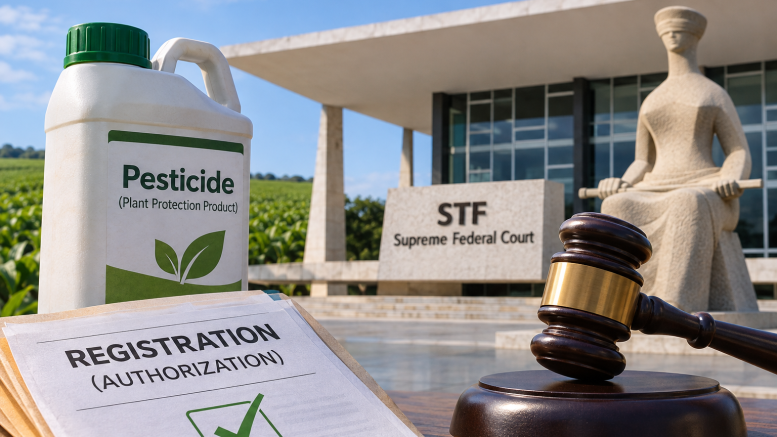
The Brazilian National Confederation of Industry (CNI) has filed a case before the Federal Supreme Court (STF) seeking to limit the authority of the Labor Prosecutor’s Office (MPT) and Labor Courts in proceedings challenging federal registrations and authorizations for pesticides, chemical products and pharmaceuticals. Direct Action of Unconstitutionality (ADI) 8046 was assigned to Justice Cristiano Zanin.
The initiative comes amid legal disputes involving active ingredients such as glyphosate and atrazine. In May, the Labor Prosecutor’s Office filed a lawsuit against Anvisa and the federal government seeking to ban glyphosate in Brazil, including the cancellation of existing registrations and a prohibition on the production, import, export, commercialization and use of products containing the active ingredient.
In September, a Brazilian Labor Court ordered a 90-day suspension of new registrations and authorizations for glyphosate-based products, including registrations by equivalence, identical products and phytosanitary use extensions. The decision did not cancel existing registrations or impose a general ban on the herbicide.
In an interview with AgriBrasilis, labor prosecutor Leomar Daroncho, a member of the MPT Working Group on Pesticides, defended the review of glyphosate authorization and stronger assessments of occupational health risks.
Another dispute involves atrazine. In a lawsuit initiated by the MPT in 2023, a Labor Court initially ruled that it lacked jurisdiction to examine the request to cancel registrations of the herbicide. However, a subsequent ruling by the Regional Labor Court of the 10th Region recognized Labor Court jurisdiction to examine the case. The controversy comes amid increasing litigation involving the active ingredient, also addressed by AgriBrasilis in an interview with Sindiveg on the use of atrazine.
In the case filed before the STF, CNI argues that Labor Courts should handle matters related to workers’ health and safety but lack jurisdiction to suspend or invalidate authorizations granted by federal regulatory authorities, such as the Ministry of Agriculture and Livestock (MAPA) and the Brazilian Health Regulatory Agency (Anvisa), with nationwide effects on the market.
The confederation requests that disputes concerning the validity of these registrations be heard by Federal Courts. The ruling could establish limits on Labor Court authority over regulatory decisions with nationwide implications, potentially affecting pesticide manufacturers, importers and registration holders.
Justice Cristiano Zanin has requested information from the Presidency of the Republic and the National Congress. The STF has not yet issued a final ruling on the case.
Source: Federal Supreme Court (STF) – 11/16/26. Official STF announcement