
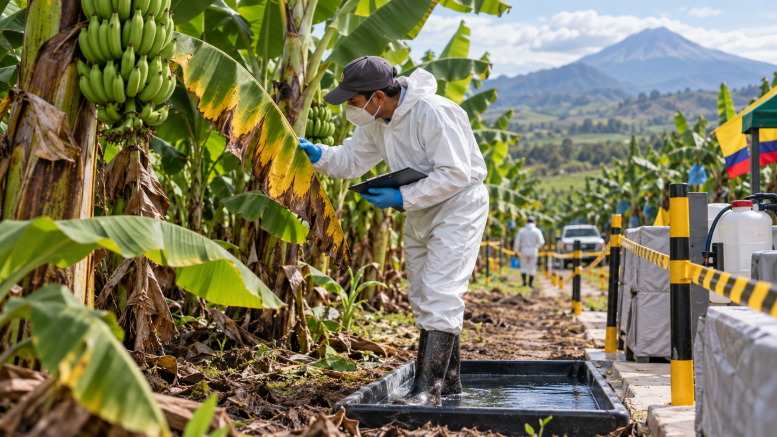
Ecuador Tightens Measures Against Fusarium TR4 in Bananas
Brazil
The Integrated Agricultural Development Company of Santa Catarina determined that, after 1/1/27, the Agricultural Defense Management System of Santa Catarina (SIGEN+), used to register and manage agricultural defense information in the State, will automatically reject agronomic recommendation documents without valid geographic coordinates for the pesticide application site. The georeferencing requirement is already established under state legislation, but the system had temporarily allowed data submission without the coordinates. (Cidasc, Technical Note No. 07/2026 – 10/6/26)
Maurício Buffon resumed the presidency of Aprosoja Brasil on 10/12/26 after a temporary leave. Lucas Beber returned to the association’s vice presidency. (Aprosoja Brasil – 10/9/26)
Fertilizer deliveries to the Brazilian market decreased 22.3% in July to 3.96 million tonnes. From January through July, deliveries declined 8.8% to 22.98 million tonnes. Domestic production of intermediate fertilizers fell 19.7% during the period to 3.34 million tonnes. (ANDA – 10/5/26)
The Court of Justice of the State of Acre extended to the entire União III farm in Rio Branco city the prohibition on the application of pesticides, herbicides, desiccants and similar products by drone until a new court ruling. The restriction, initially imposed on 9/23/26 for disputed areas, permanent preservation areas, embargoed sites, waterways and their surrounding zones, was expanded after technical records indicated that herbicide drift from drone application reached 49.01 ha of permanent preservation areas. The court also ordered the State and the municipality to inspect, within ten days, water sources used by families in the Seringal São Bernardo area and provide safe water if there is technically supported suspicion of contamination. (State of Acre Public Prosecutor’s Office – 10/8/26)
Anvisa rejected the toxicological evaluation of a post-registration request for Beauveria bassiana IBCB 66 25 g/kg + Cordyceps javanica IBCB 638 70 g/kg WP from Gênica. (Official Gazette of Brazil, Resolution RE No. 4006 of 10/8/26 – published on 10/13/26, Anvisa)
MAPA provisionally reinstated registration No. 6105 for Syngenta’s Engeo Pleno S insecticide, thiamethoxam + lambda-cyhalothrin, following a Federal Court ruling suspending the cancellation. Registration remains valid for the approved formulation until the Special Committee for Agricultural Defense Appeals issues a new decision on replacing the penalty with a fine and signing a conduct adjustment agreement. The measure does not revoke or annul the original cancellation. (Official Gazette, Act No. 63/2026 – published on 10/13/26; MAPA)
MAPA appointed Alessandro Roberto Silva de Oliveira as acting head of the General Coordination of Pesticides and Related Products from 10/14/26 to 10/25/26. (MAPA – 10/9/26)
BioFirst Group acquired the remaining 14.71% of Biotrop’s shares, bringing its ownership to 100% of the Brazilian biologicals company. The shares were acquired from shareholders including Aqua Capital and Zempar. According to the company, the transaction is expected to accelerate Biotrop’s integration and expand synergies across the biological crop protection portfolio. The transaction value was not disclosed. (BioFirst Group – 10/5/26)
Brazil Potash tested AI-powered X-ray transmission ore sorting technology to remove lower-grade material before processing at the Autazes potash project in the State of Amazonas. In a sample containing approximately 13% KCl, the system separated about 20% of the lower-grade material, increasing the KCl concentration of the portion sent for processing to approximately 27%. According to the company, pre-sorting could increase the plant capacity for potash-rich ore and potentially raise production or extend mine life. Results are preliminary and are subject to additional testing and technical and economic studies. (Brazil Potash – 10/13/26)
The Agricultural Defense Agency of the State of Piauí established a transition period through March 2027 for family farmer registration through the Agricultural Defense System of Piauí (Sidapi) for pesticide purchases. Farmers holding a National Family Farming Registry (CAF) may present a copy of the document instead of completing the system registration during the period. Agronomic prescriptions and inventory control remain mandatory. (Adapi – 10/6/26)
Fertilizer companies requested US$ 581 million in credit through the “Brasil Soberano” program until October 1st, 2026. A total of 62 companies submitted requests, with the Brazilian Development Bank approving approximately US$ 341 million in 65 transactions and disbursing approximately US$ 40.1 million. In the previous update, requests totaled approximately US$ 341 million and approvals reached approximately US$ 147 million. (BNDES – 10/8/26)
Brazil imported 3.11 million tonnes of chemical fertilizers in September, down 27.9% from the same month of 2025. Import value fell 24.1% to US$ 1.18 billion, while the average price increased 5.3% to US$ 378.90/tonne. (MDIC – 10/6/26)
Anvisa approved, in compliance with a court decision, the toxicological evaluation of prothioconazole 300 g/L FS from Zhongshan. (Official Gazette of Brazil, Resolution RE No. 4003 of 10/8/26 – published on 10/13/26, Anvisa)
The Brazilian Association of Bioinputs ended activities and stated that members will join the Associated Group for Sustainable Agriculture. According to the association, the affiliates will continue working to develop the Brazilian bioinput market, particularly production for on-farm use. (Abbins – 10/7/26)
The ag cooperative Frísia started construction of a facility in Pium, State of Tocantins, with planned investment of approximately US$ 20 million. The unit will store 42 K tonnes of grain, receive up to 600 tonnes/hour and process 240 tonnes/hour. It will include an ag input warehouse. Completion is scheduled for January 2028. (Frísia – 10/9/26)
Embrapa presented final results from the Pluricana sugarcane research project, which included genetic improvement, bioinputs and crop management recommendations. Results include 14 drought-tolerant materials, models for predicting sugar content with reliability above 90% and 456 genotypes mapped, preserved and digitized in a germplasm bank. (Embrapa – 10/8/26)
Researchers at the Federal University of Lavras advanced the standardization of laboratory rearing of the earwig Doru luteipes, a predator used in biological pest control. Packages with a single egg clutch showed lower total egg cannibalism and higher early nymph survival. The study provides guidance for scaling up rearing of the insect, a natural enemy of fall armyworm (Spodoptera frugiperda). (UFLA; BioControl – 10/7/26)
The rural extension service in the State of Rio Grande do Sul expanded the Asian soybean rust monitoring network to 100 locations for the 2026/27 season. The program uses AI to support identification of Phakopsora pachyrhizi spores and is developing a tool to send results to farmers by mobile phone. Monitoring began on October 5th, 2026 and sampling will continue through March 8th, 2027. (Emater/RS-Ascar – 10/9/26)
Fundecitrus, a Brazilian citrus protection research organization, recommended intensifying psyllid control in the State of Minas Gerais during rainy periods and periods of new growth, and rotating insecticides with different modes of action to manage citrus greening. For citrus canker, it presented regional survey results, recommendations for copper-based products and tests with alternatives. (Fundecitrus – 10/9/26)
Anvisa approved the toxicological evaluations of new microbiological products based on Trichoderma yunnanense (Iharabras), Trichoderma asperelloides and Trichoderma yunnanense (Total Biotecnologia); and a new formulated product based on octanoic acid + decanoic acid + D-limonene (Total Biotecnologia). (Official Gazette, Resolution RE No. 4004 of 10/8/26 – published on 10/13/26, Anvisa)

Latin America
Vylor, the new independent seeds and genetics company created from the Corteva spin-off, appointed Christian Meyer Pflug as Licensing Leader and Renan Elias as Project Manager and Planning Leader for Latin America. (Vylor – 10/5/26)
The average international price of urea fell 6% in the week of October 1st–8th to US$ 419/tonne FOB, according to fertilizer consultancy Ingeniería en Fertilizantes. The decline followed an Indian tender with the lowest prices in two years and an additional export quota released by China. Buyers in Latin America postponed spot purchases in anticipation of further declines. (Ingeniería en Fertilizantes – 10/10/26)
Argentina is evaluating mustard cultivars as biofumigants to manage nematodes, phytopathogenic fungi and weeds in horticultural and broadacre systems. Biomass decomposition releases isothiocyanates, compounds with biocidal activity. Previous tomato trials reduced nematode and fungal populations. The strategy also seeks to reduce chemical input use and increase soil organic matter. (INTA – 10/9/26)
The Mendoza Institute of Agricultural Health and Quality in Argentina began two consecutive aerial spraying operations against Lobesia botrana on October 14th, 2026 across approximately 90 K hectares of vineyards in the Northern and Eastern oases. Approximately 10 K hectares are expected to receive drone applications. The 2026/27 pest control program benefits more than 9 K farmers. (Iscamen – 10/12/26)
The Agricultural and Livestock Service of Chile stated Indonesia recognized the country as free from Mediterranean fruit fly (Ceratitis capitata). Fruit from areas recognized as pest-free can enter the Indonesian market without in-transit cold treatment. Products from regions affected by outbreaks may retain access through phytosanitary treatment. (SAG – 10/8/26)
The Agricultural and Livestock Service of Chile and the National Service for Agrifood Health and Quality of Argentina conducted their first joint phytosanitary inspection of tomatoes for export through the Jama border crossing. The procedure provides an alternative to Los Libertadores and seeks to reduce inspection and transportation times. Shipments must originate from an area free from Rhagoletis tomatis and be free from Pseudococcus calceolariae and Symmetrischema tangolias. (SAG – 10/10/26)
In Chile, the Center for Advanced Studies in Fruit Farming incorporated international protocols to identify Fusarium races associated with cucurbit crops following training at GEVES, a French public center specializing in varietal evaluation and seed health. The work included pathogenicity tests of Fusarium oxysporum in melon and is expected to expand capacity for varietal resistance testing and molecular identification of pathogens. (CEAF – 10/7/26)
The Foundation for Agricultural Innovation of Chile is supporting a Bioprot project to turn organic waste into biofertilizers and animal feed protein using mealworms. The company is developing the bioconversion system in Caleta Los Verdes, Tarapacá region, 24 km from Iquique. (FIA – 10/5/26)
Chrysanthemum exports from Colombia to the USA will face reduced phytosanitary requirements starting in November, after white rust (Puccinia horiana) was no longer classified as a quarantine pest. The change eliminates disease-specific requirements for cut flowers and will allow exports of cuttings and in vitro plantlets under a systems approach. Colombia supplies approximately 98% of chrysanthemum imports into the USA and flower exporters’ association Asocolflores estimates an economic benefit exceeding US$ 6 million. (Ministry of Agriculture and Rural Development – 10/8/26)
The Colombian Agricultural Institute strengthened surveillance against the giant African snail (Lissachatina fulica) in San Andrés after collecting about 50 kg and identifying new affected areas. The invasive species feeds on a wide range of plants, can damage crops and spreads rapidly. (ICA – 10/9/26)
The MoA of Costa Rica opened up a precision agriculture program for potato, onion and carrot farmers with 0.5–1 hectare of cultivated area. Non-repayable funds may finance irrigation, pumping systems, sensors and other equipment. The program includes soil and plant analyses to guide management and fertigation training. Applications remain open through November 30th, 2026. (MAG – 10/12/26)
In Ecuador, the Agency for Phyto and Zoosanitary Regulation and Control strengthened measures to contain Tropical Race 4 of Fusarium oxysporum f. sp. cubense, a fungus that causes banana wilt and can remain in the soil for long periods. Measures are focused on El Quemado, El Oro province, where the agency expanded isolation of the affected area and reinforced barriers to prevent the pathogen from spreading. (Agrocalidad – 10/8/26)
In Mexico, four brigades carried out control operations against Central American locust (Schistocerca piceifrons) across approximately 700 hectares in San Luis Potosí using targeted applications, drones and sprayers. A phytosanitary barrier between Rayón, Lagunillas and San Ciro de Acosta contained the pest before it reached agricultural areas in Rioverde and Ciudad Fernández. Surveillance remains active. (Secretariat of Agricultural Development and Water Resources – 10/9/26)
The microbial biofertilizer company Biofábrica Siglo XXI, from Mexico, was invited by the Ministry of Agriculture to participate in initiatives in Sonora and Sinaloa to expand biofertilizer use in corn and wheat during the next autumn–winter crop cycle. The initiative is linked to farmer support programs, including subsidies for these inputs. (Biofábrica Siglo XXI – 10/9/26)
In Mexico, the government of Guerrero trained farmers to produce insecticidal soap based on potassium salts of fatty acids for contact pest management in corn and fruit crops. Target pests include whiteflies, aphids, scale insects, thrips and mites. The initiative enables farmers to produce the input themselves and seeks to reduce dependence on synthetic pesticides and chemical residues in crops. (Government of Guerrero – 10/12/26)
The government of Tamaulipas, Mexico, delivered more than 359 tonnes of fertilizers to citrus farmers from October 5th – 9th. Deliveries included 77.45 tonnes for farmers in Güémez and Hidalgo, more than 183 tonnes in another distribution in Hidalgo and 99 tonnes for 321 farmers in Llera. The deliveries are part of the 2026 Productive and Economic Development Support Program. (Government of Tamaulipas – 10/9/26)
In Uruguay, high risk of Fusarium head blight in wheat expanded to virtually the entire grain-farming region, according to consulting firm Unicampo. High humidity, wet heads for several days and favorable temperatures increased the risk. The firm recommends preventive applications of triazole fungicides and their combinations and advises against strobilurins for disease management. Difficult farm access also increased demand for aerial and drone applications. (Unicampo; INIA GRAS; Inumet – 10/12/26)

READ MORE: