

“…seven companies account for 48.47% of approvals [obtained after lawsuits]: Rainbow (45), Cropchem (34), Tecnomyl (27), CHDS (14), Perterra (14), Adama (12) and Proregistros (12)…”
Flavio Hirata is a partner at AllierBrasil and founder of look2agro™, agronomist from Esalq/USP, MBA and specialist in pesticide registration.
AllierBrasil is a consulting firm specialized in pesticide registration. For more than 25 years, it has promoted agribusiness in Brazil and abroad. Organizer of Forum AllierBrasil in India, Vietnam and China.

Flavio Hirata, partner at AllierBrasil and founder of look2agro™
The use of lawsuits to expedite pesticide registration evaluations has become part of the regulatory process in Brazil, where approval timelines remain very long. In a highly competitive market, every crop season that a pesticide registration request remains in the evaluation queue means lost revenue for companies.
Companies have mainly resorted to lawsuits seeking urgent interim relief, which is a temporary court order granted before the final decision to prevent harm caused by delay. Also, in a minority of cases, companies have resorted to “writ of security”, a specific Brazilian legal remedy, usually with a request for a preliminary injunction. Both of these legal tools may allow a judge to order a provisional measure before the final decision when there is a likelihood that the claimed right exists and a risk of harm caused by delay. The difference is an action to compel performance is filed against the agencies responsible for the delay, while this specific remedy has additional legal requirements, including identification of the public authority responsible for the allegedly illegal or abusive act. In pesticide registration cases, these measures may be used to order Anvisa, Ibama or MAPA to complete the evaluation of the registration request.
Between 2021 and 2025, 352 registrations of chemical formulated products were approved following lawsuits involving at least one of the agencies responsible for the evaluation. The number rose from 51 registrations in 2021 to 94 in 2025, an increase of 84.3%. Of the total, 326 were generic formulated products (FP/ETP), representing 92.6% of registrations approved following lawsuits. These products are based on equivalent technical products and help increase competition and the number of alternatives available in the market.
Share of Registrations Approved After Lawsuits
FP/ETP – Generic Formulated Products (2021–2025)
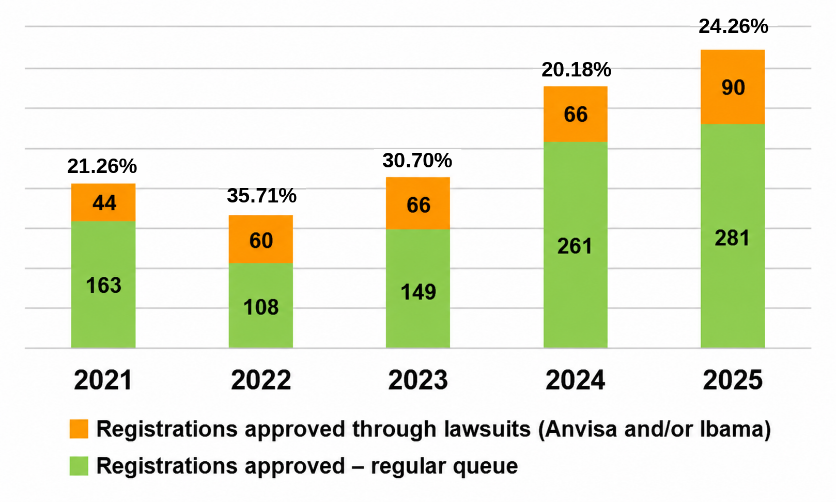
According to a survey by AllierBrasil, 25.31% of generic formulated product registrations approved between 2021 and 2025 involved lawsuits against at least one of the regulatory agencies, Anvisa or Ibama. In 2021, 44 registrations involved litigation, equivalent to 21.26% of the 207 generic products approved. In 2022, the share reached the highest level of the period, with 60 registrations, or 35.71% of a total of 168. In 2023, there were 66 registrations (30.70% of 215); in 2024, another 66 (20.18% of 327); and in 2025, 90 registrations (24.26% of 371).
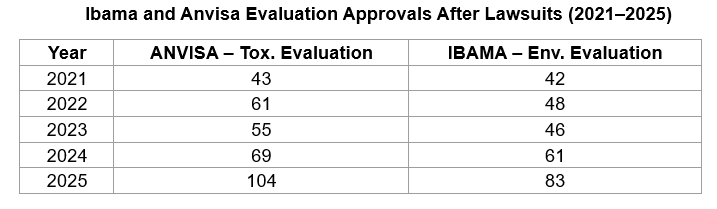
The increase in litigation was also reflected in the number of evaluations completed by regulatory agencies. Between 2021 and 2025, toxicological evaluations of chemical formulated products approved by Anvisa after lawsuits increased 141.9%, from 43 to 104. In case of Ibama, approvals of environmental evaluations resulting from court decisions increased 97.6%, from 42 to 83.
The difference in approval timelines is significant. Among registration requests subject to lawsuits, the share of generic formulated product registrations that took six years or more for approval decreased from 41.84% to 12.36%, while those taking five years or more declined from 59.57% to 31.46%. As a result, the lawsuits reduced the average approval timeline by approximately 1.5 year. Litigation accelerates individual registrations but does not resolve the regulatory backlog.
Registrations Approved After Lawsuits by Company
FP/ETP – Generic Formulated Products (2021–2025)
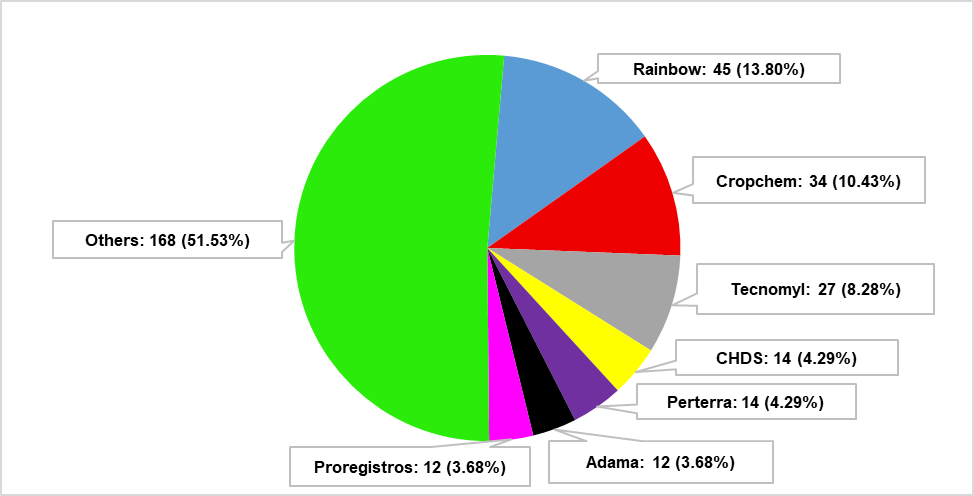
Between 2021 and 2025, of the 326 generic formulated product registrations approved after lawsuits, seven companies accounted for 48.47% of approvals: Rainbow (45), Cropchem (34), Tecnomyl (27), CHDS (14), Perterra (14), Adama (12) and Proregistros (12).
The increase in lawsuits shows this mechanism is no longer an exception within the regulatory process. The longer the waiting time for the evaluation and approval of registrations, the greater the incentive for companies to resort to the courts.
Lawsuits are among the topics that will be addressed at the Forum AllierBrasil events in India (November 3rd), Vietnam (November 6th) and China (November 11th–12th).
READ MORE: