
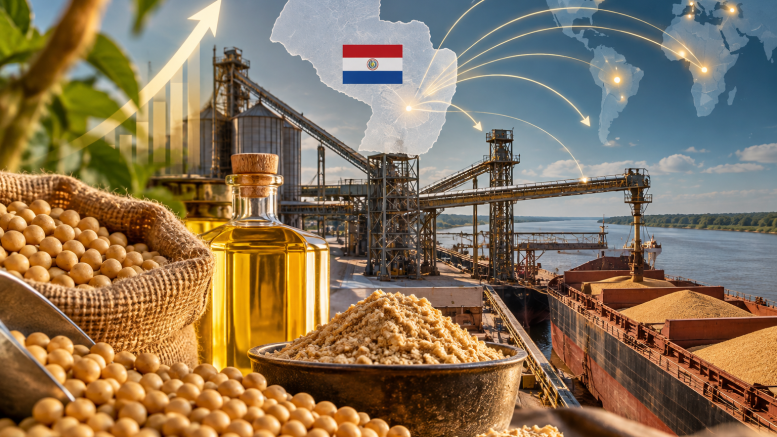
Paraguay Soybean Oil and Meal Exports Generate Nearly US$ 1 Billion

The Agricultural Chain Activity Index increased 1.1% in August when compared to July and 19% when compared to August 2025, reaching a new record high. Performance was driven mainly by primary grain production amid a record harvest. (Rosario Board of Trade)
Investment to establish the main grain crops reached US$ 14.75 billion in the 2025/26 season, up 6.2% when compared to 2024/25, with a record planted area of 39.9 million hectares. Corn accounted for US$ 5.67 billion, up 30.9% from the previous season, surpassing soybeans at US$ 4.74 billion, down 16.6%, as the crop attracting the largest investment. (Rosario Board of Trade)
Adecoagro announced the early redemption of the remaining US$ 234.92 million in senior notes carrying a 6% annual interest rate and due in 2027. The original issuance totaled US$ 500 million in 2017, while the company had already repurchased US$ 84.4 million in 2024 and US$ 150.9 million in 2025. The final redemption is scheduled for October 28ᵗʰ and will fully retire this debt issuance. (Adecoagro – 9/28/26 ; SEC)
The Rosario Board of Trade estimates exports of grains, meals and oils could reach a record US$ 42.2 billion in 2027. Agribusiness foreign-currency inflows are projected at US$ 40 billion, the second-highest level on record, while export-duty revenue is estimated at US$ 5.48 billion. Corn stands out in the current season: sales for 2025/26 reached a record 43 million tonnes at this stage of the crop cycle, equivalent to 61.3% of estimated production of 72.5 million tonnes. (Rosario Board of Trade)

From January to July 2026, China accounted for US$ 106 million, or 88%, of Bolivian beef and related product exports. Ecuador followed with US$ 8 million and Peru with US$ 3 million. The products were shipped to a total of 13 countries. (IBCE)
The government enabled access to the Productive Boost Trust Fund, with approximately US$ 65.5 million available to finance working capital, infrastructure and joint projects for small and medium-sized farmers. Created under Supreme Decree No. 5720, the fund is part of measures adopted to mitigate the impact of higher fuel prices on the productive sector following the removal of the diesel subsidy. Access to financing was agreed with farmers from Santa Cruz and Beni. (Ministry of Sustainable Production, Environment and Water – 9/26/26; BCB)

According to Biond Agro, a Brazilian ag market intelligence company, China has already contracted 43.37 million tonnes of soybeans, equivalent to 39.4% of estimated seasonal requirements of 111 million tonnes. Brazil accounts for approximately 28 million tonnes, the USA for 13.73 million tonnes and Argentina and Uruguay for 1.65 million tonnes. Coverage of Chinese requirements decreased from 69% in November to 40% in December and 17% in January, leaving room for additional purchases as the new Brazilian crop reaches the market. (Biond Agro)
Soybean planting regarding the 2026/27 season accelerated in the State of Paraná following improved soil moisture, although rainfall interrupted fieldwork in some areas. Corn planting also advanced, while second-crop corn harvest reached 99%. Excessive rainfall reduced wheat quality and yields. (Deral)
Embrapa validated in the State of Mato Grosso do Sul a new Agricultural Climate Risk Zoning (Zarc) methodology based on management levels. Each improvement across the four soil management quality levels increased relative soybean yields by 11.1% in the analyzed trials. In the 2026/27 season, the pilot project covers soybeans in the states of Paraná, Santa Catarina, Rio Grande do Sul and Mato Grosso do Sul, with rural insurance subsidies ranging from 20% to 40% depending on the management level. (Embrapa; MAPA)
The Ministry of Commerce of China stated that the 1.106 million-tonne quota for Brazilian beef imports reached 100%. Beginning October 1ˢᵗ, volumes exceeding the quota are subject to an additional 55% tariff on top of the applicable import duty. (MOFCOM – 9/29/26)
The EU published the final audit report concluding Brazilian official controls are capable of providing the sanitary guarantees required for poultry meat and honey. No technical obstacle was identified to reinstating Brazil among authorized suppliers, although exports still depend on completion of the European regulatory procedure. MAPA requested a discussion at the responsible committee meeting on October 20ᵗʰ–21ˢᵗ. (MAPA; European Commission)
Brazil and China expanded the sanitary protocol for Brazilian pork offal exports. The Brazilian Animal Protein Association estimates potential shipments above 100 K tonnes/year and more than US$ 100 million in additional revenue for the sector. China imports approximately US$ 2.5 billion/year of pork offal. (MAPA; ABPA)
The National Supply Company reported the 2026/27 season began advancing with soybean, corn and rice planting underway across several producing regions. The bulletin released on September 28ᵗʰ assessed crop conditions from September 1ˢᵗ through 21ˢᵗ and indicated that planting remained limited across much of the rainfed area in Matopiba, the agricultural region spanning parts of the states of Maranhão, Tocantins, Piauí and Bahia. (Conab)
Port of Santos, in the State of São Paulo, handled 16.38 million tonnes in August, including 3.08 million tonnes of soybean complex products, 2.39 million tonnes of sugar and 1.86 million tonnes of corn. Container handling reached a monthly record of 538.2 K twenty-foot equivalent units (TEUs), while total cargo volume increased 3.1% from January through August to 125.9 million tonnes. (Ministry of Ports and Airports)
SLC Agrícola started the public distribution of approximately US$ 98.7 million in financially settled Rural Product Notes (CPR-F), which are agricultural credit instruments used to raise financing and settled in cash at maturity rather than through the physical delivery of agricultural products. The seven-year issuance targets professional investors, with proceeds allocated to the agricultural activities of the company. (SLC Agrícola – 9/25/26; CVM)
BrasilAgro, a Brazilian ag production and farmland investment company, sold 2,592.97 hectares of the Rio do Meio farm in the State of Bahia for a nominal value of US$ 18.5 million. The transaction includes 1,752.66 productive hectares and was priced at 425 soybean bags per productive hectare. The company expects a pre-tax gain of approximately US$ 9.9 million in the 1Q27. (BrasilAgro; CVM)


Wine exports reached US$ 143.4 million in August, up 15.9% from the same month of 2025, with volume at 59.3 million liters (+18.4%). Wines with designation of origin accounted for US$ 115.9 million, with Brazil ranking as the leading destination by value and volume in this segment. (Odepa)
PepsiCo announced a US$ 1 billion investment in Colombia over the next five years to expand production capacity, modernize operations and strengthen distribution. According to the Presidency of the Republic, company operations support more than 2 K farmers in the country. (Presidency of Colombia)
The Colombian Agricultural Institute disputed figures reported by the media attributing approximately US$ 22.8 million in cattle-sector losses and 15,515 cattle deaths to El Niño and wildfires. After reviewing official records from July through September, the institute said it found no evidence supporting the reported mortality and animal movement figures. In Magdalena, Sucre, La Guajira and Atlántico, cattle movements fell 22% from 2025 and 12% from 2024, with no unusual increase in mortality. (ICA)
The government launched a consolidated direct-purchasing platform for white corn and wheat farmers participating in the Cosechando Soberanía [Harvesting Sovereignty] program. The program offers credit of up to approximately US$ 72 K per farmer, together with interest-rate subsidies and risk-protection instruments for agricultural production. For wheat, the mechanism also includes marketing incentives across 11 producing states. (Secretariat of Agriculture – 9/30/26)
Ag and fishery exports totaled US$ 1.15 billion in August, down 1.6% when compared to the same month of 2025. Total Mexican exports reached US$ 78.01 billion during the month (+40.4%), while the country recorded a US$ 605 million trade surplus. From January through August, total exports reached US$ 549.40 billion (+29.3%). (Inegi)


Costa Food Group acquired an agricultural complex and a pork-processing plant in Paraguay, in a transaction structured by Sudameris Bank. The acquisition is part of the Spanish group’s expansion plan in the country, under which cumulative investment is expected to exceed US$ 300 million, with a focus on building an integrated, export-oriented production platform. The US$ 300 million figure refers to the overall investment plan in Paraguay, rather than the price of this specific acquisition. (Costa Food Group; Sudameris – 9/29/26)
Paraguayan exports of soybean oil, meal and hulls generated US$ 997.17 million from January through August, up 20% from the same period of 2025. Soybean volume destined for domestic processing also increased from approximately 2.1 million to more than 2.3 million tonnes. (CAPPRO; BCP – 9/26/26)

Expoalimentaria 2026 is expected to generate US$ 1.1 billion in business over the next 12 months, according to the Peruvian Exporters Association. The event brought together companies and international buyers from the food and agricultural export sectors. (ADEX)
Fresh blueberry exports reached US$ 620.2 million from January through July, up 64.8%, while volume increased 45.1% to 84.8 K tonnes. The USA increased purchases by 79.5% to US$ 347.6 million, accounting for 56% of total exports. (Midagri)

The National Agricultural Research Institute, Camelina Company and Louis Dreyfus Company presented on September 30ᵗʰ preliminary results from camelina field trials conducted in Uruguay. The winter oilseed is being evaluated as an alternative to diversify agricultural production and as a source of oil for higher-value markets. (INIA – 9/30/26)

READ MORE: