
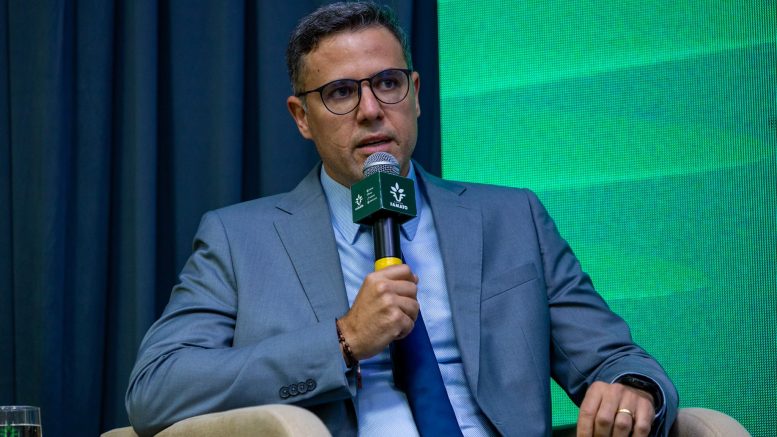
“…those who produce legally should not be treated as non-conforming simply because they do not meet a private rule that is more restrictive than the law…”
Rodrigo Gomes Bressane is the Legal Manager at the Federation of Agriculture and Livestock of Mato Grosso – Famato, where he works on issues related to environmental and land legislation, agribusiness, and legal certainty for the rural sector.
Bressane is a lawyer, professor, and speaker specializing in the environment, sustainability, and agribusiness. He holds a law degree from the University of Cuiabá and has completed specialization courses and MBA programs at the Superior School Foundation from Public Prosecutor’s Office, Ibmec, Esalq/USP, UFMT, and FGV.
AgriBrasilis – What are the impacts of the Brazilian Supreme Court decision regarding the Soy Moratorium?
Rodrigo Bressane – The decision has two significant effects. On one hand, it was positive in that it upheld the laws of Mato Grosso and Rondônia, allowing these states to establish criteria for granting tax incentives to companies that enter into private agreements containing environmental requirements that go beyond Brazilian law. On the other hand, the Brazilian Supreme Court (STF) recognized the constitutionality of the Soy Moratorium and ordered the termination of lawsuits challenging its legality, including those regarding competition law. For Famato, this second point is a cause for concern, particularly because it halts the in-depth technical analysis that was being conducted by CADE, the agency legally empowered to investigate and adjudicate violations of the economic order and free competition.
AgriBrasilis – Does the decision put an end to the legal dispute, or is there still room for contest?
Rodrigo Bressane – The Supreme Court’s decision must be respected and is binding regarding the issues expressly decided by the Court. However, it is still necessary to analyze the ruling and its precise limits, including the scope of the order to terminate the proceedings, while noting that the decision remains subject to appeal to the Supreme Court itself. Furthermore, recognizing the constitutional validity of a private agreement does not necessarily grant immunity for any and all future conduct by the participants; specific situations must be analyzed based on their own particular circumstances.
AgriBrasilis – Who wins and who loses with the moratorium?
Rodrigo Bressane – The Moratorium benefits companies that have collectively adopted this private procurement standard. Those who may be disadvantaged are rural producers who fully comply with Brazilian environmental legislation, including the Forest Code, yet still face restrictions on marketing their produce because they do not meet a private requirement that is stricter than the law itself. It is precisely this distinction between complying with Brazilian legislation and meeting additional market-imposed criteria that lies at the heart of Famato’s concerns.
AgriBrasilis – Does the absence of farmers in the creation of the Moratorium compromise its legitimacy?
Rodrigo Bressane – This is one of Famato’s key concerns. Farmers are directly affected by the Moratorium’s rules, and yet, did not have a commensurate role in the agreement’s formulation or original governance. A private mechanism that significantly impacts market access gains greater legitimacy when those who directly bear the consequences also effectively participate in defining the rules. Sustainability must be built through dialogue with and the participation of the productive sector.
AgriBrasilis – To what extent can private companies impose environmental requirements beyond the law?
Rodrigo Bressane – Private companies are free to establish their own purchasing policies and environmental commitments. The issue arises when private requirements, especially those adopted collectively by companies with significant market share, effectively become a general rule for market access. Free enterprise must coexist with free competition and Brazilian law. In Famato’s view, lawful producers should not be treated as non-compliant simply because they do not meet a private rule that is more restrictive than the law.
AgriBrasilis – Could the soybean case set a precedent for restrictions in other agricultural supply chains?
Rodrigo Bressane – This is a risk that requires close monitoring. If private and collective environmental criteria that go beyond existing legislation become a widespread condition for market access, similar models could emerge in other supply chains. The concern is not to hinder voluntary sustainability commitments, but to prevent private agreements from effectively superseding the rules democratically established by the Brazilian State.
READ MORE: