
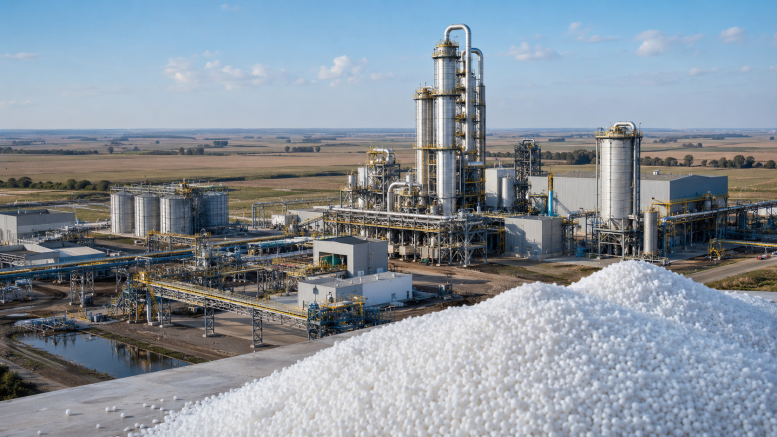
US$ 2.7 Billion Granular Urea Plant in Argentina
Brazil
MAPA published calls for accreditation of agricultural defense laboratories specialized on physico-chemical analyses of plant and animal products, animal feed and wines, beverages and acetic ferments; food and water microbiology; food residues and contaminants and milk quality. Applications will be accepted from August 3rd – 7th, 2026. (MAPA)
Researchers identified a population of Helicoverpa armigera caterpillars that was more than 300 times less sensitive to the Cry1Ac insecticidal protein used in GMO plants. The resistance also reduced the effectiveness of Cry1A.105 but did not affect Cry2Ab2. Soybean combining all three proteins killed all the caterpillars tested. The findings reinforce the importance of maintaining refuge areas with non-GMO plants and combining proteins that control the pest in different ways. (Esalq/USP; Bayer Crop Science)
The Secretariat of Foreign Trade opened a 45-day public consultation on a proposal to reduce the Mercosur Common External Tariff on diammonium phosphate and monoammonium phosphate from 5.4% to zero. Submissions filed through Brasil Participativo will inform Brazil’s position in Mercosur Technical Committee No. 1. (Secex/MDIC)
Terra Genomics raised approximately US$ 3.3 million in a seed round (early-stage funding) led by Pitanga Redux, with participation from Bold.t Capital. The funding will support a research facility in the city of Campinas, State of São Paulo, to engineer agricultural microorganisms using metabolic engineering, synthetic biology and artificial intelligence, targeting nitrogen fixation, phosphorus solubilization and pest and disease control. (Terra Genomics; Pitanga Redux; Bold.t Capital)
The bioinputs market generated approximately US$ 255 million from January to April 2026. Treated area reached 31 million hectares, up 15% year on year, led by bioinsecticides. More than 40% of the market was concentrated in second-crop corn, mainly for leafhopper and caterpillar control. (CropLife Brasil)
Coffee farming generated approximately US$ 650 million in crop protection sales in the 2025/26 season, up 22% from the previous season. Potential Area Treated, which counts every application, increased 22% to 42.8 million hectare-equivalents. Planted area expanded 4% and the average number of treatments rose 17%. Fungicides accounted for approximately US$ 192 million, insecticides for US$ 150 million and soil-applied products for US$ 123 million. (Kynetec)
The General Superintendence of the Administrative Council for Economic Defense – CADE recommended that Monsanto Company, Monsanto do Brasil, Bayer Aktiengesellschaft and Bayer S.A. should be held accountable for incentives offered to breeders to adopt Intacta RR2 PRO biotechnology. The recommendation concerning nonlinear discounts under the Monsoy Multiplica program applies specifically to Monsanto do Brasil. The investigation began in January 2018 and the final decision will be made by CADE’s Administrative Tribunal. (SG/CADE)
BASF has begun the registration process of fendioxypyracil, submitting the first regulatory dossiers in Brazil and Australia in July 2026. The active ingredient inhibits the PPO enzyme and controls broadleaf weeds and annual grasses. Submissions in the United States and Argentina are planned for 2027, with the first sales expected by 2030, subject to regulatory approvals. (BASF)
Cumulative rainfall in the State of Rio Grande do Sul since early July reached the highest level in ten years. Excess moisture combined with above-average temperatures is increasing disease pressure in wheat and, if the wet conditions persist through the crop’s final growth stages, could affect yields and grain quality. (EarthDaily)
Brazil has 859 biopesticide registrations active in the market today, including 826 microbial products. More than half have been granted since 2022, including 175 new registrations in 2025. Treated area continues to expand, but the entry of new companies and products has intensified competition and price pressure. (DunhamTrimmer)
Researchers developed a fast and low-cost protocol to visualize and quantify corn leafhopper (Dalbulus maidis) eggs within maize tissues. The method uses sodium hypochlorite and methylene blue, was validated on approximately 3,000 plants and allows each batch to be processed in 60 to 90 minutes. (Esalq/USP)
Researchers at Embrapa Environment adjusted aeration and the carbon-to-nitrogen ratio to increase the production of Clonostachys rosea propagules with potential use in biofungicides. On the fifth day of the cherry tomato trial, gray mold incidence was 79% in the control but fell to 40% with preventive conidia treatment and to 24% with either microsclerotia or a metabolite-containing culture filtrate. (Embrapa Environment)
Repeated applications of herbicide dosages outside label recommendations can affect crop selectivity in the cases of soybean and corn and increase selection pressure for herbicide-resistant weeds. To control volunteer plants, the authors recommend effective burndown, residual pre-emergence herbicides, rotation of modes of action and integration of chemical, cultural and mechanical control methods. (UniRV; Unesp)
Researchers developed a lufenuron nanoformulation using biodegradable PCL nanoparticles, with encapsulation efficiency above 99% and stability for 90 days. The formulation released the active ingredient up to eight times more slowly and provided control of Rachiplusia nu comparable to the commercial product at the recommended rate during trials. (UFSM; Unesp; INCT NanoAgro)
The biofertilizer and specialty fertilizer markets generated approximately US$ 5 billion in revenue in 2025, down 5.5% from 2024. Despite the overall decline, biofertilizers grew 76.7%, organic fertilizers 58.5%, soil conditioners 19.4% and substrates 22.8%. (Abisolo)
Arauco has started production and releasing parasitoid wasps to control defoliating caterpillars in eucalyptus farms. Since March, more than 6 million Trichospilus diatraeae and Tetrastichus howardi parasitoids have been released in the city of Inocência, State of Mato Grosso do Sul. Produced in partnership with the Senai Biomass Innovation Institute, the biological control agents complement Bacillus thuringiensis-based insecticides and are expected to reduce chemical pesticide applications. (Arauco)

Latin America
Pampa Energía approved the final decision to invest US$ 2.7 billion in building a granular urea plant in Bahía Blanca, Argentina. With an annual capacity of 2.1 million tonnes, it will be the largest urea plant in Latin America. The complex will have direct access to Vaca Muerta natural gas and is expected to begin production in late 2029, supplying Argentina and export markets, primarily Brazil. (Pampa Energía)
The National Service of Agricultural Health and Food Safety of Bolivia inspected plant nurseries in Bermejo, Department of Tarija, to verify compliance with phytosanitary regulations and the conditions for producing and marketing plant material. The inspections aim to prevent the introduction and spread of pests and diseases through seedlings. (Senasag)
The Agricultural Institute of Colombia, the Sugarcane Research Center and other entities have launched their first joint parasitoid-release strategy to control Diatraea spp. in sugarcane fams in Versalles. The program uses Cotesia flavipes against larvae and Trichogramma against eggs. Three releases are planned, followed by a final assessment. (ICA; Cenicaña; Ingenio Providencia)
The Agricultural Institute of Colombia has trained 13 farmers from the Afrobobal Community Council in Necoclí to produce a biofertilizer obtained through the anaerobic fermentation of cattle manure, molasses and minerals including boron, zinc, manganese, copper and magnesium. The initiative aims to improve soil microbiology and reduce dependence on commercial chemical inputs. (ICA)
In Chile, alkaloid-rich extracts obtained from Berberis darwinii roots reduced Drosophila suzukii oviposition by more than 80% at the highest concentration tested and increased egg, larval and adult mortality. The results were obtained under laboratory conditions and still require assessments of field efficacy, environmental stability and effects on non-target organisms. (CGNA; University of La Frontera)
Regulatory counsel Melissa Owen, founder of Law Practice, highlighted approaching deadlines in Chile and Colombia, subsequently confirmed by the countries’ authorities. In Chile, manufacturers and importers that handle more than 1 tonne/year of hazardous industrial substances must report their 2024 and 2025 volumes by August 30th, 2026, using the official spreadsheet accompanied by safety data sheets. In Colombia, manufacturers and importers of hazardous industrial chemicals, including substances incorporated into mixtures, in volumes above 100 kg per year must update their 2025 information by September 30th, 2026. Reporting is made through the National Inventory of Industrial Chemical Substances, the official database containing information on quantities manufactured or imported, uses and hazards. (Law Practice; Chile’s MMA and Minsal; Colombia’s Minambiente)
The Congress of Veracruz, Mexico, approved amendments on July 7th to the State Criminal Code and Environmental Protection Law, creating two environmental crimes related to the use of prohibited or restricted agrochemicals and damages in protected areas. The base penalty under Article 259 Bis is two to six years in prison and a fine. With the applicable aggravating factors, penalties may reach nine years and approximately US$ 10,100. (Congress of Veracruz)
Uruguay confirmed the first case in the country of glyphosate-resistant barnyardgrass (Echinochloa crus-galli) in extensive soybean and corn production systems in the Departments of Colonia and Soriano. The case, identified in 2025, was validated through laboratory and greenhouse trials and added to the International Herbicide-Resistant Weed Database on July 25th, 2026. It is distinct from the species’ previous resistance cases in rice systems. (INIA Uruguay; International Herbicide-Resistant Weed Database)

READ MORE: