
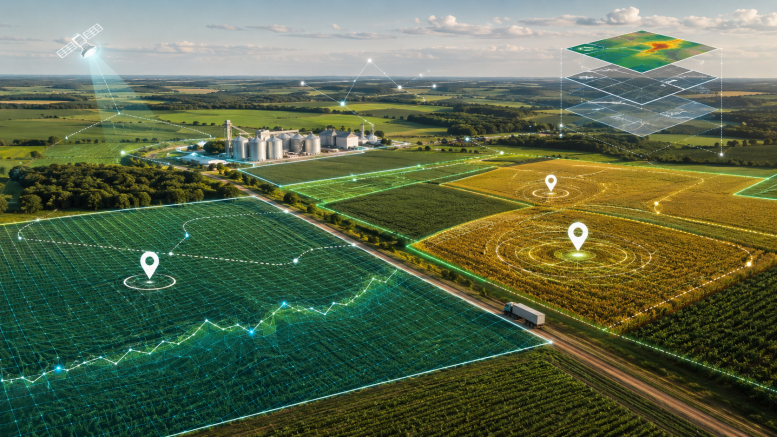
“Geospatial data are profoundly changing the way agribusiness operates and makes decisions…”
Sergio Rocha is the founder and CEO of Agrotools, a Brazilian agribusiness technology company specialized in territorial intelligence, geospatial data, risk analysis, traceability, and socio-environmental compliance.
Rocha is a board member of the Superior Agribusiness Council of Fiesp and holds training in business strategy from IMD – International Institute for Management Development, in Lausanne, Switzerland.

Sergio Rocha, founder and CEO of Agrotools
AgriBrasilis – How are geospatial data changing agribusiness?
Sergio Rocha – Geospatial data are profoundly changing the way agribusiness operates and makes decisions. The sector has always dealt with complex variables, but today we have the ability to view territories with a level of depth and scale that was previously very difficult to achieve.
This changes everything: from production management to credit granting, including compliance, traceability, and the management of opportunities and risks. At Agrotools, we understand that territory is no longer just a geographic location. It has become a strategic layer of intelligence for the entire agribusiness sector.
AgriBrasilis – What types of data are collected, and how are they processed to monitor crops and production chains?
Sergio Rocha – Today, we are talking about a massive volume of data: satellite images, climate, terrain, soil, land records, environmental data, and production information. But the central point is not the amount of data, but the ability to connect them intelligently.
When we combine geotechnology, data science, and artificial intelligence, we are able to transform scattered data into actionable information. This makes it possible to monitor crops, track production chains, and identify patterns of opportunities and risks on a large scale. The true value lies in turning complexity into clarity to support better decisions in agribusiness.
AgriBrasilis – How is it possible to identify risks such as deforestation, environmental embargoes, and socio-environmental irregularities on a large scale?
Sergio Rocha – This is a challenge that can only be solved with technology. There is no possible scale with purely manual processes. The answer lies in the automated cross-checking of territorial data, regulatory databases, and socio-environmental indicators, such as deforestation alerts, embargoes, and protected areas.
This makes it possible to identify risks with precision, speed, and standardization. The market has already understood that risk monitoring is no longer a reactive practice. Today, anticipation is a competitive advantage and, increasingly, an operational requirement.
AgriBrasilis – How are data related to credit and risk assessment?
Sergio Rocha – This relationship is increasingly direct. Agricultural credit is evolving toward a much more sophisticated analysis model. It is no longer enough to assess only financial capacity. Today, it is essential to understand production, climate, territorial, and socio-environmental risks.
Geospatial data reduce information asymmetry and increase the accuracy of risk analysis. This provides greater security for financial institutions and improves the quality of credit portfolios. In the near future, agricultural credit will be increasingly driven by territorial intelligence.
AgriBrasilis – What changes for credit with CMN Resolution No. 5,267/2025?
Sergio Rocha – The resolution accelerates a transformation that was already underway. Socio-environmental and climate risk now plays a central role in the logic of granting and monitoring rural credit. This raises the level of requirements for financial institutions, which will need to operate with greater traceability, visibility, and analytical capacity.
In practice, we are talking about a structural change. Continuous monitoring and territorial intelligence are no longer differentiators; they are becoming essential for compliance and competitiveness.
AgriBrasilis – Has traceability become a commercial requirement?
Sergio Rocha – Undoubtedly. This discussion has already moved forward. We are no longer debating whether traceability will be necessary, but how quickly companies will be able to adapt.
Markets, industries, financial institutions, and consumers increasingly demand transparency regarding the origin and compliance of production. This movement is irreversible. Traceability has ceased to be merely a competitive advantage and has become a condition for access to markets, capital, and commercial opportunities. In agribusiness, transparency is already a strategic asset.
READ MORE: