
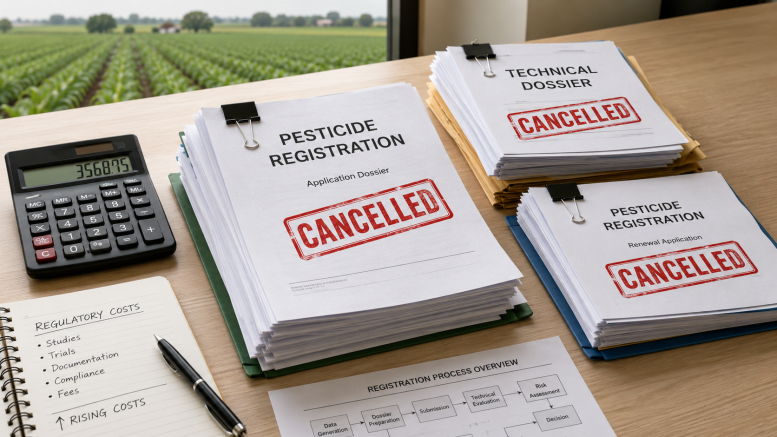
“The time required for registration approval remains excessively long…”
Flavio Hirata is a partner at AllierBrasil and founder of look2agro™, agronomist graduated from Esalq/USP, MBA, specialist in pesticide registration.
AllierBrasil is a consulting firm specialized in pesticide registration. For more than 20 years, it has promoted Brazilian agribusiness in Brazil and abroad.

Flavio Hirata, partner at AllierBrasil flavio.hirata@uol.com.br
Despite the lengthy approval process for pesticide registrations, in 2025 the Ministry of Agriculture approved 912 registrations, which is a historical record and 38% more than in the previous year. In 2026, as of June 15th, 338 registrations had been approved: 215 formulated products and 123 technical products. In the last five years (2021 – 2025), there have been 3,344 approvals.
The time required for registration approval remains excessively long, which has led companies to file lawsuits seeking the evaluation of pending applications. Between 2019 and 2025, toxicological evaluations approved by Anvisa through court decisions for chemical formulated products increased 395.24%, from 21 to 104. In the case of Ibama, lawsuits involving environmental evaluations increased 2,666.67%, from 3 to 83 approvals.
In 2026, as of June 19th, Anvisa had approved 550 pesticide assessments, 61 of them through lawsuits, representing 11.09% of the total. This was an increase of 11.11% compared with the same period of 2025, when Anvisa approved 495 pesticide evaluations, 56 of them after lawsuits, or 11.31%.
Regarding Ibama, partial data for 2026 are not yet available. In 2025, the Institute approved 475 environmental evaluations for chemical formulated products, 84 of them after lawsuits, representing 17.68%.
On one hand, there are measures to accelerate evaluations by the agencies involved, record approval numbers and a growing number of lawsuits. On the other hand, there has also been an increase in registration cancellations and suspensions. In 2025, MAPA published 158 cancellations, 44.95% more than in 2024. In 2026, 55 registrations have already been cancelled.
Registration Approvals vs. Cancellations (2019–2025)
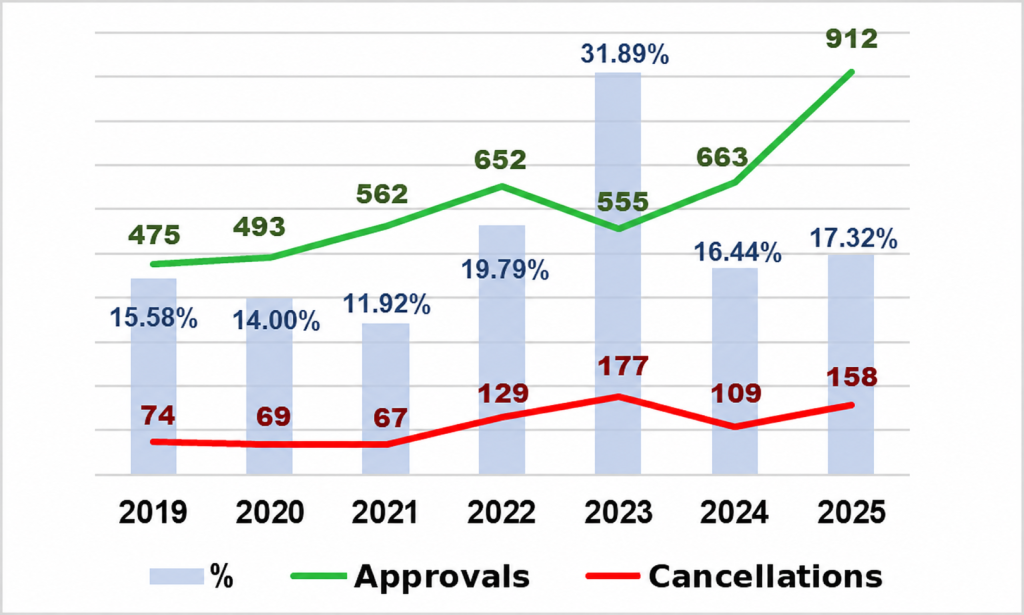
Source: Ministry of Agriculture, Official Gazette of Brazil; adapted by AllierBrasil
The chart shows the number of approved registrations that were cancelled, most of them at the request of the registration holder or due to the banning of the molecule.
Regulatory demand is increasing and involves high costs. Three ministries are involved in the registration process, each with specific rules, in addition to joint regulations.
The cost of maintaining a registration, which includes annual fees and, in some cases, environmental and/or toxicological re-evaluations, which may cost several million dollars and take more than 10 years to conclude, is among the reasons why companies request the cancellation of their own registrations. Other frequent reasons include registrations based on suppliers that no longer exist or do not have legal accreditation.
As for registration requests still under evaluation, each change and/or interpretation of legislation requires them to be adapted to new evaluation conditions. Considering the time needed to complete the evaluation, several adjustments and additional costs may be required for each application, which becomes an important factor in the decision to continue or cancel the process. In addition, failure to comply with rules and requirements within the established deadlines results in the rejection of the request.
Recent Rules Related to Pesticide Registration
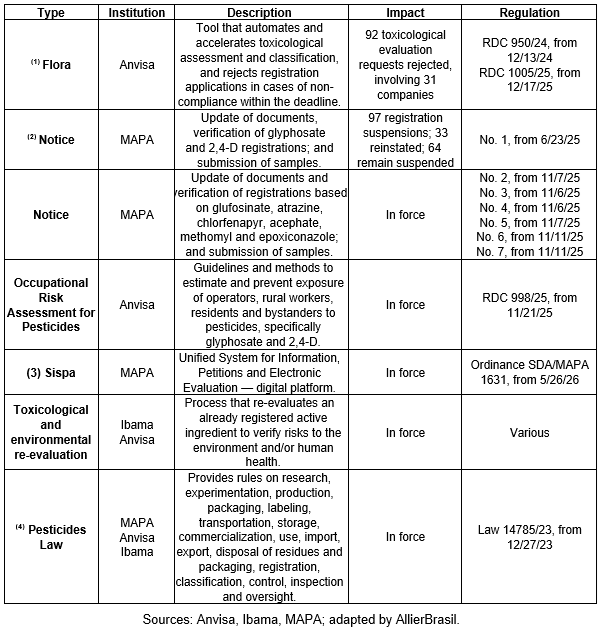
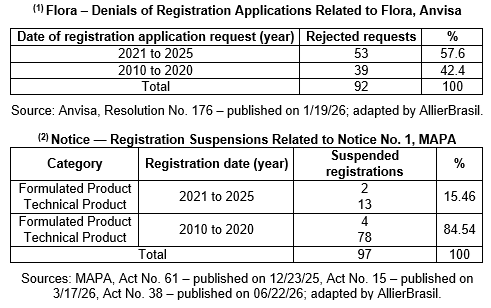
(3) Sispa
The deadlines for adapting to Sispa depend on the type of product: components, new technical product, equivalent technical product, formulated product, and premix. The first deadline expires 90 days after the publication of the Ordinance, on August 24th, 2026.
Given the complexity involved in filling out the spreadsheet, which includes obtaining restricted documents abroad, complying with the requirement is practically impossible within such a short timeframe. Companies are expanding their teams and outsourcing services, including abroad, in order to meet the required deadlines.
(4) Pesticides Law
Law No. 14785/23 provides that “once the registration for the pesticide, environmental control product, or related product has been issued, the registration holder shall have up to two years to begin production and commercialization of the product, under penalty of cancellation of the registration”. Therefore, once the Law is regulated, several registrations are expected to be cancelled.
The use of pesticides is an indispensable tool for increasing agricultural yields. Obtaining registration, however, is the main bottleneck for access to the Brazilian market. The greater the number of suppliers, price conditions and payment terms, the more options there are to benefit farmers. Fewer options certainly mean higher prices to be paid. Competition is essential.
Given their importance to the agrochemical production and supply chain, topics such as registration, occupational risk assessment, lawsuits, and supply from China will be addressed in lectures during the 17th Brasil AgrochemShow, which will be held on August 3rd and 4th at Centro de Eventos São Luís, in São Paulo.
The 17th Brasil AgrochemShow is an event featuring lectures and an exhibition, organized by AllierBrasil and China’s CCPIT CHEM, with the objective of promoting agribusiness, sharing knowledge, and developing technical and commercial partnerships between local and foreign companies.
Admission is granted through the donation of basic food hampers, which are donated to the charity institution Crê-Ser, from São Paulo. In 2025, 14 tonnes of food were donated.
Registration through the website: https://allierbrasil.com.br/agrochemshow/index_eng.php
Information: brasil@agrochemshow.com.br
READ MORE: