
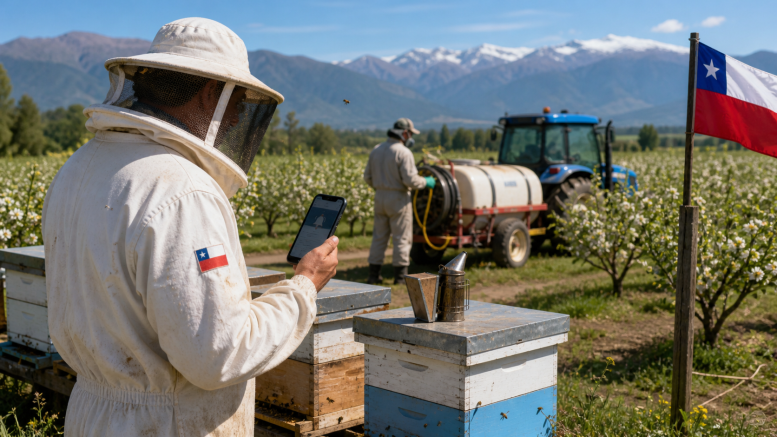
Chile Implements 48-Hour Warning Rule for Pesticide Use Near Beekeepers
Brazil
Ministry of Agriculture published a Notice complementing CGAA Notices No. 2 to 7 of 2025, related to glufosinate-ammonium, atrazine, chlorfenapyr, acephate, methomyl and epoxiconazole, whose deadlines were extended by Notice No. 8 of 2026. The notice establishes the mandatory prior submission of data on samples and analytical standards directly to the Federal Laboratory for Agricultural Defense in São Paulo, before sample delivery. The samples must be labeled with information matching the submitted spreadsheet and accompanied by a Declaration of Sample Shipment. (Official Gazette of Brazil, Notice No. 9 – published on 05/05/2026, MAPA)
Sell Agro, a Brazilian manufacturer of agricultural adjuvants, expects revenue to reach US$ 18.13 million in 2026, up 15% from 2025, and is preparing to begin operations in Paraguay. Founded in Rondonópolis, State of Mato Grosso, the company has two factories, 15 distribution centers, and has just launched a biodegradable orange-terpene-based adjuvant. (Sell Agro)
Anvisa approved, in compliance with court decisions, the toxicological evaluations of fluazinam (AGROBEATS); and chlorfenapyr 240 + methoxyfenozide 80 g/L SC (HELM). (Official Gazette of Brazil, Res. 1767, 1768 – published on 05/04/26, Anvisa)
Brazil could become the world leader in sustainable fertilizers by 2030, according to José Carlos Polidoro, advisor at the Ministry of Agriculture. The category includes micronutrients, organominerals, organic fertilizers, biofertilizers and soluble products. According to Polidoro, Brazil’s potential is linked to the market size, technical knowledge and availability of raw materials. (MAPA)
Petrobras started urea production at Araucária Nitrogenados S.A., a subsidiary located in Araucária, State of Paraná, after resuming operations at the plant, which had been hibernated since 2020. The facility received investments of approximately US$ 175 million and has the capacity to produce 720 thousand tonnes of urea/year, equivalent to approximately 8% of the Brazilian market. With this site in operation, together with the plants in the States of Bahia and Sergipe, Petrobras expects to supply approximately 20% of the Brazilian urea market. (Petrobras)
Yara reported a net income of US$ 327 million in the 1Q26, up from US$ 295 million in the same period of 2025, with revenue of US$ 4.26 billion and Ebitda of US$ 908 million. Despite the positive result, the company warned that geopolitical conflicts continue to pressure natural gas, urea and other inputs. Marcelo Altieri, president of Yara Brazil, said that the global fertilizer market would take at least one year to recover production capacity even if the wars in the Middle East and Eastern Europe ended now. (Yara Fertilizantes)
Adama appointed João Aleixo as the new Executive Vice President (EVP) for Brazil. He will lead the company’s operations in the country, focusing on growth, stronger market presence and on advancing innovation in crop protection. (Adama)
The Monitora Ferrugem RS Program concluded its monitoring of Asian soybean rust in the 2025/26 season after tracking the presence of the fungus Phakopsora pachyrhizi in 95 municipalities in the State of Rio Grande do Sul for 23 weeks. According to the State Secretariat of Agriculture, lower water availability and consecutive days without rain in January and February helped contain disease outbreaks in the State. The soybean sanitary break in the State of Rio Grande do Sul begins on July 3rd and ends on September 30th. (Seapi)
Brazil remains highly dependent on imported fertilizers, with 88% of inputs sourced abroad in 2025, totaling 45.5 million tonnes. Almost 45% of these imports came from geopolitically unstable countries such as Russia, Belarus and Iran, increasing exposure to supply shocks and price volatility. Recent tensions in the Middle East have already affected the market, with urea prices rising 67% by April. Dependence is most acute in potash (96%) and nitrogen (95%), while phosphorus shows relatively lower vulnerability (72%). (Cogo Inteligência em Agronegócios)
The Batista family, shareholders of J&F Investimentos, is negotiating financing with the Brazilian Development Bank to expand potash production in the State of Sergipe. The mine, now controlled by Stratos, produces approximately 400,000 tonnes per year and has technical capacity to reach 2 million tonnes. (J&F Investimentos)
Fertilizer imports in the State of Mato Grosso do Sul dropped 69.63% in January of 2026, reaching 3,500 tonnes, driven by a sharp decline in nitrogen-based products and no recorded imports of potash or phosphate. The reduction reflects more cautious farmer behavior amid rising costs, mainly due to a stronger US dollar and a deteriorating soybean-to-fertilizer exchange ratio, increasing risks for the 2026 season. (Aprosoja-MS)
The Federal University of Viçosa, in the State of Minas Gerais, inaugurated the Center of Excellence in Fertilizers and Plant Nutrition, also known as Hub Fosfatados-MG. The unit will focus on research, innovation and cooperation between universities, government and the private sector to develop phosphate fertilizers from domestic raw materials. The project is part of the National Fertilizer Plan, which aims to reduce Brazil’s dependence on imports. (Federal University of Viçosa)
Researchers from São Paulo State University proposed a new approach to nanoherbicide development based on the specific traits of weed species. The concept, known as plant-informed nanodesign (PIND), focuses on factors such as leaf structure and absorption pathways to improve product efficiency. The strategy could reduce yield losses, reaching up to 90% in severe infestations, and lower input use with reduced environmental impact. (Unesp)
Grupo Piccin launched the e-book “Agricultural and Forest Soil Health – Phosphorus Sources and Clay Types”, focused on more efficient phosphorus use. (Grupo Piccin)
The Agricultural Defense Agency of the State of Piauí introduced a new module of its Integrated Agricultural Defense System to monitor pesticide stocks in dealers’ stores. The tool aims to enhance traceability and strengthen enforcement. (Government of Piauí)
The Ministry of Agriculture announced the approval of 39 pesticide registrations, including 23 chemical formulated products and 16 biological products. (Official Gazette of Brazil, Act No. 25 – published on 05/04/26, MAPA)
The National Association of Phytosanitary Product Companies gathered agricultural defense agencies from Brazil’s Northeast region in the city of São Paulo to discuss the impacts of the new Pesticides and Bioinputs laws and the transition period until their regulatory decrees are published. The meeting addressed the harmonization between Federal and State rules, and progress on the Unified System for Information, Petition and Electronic Evaluation – Sispa, a federal platform designed to integrate state systems and streamline regulatory procedures. (Aenda)
The Court of Justice of the State of Mato Grosso, through the Third Chamber of Private Law, kept the continuation of a lawsuit which requests compensation over alleged damage caused by pesticide drift over neighboring crops. The defendant argued that the legal deadline to file the claim had expired, but the court considered the cell phone message offering to pay US$ 8.23 thousand as an out-of-court acknowledgment of the debt, which interrupted the suspension of the deadline. The case is still in the evidence-gathering stage and the court has not yet decided whether damage occurred or who should pay. (Mato Grosso Court of Justice)
Research by the Regional University of Blumenau is investigating the effects of pesticides on native stingless bees. According to preliminary results, different species react differently to exposure to the same product. The study questions the use of a single exotic species as a model in ecotoxicological tests and assesses mortality and sublethal effects. (Regional University of Blumenau)
Researchers from the Federal University of Rio de Janeiro, in partnership with Embrapa, developed a pesticide-free biodetergent capable of extending the post-harvest shelf life of fruits and vegetables. In tests with oranges inoculated with fungi, 11 out of 12 treated fruits remained intact after ten days. The product will be tested on a larger scale and on other fruits, such as strawberries, papayas and guavas, as well as grains such as beans and soybeans. (Andifes)

Latin America
FMC announced a US$ 281 million loss in the 1Q26, compared with a US$ 15.5 million loss in the 1Q25. Revenue decreased 4%, to US$ 759 million, pressured by a 6% drop in prices, higher raw material costs and tax-related impacts. In Latin America, revenue declined from US$ 207 million to US$ 177 million, reflecting stronger competition and lower prices in the crop protection market. (FMC Corporation)
Adama, controlled by Syngenta Group, reported net income of US$ 82 million in the 1Q26, up 289% from the same period in 2025. Revenue increased 3.7% to US$ 1.037 billion, with higher volumes and lower prices. In Latin America, sales fell 2% to US$ 144 million; in Brazil, the company cited a slight decline in revenue, with significantly lower prices and higher volumes. (Adama)
National Institute of Agricultural Technology of Argentina and the University of Agricultural Sciences of Balcarce developed a protocol to measure drift in pesticide applications using drones. The methodology adapts international standards and generates comparable data on off-target droplet movement, considering flight height, equipment speed, droplet size, wind, temperature, humidity. (INTA)
Argentina’s National Service for Agrifood Health and Quality issued Resolution No. 373/2026, updating labeling rules for phytosanitary products aligned with the GHS System of Classification and Labeling of Chemicals. The regulation redefines mandatory information for packages, labels and leaflets, including identification criteria, use precautions, application recommendations and communication about hazards. (Senasa)
An inspection in Entre Ríos, Argentina, found rural workers living in precarious housing made from silo bags and drinking water stored in pesticide packages. The operation was carried out by the Labor Secretariat, with support from the Customs Collection and Control Agency and the Argentine Union of Rural Workers and Stevedores. Inspectors also identified unregistered workers. (Labor Secretariat of Entre Ríos)
Residents of Tandil, Argentina, protested against the update of the municipal ordinance regulating agrochemical applications. Under the slogan “Stop fumigating us,” the group asked lawmakers not to vote on the new rule before hearing community concerns. The session was postponed to allow a new meeting with council members. (Concejo Deliberante de Tandil)
As previously reported, the Agricultural and Livestock Service of Chile announced it would begin to require at least 48 hours’ prior notice to nearby beekeepers before applying pesticides classified as moderately toxic to bees. The requirement now came into force on April 26th, as part of the implementation of the Beekeeping Law, and adds to the obligation already in force for highly toxic products. The notification must be made through a verifiable means, such as email, text message or written communication. (SAG)
Mexico reformed the PLAFEST regulation (Plaguicidas, Fertilizantes y Sustancias Tóxicas), which governs the registration, import and export of pesticides, plant nutrients and hazardous substances. The changes include the creation of the “new agricultural chemical product” category, 10-year protection for technical safety and efficacy data, and a requirement to provide proof to the Federal Commission for the Protection against Sanitary Risks when a valid patent exists in the country. The measure changes the regulatory strategy for companies seeking to register new molecules. (Ikan Consultores)
The company Agrollano opened up a new store in San Carlos, Cojedes State, in Venezuela, expanding access to agricultural inputs and agrochemicals through a partnership with the Venezuelan government. The initiative includes input supply, financing and technical support, focusing on key crops, such as corn and rice, to boost regional production and improve affordability for farmers. (Agrollano)