
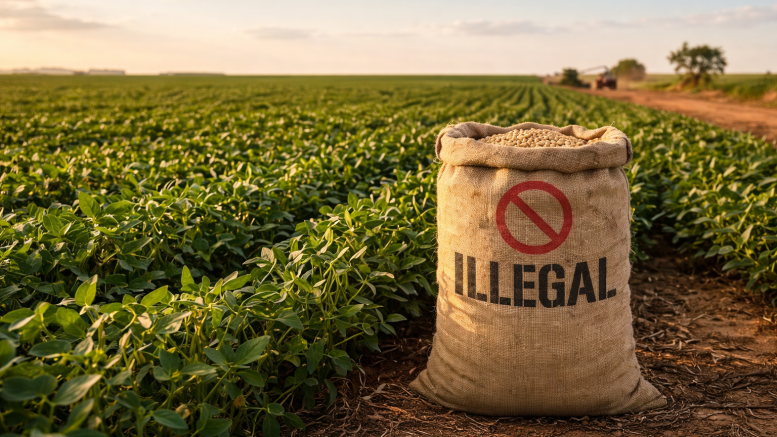
“Most of the seeds planted in Brazil are no longer mere natural inputs, but rather the result of sophisticated research and development…”
Maria Luiza Silveira is a legal specialist at CropLife Brazil, a lawyer graduated from the São Bernardo do Campo Law School and a specialist in civil procedural law from PUC/SP.

Maria Luiza Silveira, legal specialist at CropLife Brazil.
AgriBrasilis – What is the importance of intellectual property protection for seeds and the collection of royalties?
Maria Luiza – To discuss intellectual property (IP) in agribusiness, it is necessary to understand that the inputs used in the field are technological and highly modern. Most of the seeds planted in Brazil are no longer mere natural inputs but are the result of sophisticated research and development (R&D), which require energy, time and high investments from the developer. Thus, intellectual property fits into the system of developing a new seed as an essential incentive mechanism, as it guarantees the innovating agent the right to manage and authorize the use of the newly developed product according to appropriate protection.
Intellectual property is fundamentally important to keep “the wheel turning” in the sector, providing legal certainty that the asset will generate appropriate value relative to the investment made. Without IP, the innovator, who has dedicated time, resources and energy, ends up having no ownership of what they developed, or faces risks of not recouping their financial investment, which may lead to a decrease in investments aimed at valuable agricultural innovation. Royalties are a form of remuneration for the use or exploitation of agricultural inputs and/or technologies and they are essential to ensure that the holders of innovations are protected regarding the return on investment, helping to guarantee that new seeds with higher productivity, quality and resistance continue to be developed.
AgriBrasilis – What characterizes the illegal seed market and in which crops it is most frequent?
Maria Luiza – The illegal seed market involves practices that violate the applicable legislation in the seed sector, which has structured regulations providing quality and safety assurance for production, processing, storage, commercialization, preservation and other acts related to the product. For example, the production of seeds outside the national system of seeds and seedlings is one type of piracy. The disregard of intellectual property, absence of authorization to use a protected product, failure to pay royalties, cloning, or other criminal practices (theft, robbery, and/or arising from illicit commercial relationships) is also recognized as forms of illegality in the seed segment.
Currently, the illegal seed market affects several crops – soybean, corn, cotton, vegetables, rice – being most significant in the soybean commodity.
AgriBrasilis – What is the magnitude of this market and the losses to agribusiness?
Maria Luiza – A 2025 study by CropLife Brasil, in partnership with Céleres Consulting, estimates that illegal soybean seeds occupy 11% of the area planted with this crop in Brazil, equivalent to the total planted area of the State of Mato Grosso do Sul. In terms of value, illegal seeds generate losses of around US$ 1,9 billion per year for farmers, the seed industry, the grain processing sector, exports and tax revenue.
Considering the federal units with soybean-planted areas and the estimated percentage of illegal seed use, the highlights are: Rio Grande do Sul (28%), Minas Gerais (23%), Piauí (20%), São Paulo(20%), Pará (20%).
AgriBrasilis – Why is this market still growing?
Maria Luiza – The growth of this market is a point of concern for the industry, which has fostered debates and created mitigation tools among relevant stakeholders in the chain to combat this illegality. There is no single answer, but rather a combination of factors that contribute to piracy.
This illicit market tends to adopt prices lower than those practiced by the regular seed trade. This creates a false perception of savings for the farmer, which is dangerous because it hides the risks to which the agricultural production is exposed, with the quality of the crop and grains potentially being compromised. Without certification and quality control, there is a higher incidence of pests, weeds and diseases in the fields, with potential vectors for spreading invasive species that are harmful to the environment and prohibited by law.
From an industrial perspective, the use of illegal seeds targets unfair competition, causing losses to the innovation of agricultural inputs. This is because the market exposes agricultural products to distortion and unauthorized use of intangible assets protected by law.
AgriBrasilis – Does the farmer who buys illegal seeds know they are committing an infraction?
Maria Luiza – Sometimes yes, sometimes no. The industry and third sector invest in guidance and reinforcement of good agricultural practices for the use of this technology.
CropLife Brasil has provided tips to identify products that do not comply with applicable legislation: use of white bags (usually without identification) reused in big bags, absence of an invoice, lack of registration in RENASEM (National Registry of Seeds and Seedlings), and prices far below the market are important indicators to observe before purchasing seeds.
AgriBrasilis – What actions are being taken to combat the illegal seed market?
Maria Luiza – Combating the trade of illegal seeds requires joint action between the government, productive sector and society. CropLife Brasil, the entity representing the R&D sector of agricultural inputs, works on training, mediation and advocacy on the topic through various initiatives:
The association leads the Coalition to Combat Illegal Seeds, which brings together entities and agricultural input companies for permanent action against illegal trade in Brazil, strengthening measures related to legal security, innovation and sustainability in the field. Besides CLB, the initiative counts on the participation of associations such as Abrasem, Abrass, ABCSem and state-level seed sector associations, promoting coordinated and more effective actions to face this problem.
The entity also provides a reporting channel on its website to receive and address illegal activities in the field, concerning seeds as well as other types of illegal agricultural market activities and segments (chemical or biological pesticides). Combating illegal seeds is one of the pillars of CLB’s permanent commitment to Good Agricultural Practices, aimed at strengthening the correct and safe use of solutions in the field.
Another measure is the judicialization of cases of violations of intellectual property laws, gathering proof of illegality and filing lawsuits to combat potential piracy practices. In this environment, monitoring and preventive actions are carried out by an internally established Working Group, which brings together leaders of member companies and collaborators from other sector entities.
Finally, there is also discussion about updating the Plant Variety Protection Law (intellectual property protection applicable to genetically improved plants). Modernizing this legislation is an important step to strengthen the innovation system in plant breeding and improve mechanisms to combat the illegal seed market.
Read more: