
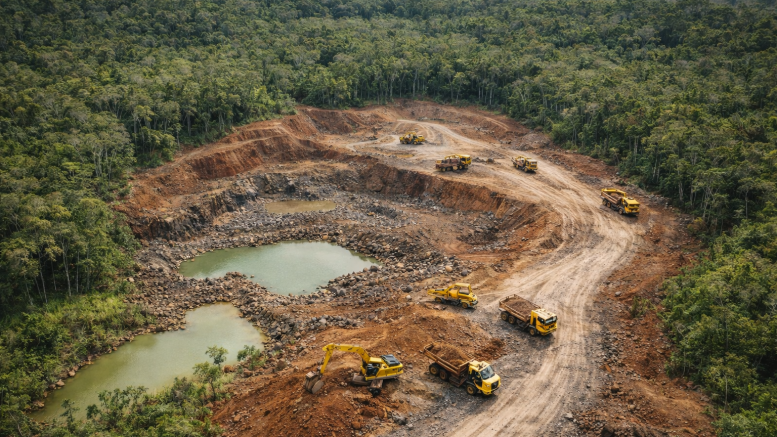
Ibama Shuts Down Illegal Mining in Indigenous Territories in the State of Mato Grosso, Brazil
Brazil
Ibama launched three Environmental Impact Assessment Guides focused on organized ports and private-use terminals, hydropower plants and seismic surveys. The publications provide methodological guidelines to improve the quality of environmental studies and standardize procedures in federal environmental licensing, with plans to expand the initiative to 35 project typologies. (Ibama)
The Ministry of Integration and Regional Development summarily recognized a state of emergency in Porteirinha, State of Minas Gerais, following an imminent risk of failure at the Lages Dam caused by heavy rainfall. The municipality is authorized to request federal funds for humanitarian assistance and emergency interventions, while the situation is being monitored by the Federal Dam Safety Group. (MIDR)
The Federal Prosecutor’s Office (MPF) recommended the National Institute for Colonization and Agrarian Reform (Incra) correct flaws in the environmental licensing of the Novas Minas Project, a bauxite mining operation in the Alto Trombetas II quilombola territory, in Oriximiná, State of Pará. According to the MPF, Incra issued a technical assessment of the environmental plan without conducting prior, free and informed consultation with the affected communities, in a possible violation of ILO Convention 169, and set a 48-hour deadline for the agency to respond. (MPF)
Ibama agents mobilized more than 10 double-trailer trucks to carry approximately 350 cubic meters of native timber seized during Operation Metaverso I in Tucuruí, State of Pará. The wood, illegally extracted from the Trocará Indigenous Land, was found hidden near sawmills and includes species such as jatobá, sapucaia, and red angelim. The material was donated to the Municipality of Novo Repartimento for use in public-interest activities, in accordance with environmental legislation. (Ibama)
The Regional Development Bank of the Extreme South and the Water and Land Institute (IAT) signed an agreement appointing the bank as the technical and financial manager of Paraná’s State Water Resources Fund. The deal provides for the management of revenues collected from water-use charges and their reinvestment in the respective river basins, in line with priorities set by basin committees and the IAT. (Sedest-PR)
Ibama, in partnership with the National Foundation for Indigenous Peoples and security forces, dismantled an illegal mining operation in the Kayabi and Aripuanã Indigenous Lands in the State of Mato Grosso. The operation neutralized 23 dredges, 12 barges, excavators, engines, and vessels, and seized mercury, gold, and other materials used in the criminal activity. The action also dismantled clandestine camps and rendered equipment unusable under Decree No. 6,514/2008 to halt environmental damage in the Legal Amazon. (Ibama)
The Environmental State Council of the State of Rio Grande do Sul has opened the electoral process for the selection of environmental organizations to fill four seats allocated to civil society in the state. Interested entities must register by March 27, submitting the documentation specified in the call for applications published in the State Official Gazette. (Consema; APEDeMA/RS)
The Minister of the Federal Supreme Court, Flávio Dino, ordered the Federal Government to explain the contingency of the National Environment Fund and to notify more than 2,000 landowners whose Rural Environmental Registry overlaps with Indigenous lands and protected areas, under penalty of suspension of the registrations. The decision is part of the Claim of Non-Compliance with a Fundamental Precept No. 743, which monitors structural measures for the prevention and control of wildfires in the Amazon and the Pantanal biomes. (STF)
The Brazilian Development Bank approved financing of US$ 29.1 million using resources from the Climate Fund, to support the ecological restoration of 15,000 hectares in the Atlantic Forest biome, in partnership with the company Tree+. The project provides for the planting and regeneration of native vegetation, with an initial focus on the Northern region of the state of Rio de Janeiro, as well as job creation, restoration of degraded areas, and strengthening of ecological connectivity. (BNDES)
The Federal Prosecutor’s Office recommended the immediate suspension of the environmental licensing process for the “Projeto Natureza,” developed by CMPC, a forestry company, in Barra do Ribeiro, State of Rio Grande do Sul, until the Free, Prior, and Informed Consultation with the potentially affected indigenous Mbyá Guarani communities is carried out. The MPF instructed federal and state authorities to ensure compliance with ILO Convention 169, consider the project’s impacts, and adopt the outcomes of the consultation as binding in the decision-making process. (MPF)
The Parliamentary Environmentalist Front launched, in the Chamber of Deputies, the 2026 Legislative Agenda, a document supported by approximately 160 organizations that sets priorities for environmental legislation, with a focus on the energy transition and the gradual replacement of fossil fuels, including Bill 6615/2025, which creates a “roadmap” for reducing the use of oil and natural gas; the Committee on Constitution, Justice and Citizenship approved a bill that includes prevention and attention to climate change in the National Environmental Education Policy, amending the legislation to incorporate climate education as a priority. The text now moves to the analysis of the Federal Senate before becoming law. (Agência Câmara Notícias)
The State Council for the Environment of the State of Ceará unanimously approved the inclusion of meliponiculture, the breeding of stingless bees, among the activities subject to environmental permit in the state. The resolution establishes criteria to regulate the activity, providing legal certainty to producers and expanding access to credit lines, while recognizing the importance of meliponiculture for pollination and biodiversity conservation. (Coema)
The Chico Mendes Institute for Biodiversity Conservation recorded an increase of nearly 50% in donations of private lands within federal conservation units in 2025, driven by a new voluntary donation mechanism created by ICMBio Normative Instruction No. 24/2025. The mechanism allows landowners to transfer properties to the government and receive environmental credits, which can be used to offset environmental liabilities. The measure has accelerated land tenure regularization in these areas and generated estimated savings of more than R$180 million for the public sector. (ICMBio)

Latin America
The Ministry of the Environment of Chile inaugurated the protected area in the Natural Monument category called Quebrada de La Plata, the first to be incorporated into the new National System of Protected Areas of Chile. The area, located in Maipú, covers about 1,110 hectares and hosts nearly 966 species of flora and fauna. The incorporation marks the first agreement with a private owner, the University of Chile, within the new system. (MMA)
The Secretariat of Natural Resources and Environment of Honduras and the Chamber of Commerce and Industries of Cortés agreed on measures to expedite environmental permitting processes in the northern region of the country. According to authorities, there are approximately US$ 4 billion in investments currently stalled in this sector alone. The government reported that it is extending working hours to reduce delays in the issuance of permits, while the business sector is considering the creation of a cooperation agreement to strengthen the efficiency of procedures. (Serna; CCIC)
A study performed by researchers from the National Autonomous University of Mexico indicates that climate change could reduce between 8% and 40% of suitable habitat for the monarch butterfly (Danaus plexippus) by 2070. Climate models show that areas suitable for eggs and larvae are likely to shift southward within Mexico, potentially fragmenting migratory routes between Canada, the United States, and Mexico. (PLOS Climate)
The Ministry of Environment and Natural Resources of the Dominican Republic presented the 2026 National Expansion and Territorial Activation Plan for the Ecohéroes Ciudadanos environmental volunteer program. The initiative aims to expand and decentralize citizen participation in environmental protection through the creation of volunteer networks in several provinces, as well as training and community actions. The plan foresees the incorporation of more than 2,000 active volunteers and the strengthening of the country’s national environmental volunteer structure. (MMARN)

Read more: