
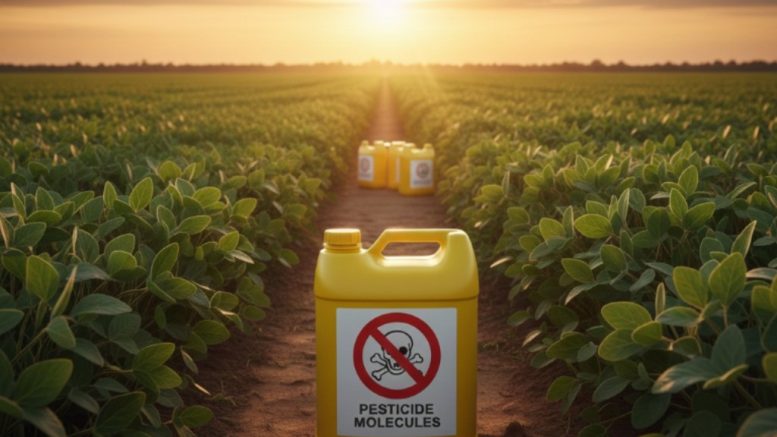
Specific Pesticide Molecules Were Banned in Panama
Brazil
Anvisa released results of the Program for the Analysis of Pesticide Residues in Food, regarding 2024, which reached the lowest number of cases of irregularity rate since 2017. The Agency analyzed 3,084 samples from 14 foods: 79.4% showed no residues or were within the MRL, while 20.6% contained pesticides not authorized for that specific crop or above the MRL. Brazil’s National Union of the Crop Protection Industry said the results reflect stronger good agricultural practices. (Anvisa; Sindiveg)
Fertilizantes Heringer fertilizer company announced Marcelo Ferri Gonçalves as its new Chief Commercial Officer. He will lead the Sales, Market Intelligence, Planning, Marketing and Supply areas, aiming to strengthen the company’s market presence and increase customer proximity. (Fertilizantes Heringer)
Embrapa signed on 12/29/25 an agreement with the Research and Development Support Foundation for administrative and financial support for a project producing scientific data for monitoring of pesticide residues and environmental control products at the interface between agricultural zones and biodiversity conservation areas. A transfer of US$ 52.8 thousand was approved, linked to the Brazilian Institute of Environment and Renewable Natural Resources’ Decentralized Execution Term (TED) No. 05/2025, with a 24-month term. (Embrapa)
Brazil’s Ministry of the Environment and Climate Change approved internal bylaws of the National Secretariat for Urban Environment, Water Resources and Environmental Quality, which, among other matters, detail responsibilities of the Service for Environmentally Sound Management of Chemicals and the Stockholm and Rotterdam Conventions. The service is tasked with following pesticide-related matters and proposing strategies to reduce highly dangerous pesticides, while also supporting implementation of those conventions and measures to control or eliminate restricted substances. (MMA)
State of Goiás will close the official soybean sowing window for the 2025/26 season on January 2nd of 2026 and planting will be prohibited from January 3rd onward, including in irrigated fields, as a plant-health measure to reduce the risk of Asian soybean rust (Phakopsora pachyrhizi). The rule (Normative Instruction No. 6/2024) also requires farmers to register fields in the Sidago system within 15 days after planting, supporting area mapping, enforcement and pest-and-disease control strategies. (Agrodefesa)
Research using Alternaria spp. isolates collected from 2020 to 2023 in commercial orchards in the State of Paraná points to rising resistance to sterol demethylation inhibitor fungicides, undermining control of the brown spot disease. The research found a high decrease of sensitivity to tebuconazole, linked to CYP51 gene overexpression, and leaf evaluation confirmed reduced field-relevant performance against resistant isolates. Difenoconazole and mefentrifluconazole showed higher in vitro activity. The authors highlight the need for resistance management through mode-of-action rotation and more judicious fungicide use. (Fundecitrus; UFPR; Esalq)
In compliance with judicial decisions, Anvisa approves the toxicological assessment of methomyl and mancozeb + cyproconazole + picoxystrobin (CHDS). (Official Gazette of Brazil, Res. No. 5288 and 5289 from 12/30/2025, Anvisa)
Carlos Aguillar has been appointed as the new District Marketing leader at Corteva. (Corteva Agriscience)
Anvisa launched a webpage focused on non-dietary exposure risk assessment for pesticides affecting operators, rural workers, residents and bystanders. The page brings together the new framework under Board Resolution (RDC) No. 998/2025, Guide No. 84/2025 and the “avaliAR Calculator” (version 1.0) for exposure estimation, aiming to strengthen health protection and standardize criteria and parameters aligned with Brazilian conditions. Available at: https://tinyurl.com/bdfybzmc. (Anvisa)
Satis, a supplier of adjuvants, biologicals and plant nutrition products, announced three new distribution centers in Balsas, State of Maranhão, Dourados, State of Mato Grosso do Sul, and Querência, State of Mato Grosso, aiming to strengthen its logistics operation and shorten delivery times in key markets. The company said the expansion increases capillarity and proximity to farmers and noted it already operates seven distribution hubs while assessing additional locations. (Satis)
According to Flavio Hirata, partner at the consulting firm AllierBrasil, the average time for generic pesticide registration approvals in 2025 was 67.4 months for equivalent technical products (56.4 months in 2024) and 64.7 months for formulated products based on equivalency (67.1 months in 2024). “The average time for the approval of a generic technical product was 24% higher than the five-year average”, said Hirata. Of the 750 chemical pesticides approved in 2025, 343 (nearly 46%) had been filed for registration in the years of 2020 and 2021. (AllierBrasil)
Oswaldo Cruz Foundation and the Brazilian Institute of Consumer Defense requested Anvisa for a temporary suspension of sales and for the revaluation of three active ingredients: glyphosate, atrazine and alachlor. Filed on December 15th of 2025, the request points to new disputes over scientific evidence used in past regulatory decisions and cites recent health-risk classifications related to atrazine and alachlor. (IDEC)
According to Gabriel Medina, professor at the University of Brasília, Brazilian and multinational companies are competing closely in Brazil’s bioinputs market, according to a survey of commercial representatives across 14 farming regions and eight segments (such as biofungicides, bionematicides and bioinsecticides). Among 27 companies considered as segment leaders, 55% are Brazilian (15) and 45% are foreign (12), with Simbiose/Bioma standing out (estimated 21.7% commercial footprint) and, among multinationals, Koppert (20.2%), Biotrop (17.3%) and Lallemand Plant Care (6.6%). (UnB)
Researchers from Embrapa’s Agroenergy and Rice and Beans units, have advanced a multifunctional bioinput based on plant-derived microbial extracts, with potential application across multiple crops. The project aims to deliver a dual-purpose biological solution: biofungicide activity (control of phytopathogenic fungi) and biofertilizer/plant growth stimulation. Next steps include scaling up production, field validation and developing an appropriate formulation. (Embrapa)
According to Luis Eduardo Pacifici Rangel, a member of the Scientific Council for Sustainable Agriculture and former Secretary for Agricultural Defense, 2025 brought progress in Brazil’s plant health policy, with the record number of pesticide registrations motivated by process modernization and the clearing of a long-standing backlog. According to Rangel, the debate should be guided by official sales data and food-residue evidence, while Brazil should accelerate regulatory frameworks (such as the bioinputs decree) and strengthen quarantine pest surveillance to reduce the risk of trade barriers. (CCAS)
In 2024, Ibama received 7,358 self-declared marketing reports from 289 registrant companies, referencing 6,100 trade names. Formulated products accounted for 64.6% of filings and technical products 35.4%; overall figures show higher sales of chemical pesticides, led by technical products and supported by a sharp rise in imports. In the top-10 active-ingredient ranking, glyphosate and its salts remained #1 (231.9 thousand tonnes), while mancozeb rose to #2 (75.1 thousand tonnes, up from 52.3 thousand in 2023); ammonium glufosinate climbed and clethodim entered at #10. The bulletins also report strong growth in bioinputs and note that 58.6% of registered chemical trade names and 13.6% of active ingredients had no sales in 2024; figures exclude stocks and may be revised. (Ibama)
StoneX announced a leadership transition in Brazil: Glauco Monte took over as Brazil Chief Executive Officer on January 1st of 2026, while Fabio Solferini, after 15 years leading the Brazil and Paraguay operations, moved to Executive Board Chair; Fernando Mazzanti was appointed Vice President in Brazil. (StoneX Consultoria)
Voluntary withdrawal of 22 pesticide toxicological evaluation requests: 20 from CropChem and 2 from Crystal. (Official Gazette of Brazil, Res. No. 2587 from 12/30/2025, Anvisa)
Plant Health Care appointed Brazilian executive Vitor Pereira as its new commercial leader for Southern Europe, starting in January. (Plant Health Care)
Leonardo Campos do Carmo has taken over as leader of STK Bio-AG in Brazil. He will be responsible for the growth strategy, financial performance, brand strengthening and the expansion of the company’s biological solutions portfolio. (STK Bio-AG)
Usiminas’ private maritime terminal in Cubatão, State of São Paulo, carried out its first-ever fertilizer unloading operation in partnership with Yara, handling 11.8 thousand tonnes imported from Norway. This is in line with the terminal’s logistics diversification strategy and strengthens an alternative route for fertilizer supply, with road and rail integration. (Usiminas; Yara)
Researchers at the Federal University of Lavras reported that combining the entomopathogenic fungus Beauveria bassiana with the plant enzyme papain produces a synergistic effect against Tenebrio molitor under laboratory conditions. The combined treatment increased mortality to about 89.7% in larvae and 85.9% in pupae, outperforming single-agent applications, supporting joint use within integrated pest management programs. Available at: https://www.mdpi.com/2813-3145/5/1/2. (UFLA)
The Ministry of Agriculture published the summary of pesticide post-registration acts. Among the deliberations, there were 40 product registration cancellations and 6 registration request withdrawals. (Official Gazette of Brazil, Act No. 65 of 12/30/2025, Ministry of Agriculture)
Rosângela Muniz, from the Brazilian Institute of Environment and Renewable Natural Resources – Ibama, stated that pesticides can raise risks of soil and water contamination, especially with aerial spraying. She stresses that enforcement of use mainly falls to state authorities, while Ibama conducts environmental assessment/reassessment, can impose use restrictions and is working to expand monitoring, including a planned partnership with the Brazilian Agricultural Research Corporation – Embrapa in 2026. (Ibama)
Brazil’s Ten-Year Energy Expansion Plan 2026–2035 (PDE 2035), which outlines the outlook for the expansion of Brazil’s energy sector over the next 10 years, includes a potential Nitrogen Fertilizer Plant in Uberaba, State of Minas Gerais, with an estimated start of operations within up to five years. The timeline is contingent on building the industrial unit and, critically, a natural gas supply pipeline. (Energy Research Office – EPE)
Brazil’s fertilizer market started 2026 in a search for balance, after urea prices moved back above US$ 400/tonne on a cost-and-freight basis. Despite higher freight and import-related costs, the cost per amount of nitrogen has again favored urea versus ammonium sulfate, while buyers remain cautious given the international outlook. (Agrinvest Commodities)
Romeu Stanguerlin has been appointed as Nortox’s new Chief Executive Officer after leaving Adama, where he spent 11 years. (Nortox)
Brazil Potash plans to begin the construction phase of the Autazes Project in 2026 to explore underground deposits of potassium chloride in Autazes, Amazonas. The start of construction is contingent on completing critical engineering work and securing financing, including a strategic project-level equity partner. (Brazil Potash)
Port of Itaqui ended 2025 with a record in fertilizer imports, reaching 4.22 million tonnes until November, an increase of 18% versus the same period in 2024 and 15% above the annual target. In November, the terminal posted its highest-ever monthly volume at 578.1 thousand tonnes, reinforcing the Northern Arc’s role in supplying Brazilian agribusiness. (Porto do Itaqui)
Ministry of Agriculture appointed Israel Costa da Silva as the acting substitute for the Head function of the Technical Products Registration Division, within the General Coordination for Pesticides and Related Products. (Official Gazette of Brazil, Personnel Ordinance SE/MAPA No. 22 from 01/06/2026, Ministry of Agriculture)
State of Mato Grosso Soybean and Corn Farmers Association (Aprosoja MT) welcomed the extension of the ICMS tax deferral on fertilizers in Mato Grosso until the end of 2026, formalized by Decree No. 1804/2025 to prevent a 4% increase in production costs. The measure, which also adjusts tax credit rules to eliminate cascading taxation, is considered strategic for maintaining the sector’s competitiveness and ensuring economic balance for Farmers in the face of climatic and financial challenges. (Aprosoja MT)

Latin América
Bayer’s Crop Science division announced leadership transitions in Latin America covering regulatory affairs and product supply. Natalie Alves took over the region’s science and regulatory affairs leadership in December of 2025, replacing Geraldo Berger, who is retiring after more than three decades in the sector. Effective January 1st of 2026, Alex Merege will move from Latin America product supply to become global soybean product leader, based in St. Louis, while Ligia Izzo will lead product supply in Latin America, overseeing seed and crop protection manufacturing and the regional supply chain, becoming the first woman in the role. (Bayer Crop Science)
Belén Luque was appointed as the new Southern Cone Director of Yara Argentina. (Yara Argentina)
Argentina updated its regulatory framework for registration and supply chain of plant protection products through Resolutions 458/2025 and 843/2025, effective as of January 5th. The rules approve and amend a new procedures-and-criteria manual for authorizing individuals and facilities involved in manufacturing, domestic trade, imports and exports, while structuring requirements for registration, labeling and related regulatory steps, including adjuvants, semiochemicals, plant growth regulators and biological inputs. (National Service of Agri-Food Health and Quality)
Entre Ríos, Argentina, reported the recovery of 398,881 kg of empty pesticide packages in 2025, up 57% versus 2024 and 108% compared with 2023. The provincial government credited stricter enforcement, training of over 100 officers and routing waste only to authorized temporary storage centers, alongside operations that shut down two illegal collection sites and imposed a fine exceeding US$ 30.4 thousand. (Government of Entre Ríos)
The Provincial Supreme Court of Justice has issued a preliminary injunction suspending parts of the municipal ordinances regulating the application of agrochemicals in the districts of Tandil and Rauch, in the Chapaleofú Basin, Argentina. The decision follows a lawsuit filed by residents and aligns with the opinion of the provincial Attorney General, Julio Conte Grand. While Farmers warn of the impact on agricultural land, the plaintiffs are seeking wider buffer zones (1,095 meters for ground applications and 2 thousand meters for aerial applications). (Supreme Court of Justice)
Specific pesticide molecules were banned and the issue of pesticide packaging disposal was reassessed during a meeting between Panama’s Minister of Agricultural Development and the Minister of Environment. The initiative aims to guarantee safe inputs and safety standards. (Ministry of Agricultural Development, Ministry of Environment)
READ MORE:
New GMO Soybean and the Demands of Brazilian Farmers