
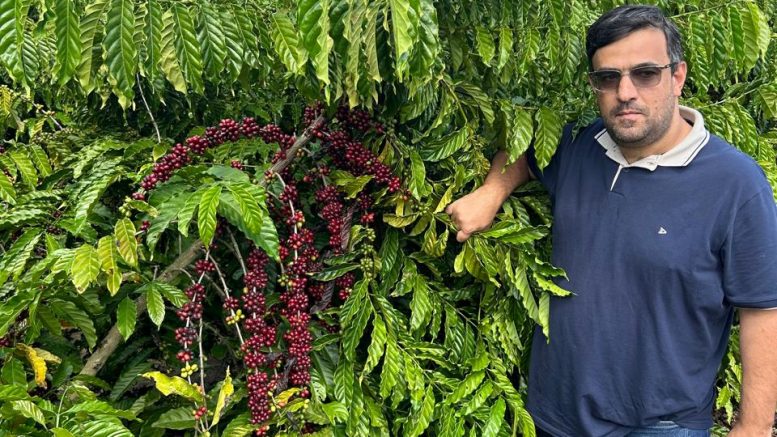
“The evolution in quality expands the possibilities for the industry to use conilon…”
Fabiano Tristão Alixandre is the state coordinator for coffee cultivation at the Capixaba Institute for Research, Technical Assistance and Rural Extension (Incaper). An agronomist with a master’s degree in Agronomy, he is currently a doctoral candidate in Genetics and Plant Breeding at the Federal University of Espírito Santo (UFES). His work focuses on genetic improvement, crop management, coffee beverage quality, sustainability, and the transfer of technology for the coffee sector.
AgriBrasilis – Why is the market demanding more Conilon coffee?
Fabiano Tristão Alixandre – This is primarily due to improvements in bean quality, driven by new technologies and better management, harvesting, and post-harvest practices. This has made it possible to increase the share of Conilon in blends with Arabica, while also opening up markets for the consumption of pure, higher-quality Canephora coffees.
Economic competitiveness, versatility for industrial use, and shifts in the global coffee supply are also significant factors. High-quality canephora coffees are gaining ground, even within the specialty coffee segment, creating new opportunities for differentiation and value addition.
AgriBrasilis – What has genetic improvement changed in Conilon coffee?
Fabiano Tristão Alixandre – Genetic improvement has made it possible to select and develop clones with greater productive potential, better beverage quality, and improved adaptation to cultivation conditions.
Cultivars developed by Incaper, such as Centenária, Jequitibá, and Diamante, offer a production potential exceeding 120 bags/ha under irrigated conditions and with proper management. These varieties also have the potential to produce coffees that score above 80 points on the Specialty Coffee Association (SCA) scale.
Clonal cultivars further increase crop uniformity and allow for better exploitation of genetic potential, provided that reproductive compatibility between clones and management recommendations are respected.
AgriBrasilis – What is being sought in new cultivars?
Fabiano Tristão Alixandre – High productivity, beverage quality, resistance to pests and diseases, and greater tolerance to drought and high temperatures. We also seek materials with stable yields and adaptability to different soil and climatic conditions.
Plant architecture, vigor, uniformity of maturation, and efficiency in the use of water and nutrients are also important characteristics. The combination of these factors can facilitate management, reduce costs, and increase production efficiency.
AgriBrasilis – What do these cultivars offer to the producer and the industry?
Fabiano Tristão Alixandre – For the producer, they mean greater production potential, better grain quality, lower risk of losses, and new opportunities for value addition. They also make it possible to produce more on the same area of land, increasing the efficiency with which land and natural resources are used.
For the industry, they offer higher-quality raw material with greater uniformity, as well as more consistent supply. Sensory improvements also expand the potential uses for Conilon coffee in blends and in products tailored to different consumer profiles.
AgriBrasilis – Is it possible to increase productivity and quality without losing hardiness?
Fabiano Tristão Alixandre – Yes. That is precisely one of the goals of genetic improvement: to select clones that combine productivity, beverage quality, and adaptation to different environmental conditions.
The materials are evaluated in different environments to measure productive stability, tolerance to biotic and abiotic stresses, and sensory performance.
However, genetic potential must be coupled with good agricultural practices. Proper nutritional, water, and phytosanitary management, along with careful handling during and after harvest, are essential for achieving gains in both productivity and quality.
AgriBrasilis – How far can Conilon coffee expand beyond Espírito Santo?
Fabiano Tristão Alixandre – Espírito Santo has established itself as the leading producer by combining favorable soil and climate conditions, a strong tradition among its producers, and continuous investment in research, genetic improvement, technical assistance, and innovation.
Rondônia and Bahia are also significant producers of canephora coffees, demonstrating that there is room for expansion. Further development in new regions will depend primarily on the selection of plant materials adapted to local conditions.
Temperature, water availability, soil characteristics, and economic viability must be taken into account. The integration of research, technical assistance, and producers will be essential for establishing new production regions.
READ MORE: