
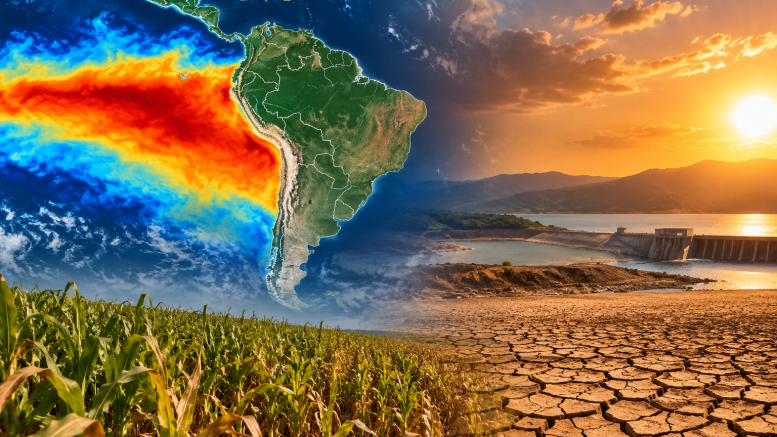
CAF Makes US$ 1 Billion Available for Possible Super El Niño in Latin America
Brazil
The Environment and Water Resources Secretariat of the State of Piauí banned the use of fire on rural properties statewide through 10/30, including controlled burns that had already been authorized. The measure responds to high temperatures, low humidity, drought and greater availability of dry vegetation. From 1/1 through 10/8, approximately 4.5 K fire hotspots were recorded, about 30% fewer than in the same period of 2025. (Environment Secretariat of Piauí)
The Brazilian Development Bank and Instituto Clima e Sociedade signed an agreement to expand investment in the recovery and conservation of Brazilian biomes. The first initiative will be ProFloresta+ 2, which may restore up to 60 K hectares, capture approximately 19 million tonnes of CO₂ and mobilize up to approximately US$ 1.2 billion in purchases of high-integrity carbon credits. (BNDES; iCS)
The National Environment Council approved national guidelines for critical air-pollution episodes and created instruments to register and track critical mining machinery. States and the Federal District must prepare plans with attention, alert and emergency levels, while excavators, backhoes, barges and mining dredges may be tracked in priority municipalities to combat illegal mining. (Conama; Environment Ministry)
The 5th Eco Invest Brasil auction approved approximately US$ 10.0 billion for investments across six value chains linked to the ecological transition, after receiving demand equivalent to approximately US$ 36.4 billion. Areas include waste circularity, green fertilizers and bioinputs, biomaterials, batteries and electric mobility, as well as biogas and biomethane. The winning proposals also provide approximately US$ 50.1 million in non-reimbursable resources during the first year for research and technological development. (Environment Ministry; Finance Ministry)
Embrapa released region-specific recommendations to reduce El Niño risks to agriculture. Guidance considers increased rainfall in the South and part of the Southeast, higher temperatures and dry spells in the Central-West and greater heat with reduced rainfall in the North and Northeast. The material complements a technical note with 163 climate-risk management measures for agricultural production. (Embrapa; MAPA)
The Ministry of Mines and Energy opened a public consultation on the 2027 emissions-reduction target for the natural gas market. The proposal sets a 1% reduction to be met through biomethane consumption, equivalent to 363.2 million m³ during the year and 3.63 million Biomethane Guarantee of Origin Certificates. The target in force for 2026 is 0.5%, while indicative percentages reach 5% in 2030. (Ministry of Mines and Energy)
AMAGGI expanded the use of pure B100 biodiesel, a fuel composed of 100% biodiesel, to three farms in the State of Mato Grosso during the 2025/26 cotton and corn harvest and soil preparation. Approximately 360 K L fueled 47 machines without perceptible power loss or equipment modifications. According to the company, replacing fossil fuel can reduce greenhouse gas emissions by up to 99%. (AMAGGI)
BTG Pactual Timberland Investment Group’s Brazil Cerrado 1 project received an “A” rating from BeZero Carbon, placing it among the top 6% of nature-based removals projects rated globally by the agency and giving it the highest ex post rating among reforestation projects in Latin America. The project spans approximately 37 K hectares in the State of Mato Grosso do Sul, while the group’s broader strategy has native ecosystem restoration underway across more than 20 K hectares of the Cerrado. (BTG Pactual TIG)
BASF reported that 23 beekeepers integrated with soybean farmers in São Gabriel, State of Rio Grande do Sul, produced approximately 36 tonnes of soybean-blossom honey in the 2025/26 season, up 44%. In August, BASF, Fundação Eco+, Unipampa and a local association also planted about 5 K native seedlings across 2.5 hectares of permanent preservation areas, Legal Reserves and other areas, focusing on biodiversity and resources for pollinators. (BASF)
Solenis relocated its global Pulp Center of Excellence from the United States to Paulínia, State of São Paulo, opening a new 500 m² facility dedicated to R&D for the pulp industry. The unit can simulate different stages of the industrial process and develop solutions aimed at operational efficiency and improved environmental performance at mills. (Solenis)
Ibama opened a public consultation on rules to register plantations and reforestation with native species and declare harvesting through the National System for Control of the Origin of Forest Products (Sinaflor) or integrated state systems. The proposal seeks to improve traceability of forest-product origin and legal predictability for farmers and companies cultivating native species for economic purposes. The consultation runs through November 6th, 2026. (Ibama)
Embrapa is selecting black-oat cultivars to recover vineyard soils in Serra Gaúcha, where copper accumulation from fungicides and herbicide-resistant ryegrass complicate management. A 12-year experiment recorded approximately 20 cm of soil loss in an uncovered area, while water infiltration reached 140 mm/h with cover and 17 mm/h without cover. (Embrapa)
Embrapa found that hoverflies controlled the sorghum aphid (Melanaphis sorghi) in forage sorghum fields without chemical pesticide applications in the State of Minas Gerais. The research indicates that greater biodiversity preservation favored natural predators and reinforces integrated pest management as an alternative to reduce chemical interventions. (Embrapa)
The Ministry of Environment and Climate Change and the Brazilian Development Bank launched an approximately US$ 4.0 million call for ecological restoration and water-resource revitalization in 44 municipalities in the States of Bahia and Pernambuco, within the influence areas of the Sobradinho and Itaparica reservoirs. Projects must restore at least 100 hectares each. Resources are part of the Floresta Viva program and commitments to revitalize the São Francisco and Parnaíba river basins. (Environment Ministry; BNDES)
The National Center for Monitoring and Early Warning of Natural Disasters reported that 276 municipalities were under severe or extreme drought in September, up 75.8% in one month, while 317 had at least 40% of potentially agricultural areas affected. For family farmers who started planting corn or beans in September, 22 municipalities faced high drought risk. On October 7th, 2026, areas in the States of Rio Grande do Sul and Santa Catarina remained under moderate flood risk. (Cemaden)
Wildfire prevention and response measures were expanded in different regions of Brazil. Suzano implemented a system in the State of Mato Grosso do Sul with 57 video-monitoring towers, artificial intelligence for automatic smoke detection and drones equipped with thermal cameras, monitoring more than 1 million hectares and directly protecting over 300 K hectares of native vegetation and conservation areas. In the State of Amazonas, Ibama ordered preventive measures on rural properties in seven municipalities, while the Government of the State of Bahia reinforced prevention, inspection and firefighting actions ahead of El Niño 2026/27. (Suzano; Ibama; Environment Secretariat of Bahia)
Pole Alimentos implemented a unit to transform poultry-processing residues such as feathers, viscera and blood into meal and oil mainly for animal feed. The project received approximately US$ 5.0 million and is part of approximately US$ 7.0 million in environmental investments by the group. The unit can process approximately 40 tonnes of residues per day. (Pole Alimentos)
The bioinputs market reached approximately US$ 1.4 billion in 2025, according to Anpii-Bio data cited by Embrapa. The segment includes biological control products, inoculants, nutrient-mobilizing microorganisms and biofertilizers, with potential to reduce dependence on chemical inputs and improve agricultural-system efficiency. (Embrapa; Anpii-Bio)
The SC Rural 2 program opened the first stage of direct support to farmers and fishers in the State of Santa Catarina, with approximately US$ 4.4 million available. The program provides for US$ 150 million in investments through 2031, including US$ 120 million financed by the World Bank and US$ 30 million from the State, and should benefit approximately 48 K families. Actions include soil conservation, biodiversity, water management, innovation and climate adaptation. (Santa Catarina Agriculture Secretariat; Epagri; World Bank)
A Federal Court ordered Adepará, the agricultural defense agency in the State of Pará, to provide Ibama and the Chico Mendes Institute for Biodiversity Conservation (ICMBio) with access to Sigeagro data on herd movements and rural properties. Cross-checking agricultural and environmental databases seeks to identify cattle originating from embargoed areas and combat illegal deforestation and cattle laundering. The ruling set a 15-day deadline. (Federal Prosecution Service)
Esalq/USP and the Crop-Livestock-Forestry Integration Network (Rede ILPF) signed a cooperation protocol to expand research, innovation and knowledge transfer on integrated crop-livestock-forestry systems. The network points to potential expansion of integrated systems across part of the 165 million hectares of pasture, with recovery of lower-productivity areas, diversification and more efficient land use. (Esalq/USP; Rede ILPF)
The bidding process for a concession covering 39.28 K hectares of the Bom Futuro National Forest in the State of Rondônia advanced to the technical-visit stage. The project provides for approximately 6 K hectares of degraded-land restoration during a 40-year contract, carbon-credit generation and stronger native seed and seedling chains. Bids will be received on November 4th, 2026 at B3. (Brazilian Forest Service)
The Water Management Institute of Minas Gerais expanded actions under the Water Farmer Program, which pays or supports farmers adopting practices such as soil conservation, vegetation recovery, spring protection and increased water infiltration. The model was presented this week as an instrument to strengthen water security and connect environmental conservation with rural activity. (Water Management Institute of Minas Gerais)

Latin America
Argentina strengthened coordination for wildfire prevention and response in national parks across Northern Patagonia for the 2026/27 season. Authorities reviewed operational resources and established common strategies among parks, the National Fire Management Service, the Federal Emergency Agency and local governments. (National Parks Administration; AFE)
The National Agricultural Technology Institute (INTA) reported that mitigation strategies adopted in livestock production in Argentina avoided 7.4 K tonnes of CO₂ emissions and increased production per breeding cow by 40% in the system studied in the Salado River Basin, Buenos Aires. Measures included improved animal health and reproduction, culling unproductive animals and pasture management. (INTA)
Chile recognized 514 public and private organizations with 880 HuellaChile seals for progress in quantifying, reducing, neutralizing and managing greenhouse gas emissions. The program, created in 2013, is part of the country’s climate-action and decarbonization strategy. (Environment Ministry)
The Environmental Assessment Service in Chile reported that 28 projects obtained environmental approval in September, associated with US$ 3.562 billion in investments. Between July and September, projects receiving favorable environmental decisions reached a record US$ 19.514 billion, mainly in energy, real estate and sanitation, including battery-storage systems of US$ 443 million and US$ 300 million. The figures represent investments associated with approved projects, not actual disbursements. (Environmental Assessment Service)
The Government of Chile started designing the first Country Platform to align public and private resources with climate projects. The first phase will prioritize transport, waste, forestry and adaptation, including biogas, biodigesters, sustainable forest management, carbon, biodiversity and water security. The country is preparing a request for support under the Green Climate Fund Readiness program. (Environment Ministry)
Chile’s Native Forest Conservation, Recovery and Sustainable Management Fund selected 882 initiatives in 2026, including 548 from small forest owners and 334 from other participants. Resources support conservation, recovery and sustainable management of native forests and xerophytic formations. (CONAF)
Sustainable irrigation programs advanced in Chile. The Agricultural Development Institute mobilized approximately US$ 32.7 million in 2025 for 3,188 projects that expanded water availability across 29.9 K hectares and served 6,199 farmers. The National Irrigation Commission also opened the first national Nature-Based Solutions competition for irrigation, with approximately US$ 307 K in subsidies covering up to 95% of project costs, including fog-water harvesting, soil conservation and natural aquifer recharge. (INDAP; National Irrigation Commission)
Colbún and the Energy Ministry in Chile advanced a community solar-generation project with investment of approximately US$ 409 K. The model will initially serve 60 families and may reach 200 by 2027, with estimated annual savings of approximately US$ 153 per family. A local cooperative will manage the system. (Colbún)
Colombia officially declared the El Niño phenomenon after confirming persistent oceanic and atmospheric conditions. The Institute of Hydrology, Meteorology and Environmental Studies – IDEAM estimates an 83% probability of strong to very strong intensity at least through March 2027. National preparedness prioritizes risks of water shortages, wildfires, livelihood losses and continuity of essential services. (IDEAM; Environment Ministry; UNGRD)
Colombia will receive €20 million from Germany for the third phase of the REM Vision Amazonia program, focused on reducing deforestation, conserving forests and developing sustainable production models with Indigenous and rural communities. The new phase is expected to run for five years from September 2027 and will be linked to targets for reducing emissions from deforestation and forest degradation. (Environment Ministry)
The Agriculture Ministry in Colombia started an international mission to seek cooperation, technology and investment for five agricultural programs. Proposals include regenerative agriculture and livestock with irrigation for 650 K small livestock holdings, incorporation of 1.5 million hectares into agriculture, infrastructure for water security and climate adaptation and six agroindustrial free-trade zones. Funding is still being sought. (Agriculture Ministry)
Colombia’s National Land Agency and authorities from the National Environmental System strengthened coordination to incorporate environmental information from the initial stages of land-access and land-management processes. The initiative brought together the 33 Regional Autonomous Corporations and seeks to verify environmental restrictions and land-use conditions before properties are allocated. (National Land Agency)
The Government of the Dominican Republic expanded actions for water efficiency and agricultural resilience. Approximately US$ 498 K was allocated in incentives to modernize irrigation at 17 dairy farms, with subsidies covering up to 70% of project costs, and rehabilitation began on the Horacio Vásquez canal in Montecristi under the World Bank-financed Resilient Agriculture and Integrated Water Resources Management Project. The works will benefit 2.55 K irrigating farmers. (Presidency; Indrhi)
The Government of the Dominican Republic reported progress in the environmental recovery of the Gurabo River, which previously accounted for about 43% of the pollution load in the Yaque del Norte River. The project includes sanitation, degraded-area recovery and relocation of families from risk zones. (Presidency)
Panama and Israel started technical cooperation to develop and strengthen an early-warning system for water quality in the Azuero Peninsula. The work builds on a remote telemetry monitoring station already installed on the La Villa River and is expected to establish thresholds, assessment criteria and communication mechanisms to anticipate risks to water-supply sources. (Environment Ministry)
The Agriculture Development Ministry in Panama and the German Agency for International Cooperation (GIZ) advanced an EU-funded project to develop deforestation-free agricultural supply chains. The initiative includes sustainable livestock in Darién and coffee in the Canal basin, as well as georeferencing, traceability, digitalization and practices for efficient water use. (Agriculture Development Ministry)
FAO and the Inter-American Development Bank opened a regional meeting in Panama to develop a Latin American roadmap for solutions to decouple agricultural production from deforestation. Discussions include traceability, deforestation-free trade, agroforestry, silvopastoral systems, financing and support for small-scale producers. (FAO)
Peru approved a new Regulation for Integrated Solid Waste Management in the Agriculture and Irrigation Sector. The rules cover source reduction, segregation, selective collection, transport, treatment, material and energy recovery, storage and final disposal in authorized areas under circular-economy principles. The decree replaces the sector regulation issued in 2012. (MIDAGRI; El Peruano)
Peru completed the migration of the Flash Flood Guidance System to national servers operated by the National Service of Meteorology and Hydrology – Senamhi, strengthening the operational autonomy of the early-warning system. The platform integrates hydrometeorological data to identify conditions favorable to flash floods and also supports regional cooperation with Ecuador and Colombia. (Senamhi; Environment Ministry)
The Amazon countries Bolivia, Brazil, Colombia, Ecuador, Guyana, Peru, Suriname and Venezuela approved a permanent coordination mechanism for integrated water management under the Amazon Cooperation Treaty Organization. The framework provides for stronger hydrological monitoring and data interoperability, regional protocols, drought and flood preparedness, climate adaptation and a regional portfolio of projects and financing. (ANA; RADA; ACTO)
CAF reported that the portfolio of operations and initiatives for agriculture already mobilizes more than US$ 2 billion in Brazil, Chile, Colombia, Ecuador, Panama, Peru and the Dominican Republic. Resources cover credit, water infrastructure and irrigation, agroexports, technology and sustainable production. The institution maintains a target of US$ 8.5 billion in cumulative agricultural financing by 2030. (CAF)
Cirion Technologies reported an 11% reduction in total greenhouse gas emissions in 2025. The company uses 100% renewable electricity through International Renewable Energy Certificates (I-REC) at data centers in Brazil, Chile, Colombia and Peru; an artificial-intelligence system also reduced cooling consumption by 13.8% at a facility in Bogotá. (Cirion Technologies)
CAF made an initial US$ 1 billion available to support countries in Latin America and the Caribbean in preparing for and responding to a possible “super El Niño” episode in 2026/27. The World Bank warned that the phenomenon may affect agriculture and hydropower generation and raise food and energy prices, while Argentina will reinforce response capacity in northeastern and coastal provinces amid the risk of heavy rainfall and flooding. (CAF; World Bank; Government of Argentina)
More than 90 representatives from 20 countries in Latin America and the Caribbean discussed the implementation of carbon-pricing instruments and carbon markets at ECLAC. Discussions covered financing under Article 6 of the Paris Agreement, interministerial governance, registry interoperability and stronger monitoring and verification systems. (ECLAC)

READ MORE: