
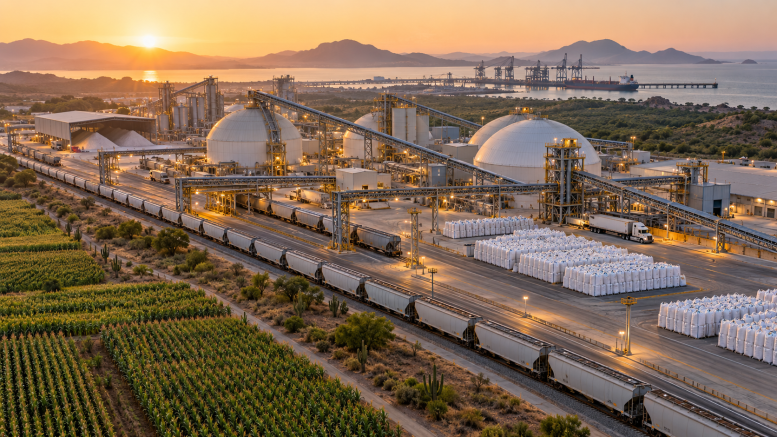
Mexico Plans US$ 5.18 Billion Investment to Expand Fertilizer Production
Brazil
Fertilizer companies requested US$ 326 million in credit under the new phase of the “Brasil Soberano” Plan, a federal credit program designed to support Brazilian companies affected by geopolitical instability and higher trade tariffs. The Brazilian Development Bank – BNDES has already approved approximately US$ 141 million for the sector. Credit lines cover working capital, machinery and equipment and investment projects. (BNDES)
The Brazilian bioinputs market is to end 2026 with 5%–7% growth in value and approximately 10% in volume, according to ANPII Bio. In 1H26, sales volume increased 7%, while sales value remained stable. Biological products with more than one class of use accounted for 22% of sales value in the 1Q26, compared with 16% in 2025. (ANPII Bio)
Marcelo Batistela was appointed as Senior Vice President of Business and Managing Director at BASF Agricultural Solutions in Brazil. (BASF)
Embrapa released two new cotton cultivars developed in partnership with Lyntera. Both are resistant to nematodes and crop diseases. One includes technology for caterpillar resistance and glyphosate tolerance, while the other combines insect resistance and herbicide tolerance. (Embrapa)
Research presented at the 15th Brazilian Cotton Congress indicated increased incidence of ramularia leaf spot, caused by the Ramulariopsis gossypii and Ramulariopsis pseudoglycines fungal complex, and target spot, caused by Corynespora cassiicola. Specialists also warned that periods of heat and drought may favor aphids and whiteflies, reinforcing the need for monitoring and integrated pest management. (Abrapa; Embrapa)
Pesticide costs for corn in the State of Mato Grosso were estimated at US$ 174/ha for the 2026/27 crop, up 23.37% compared with the previous season and representing the largest increase among the main production cost components. Fertilizers and soil amendments increased 9.08% to approximately US$ 297/ha. Total production expenses were estimated at approximately US$ 725/ha (+13.89%). (Senar-MT/Imea)
MAPA cancelled four pesticide registrations and four registration processes. (Official Gazette of Brazil, Act No. 60 of September 22ⁿᵈ, 2026 – published on September 28ᵗʰ, MAPA)
Anvisa approved, in compliance with court decisions, the toxicological evaluations of two formulated pesticides based on equivalent technical products: one based on chlorantraniliprole + chlorfenapyr, from Adama, and another based on fluindapyr + mancozeb + prothioconazole, from Gowan. (Official Gazette of Brazil, Resolutions-RE No. 3795 and No. 3796 – published on September 28ᵗʰ, Anvisa)
The government considers that the risk of fertilizer shortages for the 2026/27 season is limited. A memorandum signed between MAPA and a Moroccan supplier establishes a reference volume of 3.8 million tonnes of phosphate fertilizers for Brazilian operators in 2026 and 2027, subject to commercial negotiations. (MAPA; OCP Nutricrops)
Sanepar expanded the availability of biosolids produced from treated sewage sludge for agricultural use in the State of Paraná. The input contains organic matter, nitrogen, phosphorus and other nutrients and can reduce fertilizer and soil amendment costs. (Sanepar)
The agricultural defense authority of the State of São Paulo launched a sanitary education project on responsible pesticide use. The first event addressed prescription, purchasing, risk mitigation, storage, bioinputs and disposal of empty pesticide packages. (Agricultural Defense Authority of the State of São Paulo)
Prosecutors in the State of Mato Grosso recommended farmers in Tapurah, State of Mato Grosso, comply with minimum pesticide application distances near urban areas. Mechanized ground applications must remain at least 90 m away, while aerial applications must observe a 500-meter buffer from populated areas and public water sources. (MPMT)
Investigations identified organizations specialized in counterfeit pesticides operating in the Ribeirão Preto and Franca region, in the State of São Paulo. In the State of Santa Catarina, an operation by the Civil Police and the Santa Catarina Agricultural Development Company – Cidasc arrested a suspect for illegally selling pesticides through social media and seized unregistered products. (Civil Police of the State of Santa Catarina; Cidasc)
The treated area with bioinputs in Brazil reached 46 million hectares in the 1H26, up 18.3%. The market reached approximately US$ 345 million in sales during the period. Bioinsecticides accounted for 47% of sales and 35% of the treated area. (CropLife Brasil)
FMC submitted in Brazil the regulatory dossier for the active ingredient rimisoxafen, a herbicide classified in HRAC Groups 12 and 32. It is the ingredient’s second global registration request, following the United States. Registration requests for formulated products are expected to follow. The active ingredient is not yet registered for sale or use in any country. (FMC)
Potassium chloride (KCl) prices at Brazilian ports declined for nine consecutive weeks, accumulating a drop of just under 10%. Lower purchasing urgency as soybean planting advanced contributed to the decline. (StoneX)
Research by Embrapa and USP identified the bacteria Streptomyces virginiae CMAA1738, Paenibacillus ottowii CMAA1739 and Pseudomonas inefficax CMAA1741, which reduced the severity of wheat root rot caused by Bipolaris sorokiniana by approximately 60% under controlled conditions. The bacteria modified the rhizosphere microbiome without consistently reducing the amount of the pathogen in the soil. (FAPESP; Embrapa)
Nutrien ended the agricultural input retail operations in the States of São Paulo and Mato Grosso do Sul. The company said the decision is part of a review of the operations portfolio. Since May, Nutrien had been evaluating strategic alternatives for the retail business in Brazil. (Nutrien)
Brazil authorized up to approximately US$ 959 million in tax credits between 2027 and 2031 for domestic production projects involving fertilizers, raw materials, remineralizers, bioinputs and biofertilizers. The annual limit is approximately US$ 192 million and credits may cover up to 20% of eligible project expenditures. (Complementary Law No. 235/2026, Presidency of Brazil)
The Brazilian market for Bacillus-based biological control products reached US$ 403.17 million in 2025, up 252% from 2020. Potential treated area increased from 7.5 million to 37.2 million hectares and these products accounted for approximately 47% of Brazilian biological control agent sales in 2025. (Brazilian Journal of Microbiology)

Latin America
Syngenta Crop Protection reported sales of US$ 6.6 billion in the 1H26, up 4%. Sales in Brazil increased 7% despite continued pricing pressure. In Latin America, sales declined 11% due to lower prices, reduced volumes, elevated channel inventories and continued destocking, particularly in Argentina. Biologicals sales increased across all regions. (Syngenta Group)
Brazil and Argentina advanced discussions to expand Argentine fertilizer supplies to the Brazilian market. Projects include Pampa Energía’s new urea plant in Bahía Blanca, Argentina, with an investment of US$ 2.7 billion and annual capacity of 2.1 million tonnes. Brazil considers Argentina a potential major fertilizer supplier, particularly for urea. (IICA; Pampa Energía)
Argentina updated the National Program for the European grapevine moth (Lobesia botrana), consolidating a regulatory framework applicable throughout the country. The regulation updated the risk mitigation system for fresh grapes intended for the domestic market, the contingency plan and the procedure for authorizing imports of pheromone compounds used to control the pest. (Official Gazette of Argentina, Senasa Resolution No. 870/2026 of September 24th, 2026 – published on September 25th)
Argentina established a new procedure for administrative authorization of the use of crop protection products for minor crops, pests under official control and new spraying methods, including drones. (Official Gazette of Argentina, Senasa Resolution No. 869/2026 of September 23rd, 2026 – published on September 24th)
China’s share of Chilean fertilizer imports fell from 48.2% in 2025 to 3.2% in the 1H26 following Chinese export restrictions. Malaysia, Turkmenistan and Brunei gained share as suppliers. Chile is also supporting local projects related to fertilizers, biofertilizers and biostimulants. (Ministry of Economy, Development and Tourism of Chile)
Mexico maintains a public and private investment plan of approximately US$ 5.18 billion between 2026 and 2030 for the recovery of the petrochemical industry and expansion of fertilizer production. The government aims to increase fertilizer output to more than 4 million tonnes per year. A new fertilizer plant in Veracruz involves an additional investment of approximately US$ 1.41 billion. (Presidency of Mexico; Government of Veracruz)
Mexico created a platform for consolidated and direct purchases of seeds, fertilizers, bioinputs and other inputs for white corn and wheat. The system will become available on September 30ᵗʰ and will allow purchases directly from manufacturers and authorized distributors. (Secretariat of Agriculture)
Uruguay reported that a scientific study on glyphosate residues in food was corrected after a calculation error was identified. Revised values were significantly below those initially reported and, according to the corrected data, all foods analyzed except powdered milk were below the maximum residue limits considered. In analyses of eight food samples, the Ministry did not detect glyphosate. (MGAP)

READ MORE: