
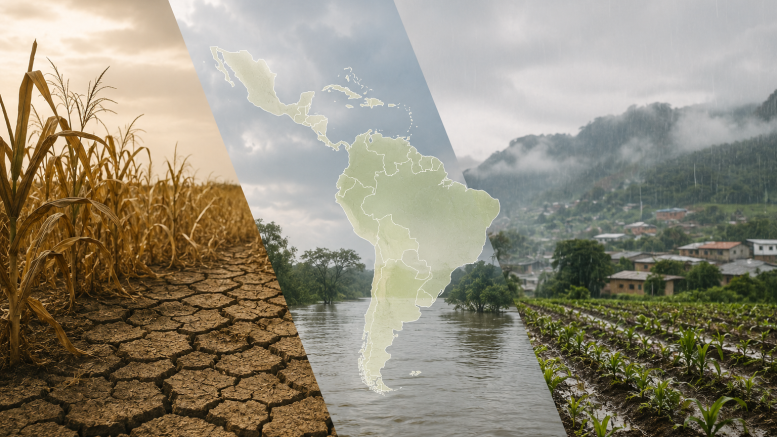
El Niño Alerts and Heavy Rains Heighten Climate Risks Across Latin America
Brazil
The affected area by drought in Brazil decreased between May and June, from 50% to 45%. Drought conditions eased in the States of Ceará, Goiás, Mato Grosso do Sul, Paraná, Rio Grande do Norte, Santa Catarina and São Paulo. The phenomenon intensified in the States of Alagoas, Bahia, Minas Gerais, Pernambuco, Piauí, Rio Grande do Sul and Sergipe. (ANA)
The State of Rio Grande do Sul Civil Defense authorities maintain flood warnings for sections of the Taquari River due to continued rainfall and rising water levels. Farmers in at-risk areas are advised to take preventive measures to protect people, animals, machinery and equipment. (Defesa Civil-RS; SGB)
The Environmental Foundation of the State of Minas Gerais halted Sigma Lithium operations in the rural areas of Araçuaí and Itinga following an inspection conducted from May 25th to 29th. The company was formally notified on July 13th and is negotiating an environmental settlement agreement to resume the activities that were partially and temporarily suspended. Sigma Lithium disputes the alleged irregularities. (Feam; Supram Jequitinhonha)
The Federal Public Prosecutor’s Office brought together public agencies, research institutions and civil society representatives to map the causes of coastal pollution in the city of João Pessoa, State of Paraíba. The identified sources included illegal sewage discharges, pollution carried by urban rivers, improper solid-waste disposal and effluent from ships. (MPF)
Bayer inaugurated a biomass-fired boiler at the plant in São José dos Campos, State of São Paulo, as part of the company’s largest decarbonization project in Latin America. The facility will replace natural gas and is expected to reduce the plant’s emissions by 40%. The unit mainly produces herbicides. The investment amount was not disclosed. (Bayer)
The National Development Bank has approved approximately US$ 19 million in financing for Grupo Potencial to build a new biodiesel plant in the city of Lapa, State of Paraná. The financing is part of a total investment of approximately US$ 45.3 million, including US$ 15.2 million from the Climate Fund. The facility will have the capacity to produce 1,200 tonnes of biodiesel/day and reduce emissions by approximately 782,200 tonnes of CO₂ per year. (BNDES; Grupo Potencial)
Asset manager Patria Investimentos has partnered with the Restoration Seed Capital Facility to expand the investment pipeline of the Reforest Fund in Brazil. Targeting up to US$215.8 million, the fund invests in reforestation and agroforestry systems that combine environmental restoration with crops such as coffee, cocoa, assaí and avocado, as well as tropical timber species. (Patria Investimentos; RSCF)
The Government of the State of Espírito Santo and eight financial institutions agreed to provide approximately US$ 1.97 billion in credit to the State’s agricultural sector for the 2026/27 season, in addition to US$ 256 million through Rural Product Certificates. Banco do Brasil, Banco do Nordeste, Banestes, Caixa, Cresol, Sicoob, Sicredi and Bandes participate in the plan, which prioritizes soil conservation, efficient water use and climate-adapted technologies. The overall target is approximately US$ 2.23 billion in financing through 49,100 operations. (Espírito Santo State Agriculture Secretariat)
SIG packaging installed a photovoltaic system comprising 1,136 panels and 550 kWp of capacity at the factory in Vinhedo, State of São Paulo. All electricity generated will be consumed by the facility, which aims to operate with 100% renewable electricity. The project complements an investment of approximately US$ 7.6 million announced in 2025 to modernize the plant. (SIG)
Sustainable tourism social enterprise Vivalá reported expeditions injected approximately US$ 1.66 million into local economies across Brazilian territories between 2015 and 2025. Of this amount, more than US$ 166 thousand was directed to Indigenous territories through the procurement of community-based services. The company’s impact report also covers operations in protected areas, territorial impacts and carbon offsetting. (Vivalá)

Latin America
In Bolivia, bills seeking to repeal Laws No. 1171, 741 and 337, associated with the use of fire and deforestation, remain stalled in the Lower House of Congress due to insufficient parliamentary support. The laws cover fire management, authorize clearing and burning of up to 20 hectares under certain conditions and establish exceptional measures for regularizing illegal clearing and burning. (Bolivian Lower House of Congress)
The government of Chile has declared a Constitutional State of Catastrophe in the Coquimbo Region and Huasco Province following heavy rainfall that caused flooding, isolated communities, disrupted roads and damaged infrastructure. The government is assessing whether to declare an agricultural emergency in the affected areas and has mobilized resources, equipment and relief operations. (Ministry of the Interior; Senapred)
A forest fire in El Peñón, in Colombia, was brought under control after approximately three days, aided by rainfall. The Santander Regional Autonomous Corporation will conduct a technical assessment of damage to flora and fauna. (CAS; Santander Risk Management Office)
The National Emergency Operations Committee of Ecuador has raised the El Niño alert level to orange in 17 provinces. The government made implementation of the national action plan a priority, ordered permanent monitoring and regular public updates and announced approximately US$ 600 million for preventive measures. (COE; Erfen; Inamhi; Inocar)
The Development Bank of Latin America and the Caribbean – CAF has launched the Vela Fund in Mexico City, Mexico, an investment vehicle that aims to mobilize between US$ 100 million and US$ 150 million for sustainable companies and projects in Latin America and the Caribbean. CAF will participate as an anchor investor with up to US$20 million, while the fund will be managed by Sonen Capital and Mexico’s Fondo de Fondos. The resources will be directed to areas such as regenerative agriculture, sustainable food systems, biodiversity and the blue economy. (CAF)
The National Confederation of Beekeepers of Peru warns of potential beehive losses along the coast due to El Niño. According to the organization, approximately 30% of coastal hives were lost during the previous event and approximately 15 thousand coastal beekeepers could be affected. Pollination-dependent crops such as avocados, blueberries, citrus fruits and mangoes jointly cover approximately 233 thousand hectares. (Conapi; Midagri)

READ MORE: