
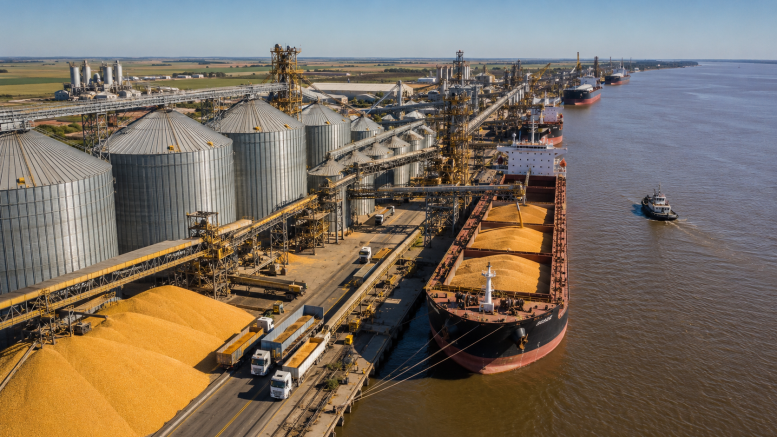
Argentina Sets 1H26 Grain Export Record as Corn and Wheat Shipments Rise

The Rosario Board of Trade reduced the 2026 forecast for the agricultural foreign-exchange inflows to US$ 34.9 billion, about US$ 1.2 billion below the previous estimate, due to lower international prices. By June, the sector had settled US$ 15.77 billion, down nearly 14% from the same period in 2025. (Rosario Board of Trade)
The Government signed the concession contract for the Trunk Waterway with the Jan de Nul–Servimagnus consortium, ending the state-management phase of the country’s main river route for foreign trade. The new concession provides for an automatic 13.5% reduction in tolls, deepening works, and the incorporation of technology, with direct impact on costs for agroindustrial exports. (National Ports and Navigation Agency)
Argentina advanced in the deregulation of the dairy chain by eliminating the Dairy Operators Registry and removing the sector from the Meat and Dairy Operators Information System. The measure reduces administrative requirements for 468 operators and reinforces the government’s regulatory simplification agenda in a chain pressured by costs, export competitiveness, and the need for greater productive formalization. (Secretariat of Agriculture)
Record grain and derived product exports in the 1H26, with more than 60.7 million tonnes shipped. Corn reached 21 million tonnes, wheat 11.1 million tonnes, sunflower, including grain and by-products, 4.4 million tonnes, and soybean exports 20.1 million tonnes (-3% compared with 2025), with the lowest share of total exports in 26 years. Wheat planting for the 2026/27 season is close to completion, while soybean harvesting is in its final stage and corn and sorghum harvesting remain limited by high grain moisture. (Rosario Board of Trade; Secretariat of Agriculture)
Bunge will expand presence in winter oilseeds in Argentina, focusing on canola and other alternative crops, such as safflower and camelina. The company said the production agreements covered almost 90 thousand ha across more than 1 thousand cultivated areas in eight provinces in the last crop season. (Expoagro; Bunge Argentina)

The Government and the Parliamentary Agricultural Front ended meeting without an agreement on the renegotiation of rural debts. The disagreement involves eligibility criteria and financial conditions. The FPA defends Bill No. 5122/2023, approved by the Senate, which provides for credit of up to approximately US$ 1.8 million per beneficiary and US$ 9.1 million for cooperatives, upon proof of a loss of at least 30% of gross income in two or more crop seasons between 2019 and 2025. The Executive Branch’s proposal limits credit to approximately US$ 73 thousand for small-sized farmers, US$ 364 thousand for medium-sized farmers and US$ 727 thousand for other categories, with payment of 5% to 10% of previous debts required to access the new credit. (FPA)
The off-season corn harvest remains below the historical average, reaching 26.1% in Brazil’s Center-South, below the same period last year (29.1%) and the historical average of 30.3%. Irregular rainfall, delayed planting, and slower harvesting contributed to the scenario. Production for this crop is projected at 112.4 million tonnes. (Datagro)
Orange juice exports decreased 30% due to weaker international demand and did not follow production volume, which reached 746.5 thousand tonnes, stable compared with the previous period (745.7 thousand tonnes). (Datagro)
Agribusiness exports from the State of Rio Grande do Sul grew 3.9% compared with the same period last year, reaching US$ 1.24 billion and accounting for 68.9% of all sales in the period. Revenue increased despite a 2.2% decline in shipped volume. In the 1H26, the State’s exports totaled US$ 6.84 billion, up 8.3% compared with the same period of the previous year. (Farsul)
The State of São Paulo recorded a US$ 10.38 billion surplus in agribusiness trade in the 1H26, with exports totaling US$ 13.34 billion and imports reaching US$ 2.96 billion. Agribusiness accounted for 37.9% of the State’s total exports. The main exported groups were sugar and ethanol, meat, soybean complex, forest products and juices. China was the main destination, with a 28.3% share. (APTA; IEA-Apta; ComexStat/MDIC)
The Brazilian Soluble Coffee Industry Association, the Brazilian Coffee Exporters Council, and the National Coffee Association of the USA defended, at a hearing of the Office of the US Trade Representative, the exclusion of Brazilian soluble coffee from the proposed additional 25% tariff under Section 301. The entities argued Brazil accounts for 22% of US soluble coffee imports, the product is a relevant input for the US food and beverage industry, and the tariff could increase costs, reduce supply and pressure consumer prices. (Abics; Cecafé; National Coffee Association)
LS Tractor announced a new expansion cycle in Brazil, with a US$ 3.87 million investment planned for the next two years, following US$ 7.75 million invested since 2024. The resources will be allocated to portfolio expansion, information technology, infrastructure and operational expansion. The company appointed Bono Kim as president of the Brazilian operation and projects a 50% increase in revenue in the country between 2026 and 2028. (LS Tractor)


Fresh fruit and vegetable exporters may
Chile received a delegation of 22 company representatives and investors from the UAE to discuss business and investment opportunities in strategic sectors, including agribusiness. Chilean entities such as the National Agriculture Society and the Agri-Food Export Council participated. (Subrei; ProChile; InvestChile)
Fruit exports reached US$ 7.94 billion FOB in the 2025/26 season to date (+3.5% compared with the same period of the previous season). Fresh fruit accounted for 72.7% of the exported value, with US$ 5.78 billion FOB; cherries, grapes, blueberries, avocados, and apples concentrated 83% of this total. Between January and May 2026, vegetable exports totaled US$ 319 million FOB (-3% compared with the same period in 2025), with vegetable seeds reaching US$ 126 million FOB (+15%) and tomato paste exports to Brazil increasing (+94%). (Odepa)


The Rural Association launched a new stage of the GANARP project, a digital tool to modernize livestock management, strengthen traceability, organize production data and meet new requirements from international markets. The system includes individual animal records, movements, health data, supplementation, reproductive information and control of the usage of animal health products. (ARP)
Chile remains the main buyer of Paraguayan beef in 2026, with approximately 43 thousand tonnes purchased and an approximate value of US$ 300 million. (ARP; Senacsa)
The Chamber of Exporters and Traders of Grains and Oilseeds participated in the Paraguay–UAE Business Leaders Meeting, held during the visit of the UAE Minister of Foreign Trade. Buyers and potential investors expressed interest in animal feed, cereals, oilseeds, soybeans, alfalfa, corn, rice and powdered milk, as well as joint ventures with cooperatives for production under leasing. (Capeco)

Peru is seeking to strengthen the cocoa chain with new high-performing cocoa varieties, with greater disease resistance and quality standardization for exports. A study by the Institute for Research on Sustainable Development of Ceja de Selva identified four new cocoa varieties with better field performance; one of them, from the Awajún group, showed 41% genetic proximity to the CCN-51 cultivar, indicating potential to expand the genetic base used in cocoa breeding. The National Quality Institute also approved a technical standard for good harvesting and processing practices, with guidelines for management, fermentation, drying, infrastructure, and protective equipment, all decisive factors for quality, prices, and access to international markets. (Indes; Inacal)
Increase in fruit exports, especially passion fruit, grapes, blueberries, mangoes and avocados. Passion fruit exports are expected to reach approximately US$ 78.6 million in 2026 (+5% compared with 2025). The National Institute for Agricultural Innovation announced the planting of 40 thousand grafted passion fruit seedlings, with potential to increase productivity from 15 t/ha to 40 t/ha. In the 1H26, exports of grapes, blueberries, mangoes, and avocados totaled approximately US$ 431 million, while the Ministry of Agrarian Development and Irrigation projects that the country could surpass Chile in fruit exports by 2028. However, citrus exports decreased (-20%) in one month, with mandarin exports down 40% and lemon and orange exports up 5% and 10%, respectively. (ADEX; INIA; Midagri; ProCitrus)

Cold weather and lower domestic supply are increasing the country’s dependence on fruit imports from Brazil. Watermelon and melon supply was supported by Brazilian imports, while winter conditions threaten the stability of vegetables such as chard, spinach, beetroot, broccoli, and lettuce. The scenario highlights the vulnerability of Uruguay’s fruit and vegetable supply to climate shocks and regional seasonality. (MGAP)

READ MORE: