
“At the same time, field performance and the sector’s progress do not depend solely on the origin of the equipment…”
Marcus Lawder, commercial director at DronePro, is an agronomist graduated from the Federal University of Paraná, with an MBA in Business Management from FGV.
Founded in 2016, DronePro was one of the first official partners of DJI Agriculture in Brazil. Focused on the Northern region, the company has a distribution and technical support center in Marabá, State of Pará and a network of 63 dealerships across the region.

Marcus Lawder, commercial director at DronePro
AgriBrasilis – Does Brazil have the technology to manufacture agricultural drones?
Marcus Lawder – Brazil has the technical capacity to develop agricultural drones and already has companies operating in this segment. However, when it comes to large-scale spraying, the market is still predominantly supplied by imported technologies, which are the result of years of investment in research, industrial scale and systems integration, with major advances in flight automation, payload capacity, application precision and operational efficiency. This level of technological maturity is still under development in Brazil and the domestic industry is gradually advancing in the segment.
At the same time, field performance and the sector’s progress do not depend solely on the origin of the equipment, but also on the structure supporting its operation, including technical assistance, parts availability, operator training, field support and adaptation to the specific characteristics of Brazilian agriculture.
AgriBrasilis – What explains the jump from 3,000 to 35,000 agricultural drones in the country between 2021 and 2025?
Marcus Lawder – This growth is the result of a combination of technological advances, operational gains in the field and regulatory evolution.
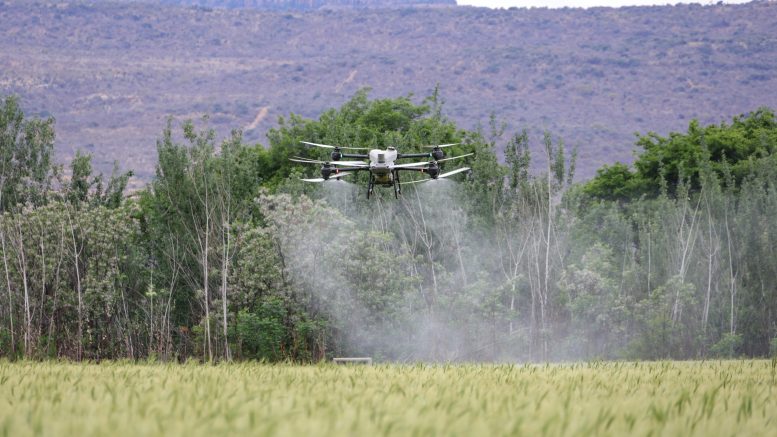
Drones provide greater safety for applicators, application precision, operation in hard-to-reach areas, reduced consumption of water and inputs and expanded operational windows, with results equivalent to or even better than traditional spraying methods.
The study “Use of agricultural drones in Brazil: from research to practice,” by Embrapa, shows, for example, that drones can achieve greater droplet penetration into the crop canopy and higher deposition in the lower third of plants — areas difficult for conventional sprayers to reach — with rates up to 1.9 times higher.
Spraying also maintains efficiency even with lower spray volumes, increasing operational autonomy and area coverage capacity, while eliminating crop damage caused by machinery traffic, which can reach up to 7% in soybeans and 4.8% in rice.
Equipment has also evolved rapidly in payload capacity, operational autonomy and automated systems.
Finally, regulation has reduced barriers and created clearer rules for the sector, driving its expansion.
AgriBrasilis – How have regulatory changes impacted this market?
Marcus Lawder – Starting in 2021, through Ordinance No. 298 issued by the Ministry of Agriculture (MAPA), Brazil established specific rules for the use of agricultural drones, bringing greater legal certainty and clear criteria for operations, training and operator registration.
New measures promoted by MAPA and the National Civil Aviation Agency also helped simplify requirements, reduce regulatory barriers and professionalize the market. This year, the entry into force of the Brazilian Special Civil Aviation Regulation No. 100 modernized Brazilian regulations by adopting operational risk-based criteria aligned with international standards.
Despite the progress, the regulatory environment still involves different agencies, such as the National Civil Aviation Agency (ANAC), Department of Airspace Control (DECEA),
Even so, the overall balance is positive and Brazil currently has one of the most structured regulatory environments.
AgriBrasilis – In which situations is the use of drones more recommended than manned aircraft?
Marcus Lawder – Both technologies have distinct operational characteristics and the choice depends on the area conditions and the application objective.
Drones are more recommended in areas with irregular terrain or difficult access, as well as in situations requiring quick responses and where there are logistical or climate restrictions for manned aircraft operations.
Another important advantage is operation without ground contact, avoiding soil compaction and crop damage, as well as providing greater operational safety, with fewer risks associated with low-altitude flights and operator exposure during application.
Manned aircraft, on the other hand, continue to be more recommended for large, flat and continuous areas, where operational volume is the main factor.
In practice, the two technologies are complementary within agricultural operations.
AgriBrasilis – Who is driving demand for drones the most?
Marcus Lawder – Initially, service providers played an important role in spreading agricultural drones across Brazil, allowing many farmers to test the technology before investing in purchasing equipment.
As the market matured, this demand profile diversified and farmers themselves also began investing directly in drones.
This movement was accompanied by the growth of specialized dealerships and the professionalization of the sector. In DronePro’s case, for example, most of its partner network is now made up of dealerships specialized exclusively in drones.
In general, the sector has evolved rapidly and now requires not only equipment supply, but also technical support and operational training to ensure efficient use of the technology.
AgriBrasilis – What are the main mistakes related to improper use of this equipment? How can drift, coverage failures and poor calibration be avoided?
Marcus Lawder – Among the most common problems are applications carried out under unsuitable weather conditions, incorrect flight height and speed, inadequate droplet size selection and equipment calibration failures.
Drift, for example, usually occurs when there is excessive wind, high temperatures, or low air humidity. Coverage failures are generally associated with incorrect adjustments to application width, flow rate, or overlap between passes.
Therefore, efficient use of the technology requires monitoring weather conditions, proper operational planning, operational safety and correct equipment calibration according to the crop and phytosanitary target.
Even with automated systems and advanced navigation features, efficiency still depends on operator training and the proper use of application parameters.
READ MORE: