

Soybean and corn harvests are boosting exports, which could exceed US$ 36 billion in 2026. Soybean harvest was estimated at 50 million tonnes and corn at 68 million tonnes. The progress of the harvest has accelerated grain shipments, with a record number of trucks arriving at ports in Rosario. (BCR)
Inflation reached 2.6% in April, down from 3.4% in March. In the 12-month period, the Consumer Price Index reached 32.4%. Despite the monthly slowdown, Javier Milei’s government still faces difficulties in keeping inflation below 2% per month, amid exchange rate volatility and the effects of the country’s economic adjustment. (Indec)

André de Paula, Brazil’s Minister of Agriculture, is on an official mission to China aimed at strengthening agricultural cooperation and expanding market access for Brazilian products. The agenda includes participation in SIAL 2026 and meetings with Chinese authorities on trade, sanitary matters and sustainable agriculture. Brazil will have a record presence at the fair, with 82 exhibiting companies and an expected US$ 3.3 billion in business deals. (MAPA)
Agribusiness exports totaled US$ 16.65 billion in April, up 11.7% compared to the same month in 2025 and a record for the period. The performance was driven mainly by soybean shipments in grain form, as well as an increase in shipped volumes. Agribusiness accounted for 48.8% of the country’s total exports in the month. (MAPA)
China has authorized the reinstatement of three Brazilian meatpacking plants to resume beef exports after a suspension in 2025. Among the approved facilities is the JBS plant in Mozarlândia, State of Goiás. The decision followed a meeting between Brazilian and Chinese authorities in Beijing and reinforces confidence in Brazil’s sanitary system, according to the industry. (ABIEC)
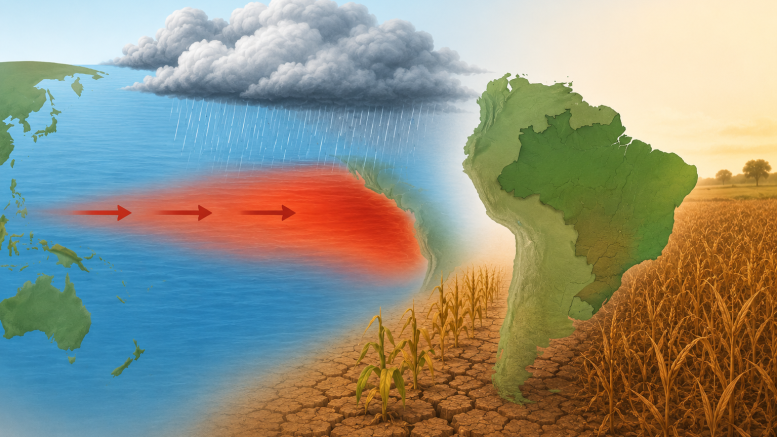
Increased probability of a new El Niño event in the 2H26. According to the National Institute of Meteorology, there is a 62% chance of the El Niño pattern developing between June and August, with probability rising to 80% from August onward. If this scenario is confirmed, the phenomenon is expected to mainly influence late winter and spring in Brazil, with a tendency toward increased rainfall in the South, raising risks for wheat and oat crops, especially during flowering, grain filling and maturation. In the North, Northeast and parts of the Center-West and Southeast, reduced rainfall may increase the frequency of dry spells, affecting the planting and early development of crops such as soybeans and corn. Available at: https://portal.inmet.gov.br/uploads/notastecnicas/Nota-T%C3%A9cnica.pdf (Inmet)
Local demand for corn is expected to reach a record level of 100 million tonnes in 2026, an increase of 11.11% compared to the previous year, mainly driven by the expansion of the corn ethanol sector. Growth is also supported by rising consumption in animal feed production, which remains the main destination for the grain in the country. (Pátria AgroNegócios)
With an investment of US$ 5.38 million, Farm Sentinela, in Cerrito, State of Rio Grande do Sul, is building a large-scale facility dedicated to live cattle exports, with the capacity to handle up to 120 thousand cattle/year. The project includes feedlot capacity for up to 22,000 animals at the same time, as well as logistical and sanitary infrastructure aimed at international markets, especially the Middle East. The initiative reinforces the expansion of Brazilian livestock farming into large-scale, highly technological export operations. (Fazenda Sentinela)
Brazilian agribusiness is negotiating with the EU to restore its authorization to export meat to the bloc, after the country was removed from the list of approved suppliers. The EU measure was driven by stricter requirements on traceability and control over the use of antimicrobials throughout the entire production chain. The Ministry of Agriculture and sector entities are working on a protocol that would allow the separation of farmers in compliance with European rules. If no agreement is reached, the restriction may take effect in September. (Federal Senate of Brazil)
The cooperative sector in the State of Santa Catarina recorded revenue of approximately US$ 21 billion in 2025, a 15.8% increase compared to the previous year. The result reflects the sector’s expansion in the state, with continuous growth in recent years and projections of sustained growth through 2028. (OCESC System)
The disbursement of funds from the Rural Insurance Premium Subsidy Program fell by 62.8% through May 2026 compared to 2024. A total of US$ 19.6 million was approved for May, August and November, amid a mismatch between the budgeted amount and the program’s execution. (FGV Agro)
Agricultural exports to countries in the Gulf Cooperation Council rose 1.97% in the first four months of 2026, reaching US$ 1.76 billion, according to data from the Arab-Brazilian Chamber of Commerce. The result came despite higher logistics costs due to the conflict in the Middle East and the closure of the Strait of Hormuz, with exporters adjusting routes. Among the highlights, sugar (+28.74%), beef (+28.77%) and coffee (+58.50%) posted strong growth, while corn also increased over the period. Chicken exports, however, fell by 5.98%. (Arab-Brazilian Chamber of Commerce)

The government announced a set of measures to reduce the impacts of the El Niño phenomenon on the agricultural sector. The actions include subsidies for agricultural inputs, risk management programs, irrigation systems and incentives for crop insurance, aiming to strengthen productive resilience in more than 400 municipalities. (Minagri)
The Colombian economy grew 2.2% in the first quarter of 2026, with uneven performance across sectors. Growth was driven by commerce, services and industry, while the agricultural sector contracted by 1.4%, with a sharp decline in coffee production (-30.5%) and fish farming (-19.5%), significantly affecting regions such as Huila, where these activities play an important role in the local economy. (DANE)
The National Federation of Poultry Farmers of Colombia warned of a risk of shortages in the country’s poultry sector due to blockades on the road to Buenaventura, caused by protests from artisanal mining communities. According to the association, the port receives approximately 234 thousand tonnes per month of corn, soybeans, soybean meal and other feed inputs, equivalent to 7.8 thousand tonnes per day. The disruption affects the supply of feed plants and puts egg and chicken meat production at risk in Colombia. (Fenavi)


A survey released in 2026 by Costa Rica’s National Institute of Statistics and Censuses showed a reduction in the planted area of traditional crops between 2019 and 2024. Coffee fell from 81,937 to 71,570 hectares, while potatoes dropped from 3,298 to 1,679 hectares and carrots from 923 to 549 hectares, reflecting changes in the agricultural production structure. (INEC)

Panama maintains a blockade on Costa Rica’s agricultural exports, which has already accumulated losses exceeding US$ 200 million. The measure interrupts the shipment of approximately 85 thousand kg of milk per day and also affects meat, fruits and other agricultural products, generating impacts across various supply chains and diplomatic tensions between the two countries. (WTO)

The Chamber of Exporters and Traders of Grains and Oilseeds is seeking to expand its social responsibility program “Nutrición con Soja” to more regions of Paraguay, in partnership with the Sarabia Foundation and the Alto Paraná Governor’s Office. The initiative distributes soybean-based products, such as soy milk and soybean pulp, free of charge to vulnerable families in more than 12 locations across the country, while also providing training on how to prepare soy-based recipes. (Capeco)

Uruguay took 63% of the rice quota granted by the EU to Mercosur for 2026, according to Deputy Foreign Minister Valeria Csukasi. The annual quota of 6,667 tonnes has already been fully used, with Uruguayan exports accounting for most of the total. The government highlighted the result as one of the first commercial effects of the Mercosur-European Union agreement for the agricultural sector. (Ministry of Foreign Affairs)

READ MORE: