
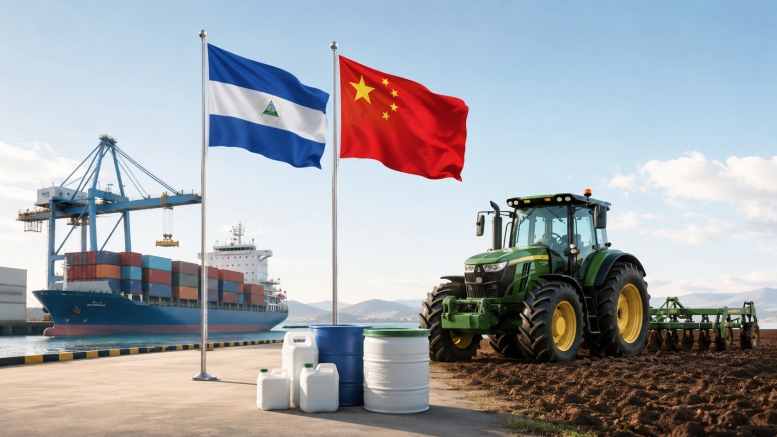
Nicaragua Removes Import Tariffs on Chinese Agrochemicals and Agricultural Machinery
Brazil
Anvisa approved, in compliance with a court decision, the toxicological evaluation of flumioxazin 32 g/L ZC (PILARQUIM), clomazone 360 g/L CS (BRILLIANCE), ethiprole 200 g/L SC (PERTERRA) and spinosad (QILU). (Official Gazette of Brazil, Res. 2033 – 2036 – published on 05/18/26, Anvisa)
The Ministry of Agriculture published a list with 60 registration requests of technical pesticides. (Official Gazette of Brazil, Act No. 30 – published on 05/15/2026, MAPA)
Vittia reported net revenue of US$ 24.04 million in the 1Q26, down 11.5% from the same period in 2025. The company attributed the decline to farmers’ caution in purchasing inputs, amid pressure on profitability, tighter credit and more selectivity. Adjusted net income was negative by US$ 1.16 million, while net debt fell 19.9% to US$ 43.4 million. (Vittia)
The State of Amazonas discussed the implementation of a State Fertilizer Plan during a public hearing at the State Legislative Assembly. The Federation of Agriculture and Livestock of the State of Amazonas defended a plan to attract investments in sustainable mining and to use the State’s potential in potassium, phosphorus and natural gas. The entity said dependence on imported fertilizers increases the vulnerability of Amazonas agriculture, increases production costs and may affect food security and food prices. (FAEA/Senar; Aleam)
The Military Police seized 251 packages of crop protection products of illicit origin in Cuiabá, State of Mato Grosso. The material was found during a police operation, along with drugs, a precision scale, card machines, etc. (Mato Grosso Military Police)
State of Minas Gerais announced an investment of more than US$ 590 thousand in the Citros Guard 4.0 project, which will use AI, drones and machine learning to monitor greening in citrus. The initiative comes at a critical moment, in which the 2026/27 harvest in the citrus belt is expected to fall 12.9%, to 255.20 million boxes, pressured by the lower-yield year in the crop’s biennial cycle, irregular weather and the spread of the disease. The move highlights phytosanitary technology as a strategic factor to protect production and position the State of Minas Gerais as a new citrus frontier in Brazil. (Fundecitrus)
Researchers published in 2026 the first formal report of Andrallus spinidens in rice in Brazil in recent decades, based on specimens collected in Itapecuru-Mirim, State of Maranhão. The predatory stink bug was observed preying on Mocis latipes caterpillars, a pest with potential to damage rice production. The study also cites a historical record from Roraima, dated 1981, and recommends monitoring the species as a possible biological control agent. Available at: doi.org/10.37486/2675-1305.ec08011. (UEMA; UFRGS; USP; Unesp)
The summer corn crop protection market grew 21% in the 2025/26 season, rising from US$ 480 million to US$ 580 million. The increase was driven by expanded planted area and more intensive crop treatments. Herbicides remained the leading category, at US$ 178.6 million, while fungicides gained ground, with greater adoption of premium products. (Kynetec Brasil)
Researchers developed a coating made from castor-oil-based polymer and nanoclay capable of controlled urea release. In tests with piatã grass, the technology reduced rapid nitrogen release and doubled nutrient uptake compared with uncoated urea. The innovation may reduce environmental losses, fertilizer waste and costs, at a time when Brazil imports more than 85% of the fertilizers it consumes. (Embrapa; Unaerp; Unesp; USP)
Cargill strengthened its ag inputs business in Brazil. 30% of its grain clients now buy fertilizers, crop protection products and seeds directly from the trading company, compared with 5% six years ago. The company sees risks of tighter supply in the crop protection market, amid Chinese export restrictions and rising prices, with glyphosate up to 60% more expensive. Meanwhile, Cargill Alimentos returned to profit in Brazil, with US$ 330 million in net income in 2025, and Cargill Agrícola negotiated the sale of its bioindustrial unit in Ponta Grossa, State of Paraná, to Dekel. (Cargill)
Petrobras resumed fertilizer production at the State of Bahia Nitrogen Fertilizer Plant, in Camaçari, after an investment of US$ 19.71 million. The unit is already operating at 90% of capacity and can produce 1,300 tonnes/day of urea and 1,300 tonnes/day of ammonia, supplying approximately 5% of national demand. The resumption reinforces the strategy to expand domestic nitrogen fertilizer production and reduce Brazil’s dependence on imported fertilizers. (Petrobras)
Cowpea beans with glyphosate residues up to 355 times above the legal limit remained for more than a year without a recall order from the Ministry of Agriculture, according to an investigation by the ONG Repórter Brasil based on inspection reports, laboratory analyses and administrative decisions. The irregularities involved batches processed by NJF Indústria e Comércio, which was fined in at least seven States between 2020 and 2025 for residues above legal limits or unauthorized substances in beans. Anvisa said the levels identified require attention from competent authorities, especially due to the risk of continuous exposure among vulnerable groups. (Anvisa; NGO Repórter Brasil)
Bayer expects to launch the icafolin-methyl herbicide in Brazil in 2028, presenting it as the first new mode of action in almost 30 years for post-emergence weed control. Anvisa has already included the active ingredient in Brazil’s list of pesticide active ingredients, but the product still depends on the evaluations by the Ministry of Agriculture and Ibama for technical and commercial use. The planned launch in Brazil has drawn criticism from some organizations and researchers, who question the alleged lack of independent studies and are calling for more data on environmental and health risks. (Bayer)
The State of Piauí will require online registration, as of June 1st, 2026, for the purchase, sale, inventory and movement of pesticides through the State Integrated Agricultural Defense System. Ordinance No. 33/2026 from the Agricultural Defense Agency replaces physical records with digital control and requires identification of the destination rural property. Companies that fail to register transactions, report inventory inconsistencies or omit agronomic prescription information may face penalties. (Government of Piauí; ADAPI)
Research from the University of São Paulo’s School of Public Health investigated passive pesticide contamination among farmers in rural settlements in Pontal do Paranapanema, State of São Paulo. The study points out that institutional, economic and political contradictions help perpetuate the problem, with limited inspection effectiveness and difficulties in accountability. The research argues that contamination should be treated not only as a technical issue, but as the result of social, economic and political relations in Brazil. (Jornal da USP)
A shipment of approximately one tonne of asparagus imported from Peru was blocked at Guarulhos International Airport after the detection of Prodiplosis longifila, a quarantine pest absent from Brazil. The insect can affect tomato, asparagus, citrus, pepper, cotton, beans, avocado, artichoke and onion, increasing management costs and the risk of production losses. (MAPA)
Mosaic warned of a risk of insufficient phosphate fertilizer supply in the global market, amid raw material constraints and geopolitical uncertainty. According to CEO Bruce Bodine, nearly 20% of seaborne phosphate and half of seaborne sulfur originate in the Middle East, increasing supply chain vulnerability; in Brazil, the company is taking a more cautious approach to sales and capital allocation due to a more complex credit environment. (The Mosaic Company)
DVA appointed Vicente Gongora, former CTO at UPL, as CEO of its Global Agro Division. An agronomist, Gongora will lead the company’s next growth phase in the global agricultural market. (DVA)
The State of Rio Grande do Sul granted Águia Fertilizantes an operating license for the State’s first natural phosphate fertilizer plant, linked to the Três Estradas Phosphate Project. Initial production capacity will be up to 150 thousand tonnes/year, with 70 thousand tonnes expected in 2026; in 2027, capacity may reach 300 thousand tonnes/year. (SEMA-RS; Fepam)
LOTS Group and Cocal will begin transporting vinasse, an organic fertilizer derived from ethanol production, using 44 biomethane-powered trucks. The project is expected to replace more than 19 million L of diesel and avoid approximately 41 thousand tonnes of CO2 over five years, reducing the operation’s emissions by 91%. (LOTS Group; Cocal)
The Brazilian National Union of Crop Protection Industry said Brazil’s crop protection market is expected to remain stable or decline slightly in 2026. According to the new chairman, Antonio Mauricio Marques, the projection reflects farmers’ indebtedness, expensive credit, lower commodity prices and rising raw material costs linked to the conflict in the Middle East. (Sindiveg)
According to market analyst João Vitor Aguiar, Brazilian fertilizer imports show a change in composition in 2026. From January to April, the country imported 3.41 million tonnes of nitrogen fertilizers, down 3%, with ammonium sulfate reaching 51% of the category’s imports. Phosphate fertilizer purchases fell 6%, to 3.12 million tonnes, while potassium chloride imports rose 16%, reaching 4.4 million tonnes. (Pátria AgroNegócios)
An article by Luis Eduardo Pacifici Rangel, Girabis Evangelista Ramos and Carlos Ramos Venâncio, members of the Sustainable Agro Scientific Council, called for a review of regulatory data protection in Brazil’s crop protection market. According to the authors, the current interpretation may extend exclusivity, delay the entry of generics and limit competition, even after patents expire. The text proposes regulatory prioritization for active ingredients with no current protection and limited competition. (CCAS)

Latin America
The Iran war is increasing fuel and fertilizer costs in Latin America. In Chile, gas prices rose by about 30% and diesel by 60%; in Brazil, diesel increased by more than 20%, affecting soybean harvesting, corn planting and production costs in the field. In Argentina, the Entre Ríos Grain Exchange already projects an 18% drop in wheat area in 2026/27, to approximately 600 thousand hectares, due to higher fertilizer costs and weaker profitability. (National University of La Plata; Entre Ríos Grain Exchange)
The Pesticide Action Network and its Alternatives for Latin America advocated expanding agroecology as a way to reduce dependence on agrochemicals in the region. The article cites cases in Argentina, Costa Rica and Paraguay, linking the agroecological transition to lower costs, reduced pesticide exposure and stronger food sovereignty. (Rapal)
In Tandil, Argentina, the municipal regulation on the use of agrochemicals is back to the center of debate after protests by environmental organizations and discussion in the City Council. The discussion involves Ordinance No. 17404, which regulates the responsible management of agrochemicals in the district of Tandil, including transport, storage, application and control. The issue is an important topic in the region because it involves rules for pesticide applications near urban areas, waterways and vulnerable spaces. Available at: https://www.hcdtandil.gob.ar/legislacion/Ordenanza-17404.html. (HCD)
Gisela Poletta, researcher from the National University of the Litoral, in Argentina, is investigating how agrochemicals and veterinary drugs affect the DNA of broad-snouted caimans (Caiman latirostris) in agricultural areas of Santa Fe province. According to Poletta, the studies indicate genetic damage, changes in gene expression and delayed growth in exposed hatchlings, reinforcing the species’ role as a bioindicator of environmental contamination. (UNL)
Entre Ríos province, in Argentina, launched a training course on phytosanitary product applications under Provincial Law No. 11178 on Good Practices. The first edition will take place on May 20th in Larroque, for operators of ground and manual application equipment seeking to obtain or renew their license. The schedule will continue until October in other municipalities. (Government of Entre Ríos)
Yacimientos Petrolíferos Fiscales Bolivianos and the Association of Oilseed and Wheat Farmers reached agreements to secure urea supply during Bolivia’s winter crop season. Demand from the association’s members exceeds 11 thousand tonnes/year, benefiting more than 14 thousand farmers. The company expects to sell 87,413 tonnes of urea in the domestic market in 2026. (YPFB)
Colombia is discussing a bill to extend hydrogen tax incentives to ammonia and green fertilizers. According to the Colombian Hydrogen Association, the country imports more than 80% of its fertilizers, and local production of renewable hydrogen could reduce external dependence on agricultural inputs and exposure to geopolitical issues. (Hidrógeno Colombia)
The Federation of Agricultural Cooperatives from the State of Santa Catarina, Brazil, is negotiating a partnership with Tecnomyl, from Paraguay, to launch its own pesticide portfolio. The proposal includes herbicides, insecticides and fungicides for cooperatives in the States of Santa Catarina and Rio Grande do Sul, with a focus on reducing production costs and increasing profitability for farmers. Tecnomyl maintains an office in Shanghai to source molecules and has been expanding its presence in Brazil’s post-patent crop protection market. (Fecoagro; Tecnomyl)
Nicaragua removed import tariffs on some Chinese products, including agrochemicals, yellow corn, agricultural machinery, vehicles, parts and industrial equipment. The measure accelerates tariff reductions under the Free Trade Agreement between Nicaragua and China, in force since 2024, and seeks to facilitate the entry of inputs and machinery into the country. (Ministry of Commerce of China)
Authorities called for better control over the sale of highly toxic insecticides in the Dominican Republic, after an aluminum phosphide poisoning incident in Santo Domingo left two people dead. Experts defended sales only under professional recommendation, stricter oversight and compliance with rules on pesticide use and commercialization. (ANMPU)

READ MORE: