
Study Finds Asian Soybean Rust Spreads Coordinately Across Brazil
Brazil
In compliance with court decisions, Anvisa approved the toxicological evaluations of novaluron (Somax), difenoconazole + tebuconazole (Syngenta), and fenpropimorph (CHDS). The agency also approved, for registration purposes, the toxicological evaluation of a new microbiological product based on ascaroside (Lemma). The agency also published the withdrawal of the evaluation requests for lambda-cyhalothrin (GSP) and fipronil (Rainbow). In addition, the evaluation acts for fluroxypyr-meptyl + picloram (Proregistros) and acephate (Solus) were rejected. (Official Gazette of Brazil, Res. No. 890-892 and 898-899, from 3/5/26, Anvisa)
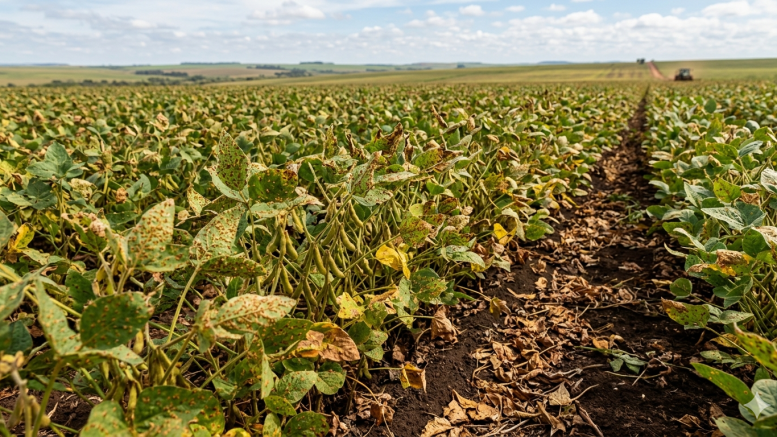
Researcher Renan Fonseca Nascentes, from Renove AgroPesquisa, concluded that Asian soybean rust advances in a coordinated pattern at the national scale, rather than only at the local level, with the critical dissemination period concentrated between late December and early January. According to Nascentes, late plantings or second-crop soybeans tend to coincide with the epidemiological peak, increasing the risk of severe infections, losses and control failures, while earlier sowing reduces crop exposure to higher inoculum pressure. (Renove AgroPesquisa)
In the State of Rio Grande do Sul, the 2025/26 soybean crop remains at a decisive stage, with intensified management against Asian soybean rust amid rising nighttime humidity and alerts from the responsible authorities. The report also points to pressure from mites, thrips and stink bugs, while irregular rainfall only partially relieved water stress and kept yield losses in part of the fields. In corn, the corn leafhopper (Dalbulus maidis) remains the main phytosanitary concern, with reinforced monitoring and chemical control in different regions of the state. (Emater/RS)
Research with 36 populations of Leucoptera coffeella across Brazilian coffee-farming regions found significant control failure risks for abamectin, chlorpyrifos, deltamethrin and profenophos. The authors identified resistance levels ranging from low to extremely high, with the most critical cases involving deltamethrin, abamectin and chlorpyrifos, as well as enzymatic changes confirming biochemical resistance mechanisms. According to the researchers, the spread of resistance is compromising chemical control efficacy and underscores the need for continuous monitoring and integrated pest management strategies to sustain coffee production. (Universidade Federal de Viçosa; University of Puerto Rico; Cenicafé)
According to InnVitro, Law No. 14785/2023 changed pesticide toxicological assessment in Brazil by replacing the former prohibitive toxicological endpoints with the concept of unacceptable risk, based on the relationship between hazard and exposure. The consulting firm highlights that the publication of RDC 998/2025, Guide No. 84/2025, and the evaluAR calculator established a new standard for non-dietary risk assessment of operators, workers, residents and bystanders, with mandatory use of the exposure estimation tool. (InnVitro)
Researchtudy concluded that biological nitrogen fixation generated cumulative savings of about US$ 15.7 billion in Brazilian sugarcane farming from 2013/14 to 2022/23. According to the authors, the partial replacement of synthetic nitrogen fertilizers also avoided approximately 192 million Mg of equivalent CO2. (Biomass and Bioenergy)
According to Lilian Gonçalves, registration coordinator at Bequisa, the technical training provided by ANVISA on the evaluAR calculator contributes to greater methodological clarity and to the standardization of risk analyses in the regulatory process. The tool was developed to support the implementation of Brazil’s new regulatory framework for non-dietary pesticide exposure risk assessment and is aligned with RDC No. 998/2025 and Guide No. 84/2025, which address exposure estimates for operators, re-entry workers, residents and bystanders. (Lilian Gonçalves, registration coordinator at Bequisa)
Ibama appointed Gabriel Sehnem Heck as substitute head of the Division of Environmental Risk Assessment of Pesticides, Components and Related Products. The agency also relieved, at her own request and effective February 25th, 2026, Grazielle Diniz Lopes from the same position. (Personnel Ordinances No. 398 and No. 404, from 3/6/26, Ibama)
Aguia Fertilizantes said it will launch, during Expodireto 2026, the “first phosphate fertilizer produced in the State of Rio Grande do Sul”. According to the company, the initiative is intended to offer a local alternative to help reduce the dependence on imported phosphate. (Aguia Fertilizantes)
The Brazilian Confederation of Agriculture and Livestock warned that the war in the Middle East is already putting pressure on Brazilian agribusiness costs, with higher diesel, nitrogen fertilizer and logistics expenses. According to the entity, the conflict is also increasing uncertainty over corn exports to Iran, an important destination for Brazilian grain. (CNA)
StoneX said the conflict in the Middle East has triggered a sharp increase in nitrogen fertilizer prices, with urea rising more than 15% and ammonium nitrate about 28% at Brazilian ports in one week. According to the company, the surge reflects risks to global supply, lower production in Qatar, and logistical disruptions in the Strait of Hormuz. (StoneX)
The Brazilian Association of Soybean Farmers urged caution in fertilizer purchases amid the volatility caused by the conflict in the Middle East. According to the entity, the current scenario does not yet justify panic-driven advance buying and decisions should be based on actual need, planning and the farmer’s financial capacity. (Aprosoja Brasil)
Ministry of Agriculture has published the withdrawal of 20 pesticide registration requests and the cancellation of 19 pesticide registrations. (Official Gazette of Brazil, Act No. 13 from 3/5/26, Ministry of Agriculture)
Crop protection products for apples generated US$ 81.5 million in southern Brazil in the 2024/25 season, with 52% of the total in the State of Santa Catarina and 48% in the State of Rio Grande do Sul. Fungicides accounted for the largest share of this market, driven mainly by apple scab control, while bitter rot also gained relevance with a sharp increase in treatments and in potential treated area over recent cycles. (Gabriel Baracat Pedroso, Key Account Coordinator at Kynetec Brasil)

Latin América
Biotrop has appointed Laura Landucci as Sales Coordinator Latin America – Strategic Alliances. (Biotrop)
The Ministry of Agrarian Development of the Province of Buenos Aires, Argentina, will hold two technical training sessions on agrochemicals during the 57th Provincial Wheat Festival in Tres Arroyos. According to Adolfo Antonio Caamaño, director of Plant Health and Control for the province, the sessions will cover the regulatory framework for phytosanitary products, focusing on mandatory agronomic recommendations, transport, application and licensing requirements for operators and machinery. One session will target the Rural Patrol and police forces, and the other will be aimed at agronomists and other sector professionals. (Ministry of Agrarian Development of Buenos Aires)
Agrihold Group announced the acquisition of an equity stake in Agrivalle, a Brazilian bioinputs company with operations in Brazil, Paraguay and China. According to the group, the deal is intended to expand its presence in Latin America, with a focus on synergies between chemical and biological solutions in higher-growth, higher-value segments. Agrivalle said Agrihold’s entry as a minority shareholder is expected to strengthen its expansion in Paraguay, where bioinputs adoption remains low, supported by the group’s already established commercial and technical structure in the Paraguayan market. (Agrihold; Agrivalle)
Chile has begun requiring mandatory prior notice for applications of pesticides classified as “highly toxic” to bees, with a minimum 48-hour advance warning. Starting on April 26th, the requirement will also apply to “moderately toxic” products, in a measure that strengthens pollinator protection and places responsibility on farmers to notify potentially affected beekeepers through a verifiable channel. (SAG)
Mexico’s Secretariat of Agriculture and Rural Development said the Field Schools strategy increased maize yields by up to 25% in 25 states during 2025. According to the government, the initiative also reduced production costs per tonne by 21%, with lower spending on agrochemicals and operating costs. (Mexico’s Secretariat of Agriculture and Rural Development)
Mexico wants to make agrochemicals one of the priority issues in its new Circular Economy Law, with rules focused mainly on packaging management and extended farmer responsibility. According to Secretary Alhely Rubio Arronis, the proposal aims to require companies to take responsibility not only for placing these products on the market, but also for the collection, traceability and final disposal of their waste. (Government of Mexico)
Panama’s government said it is seeking support from Morocco to reduce the risk of fertilizer shortages and price increases amid tensions in the Middle East. According to the report, the country expects to receive 1,000 tonnes of the input for small farmers while assessing the impact of international volatility on agricultural costs. (Government of Panama)
READ MORE:
Sustainable Investments in Brazil: Value Lies in Transformation, Not Exclusion