
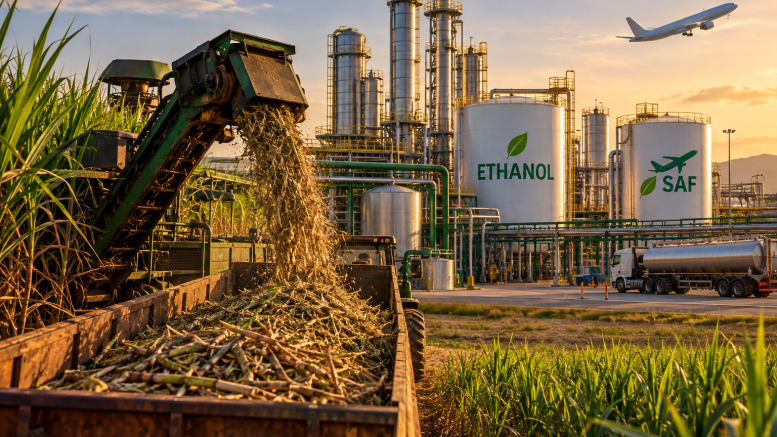
Mexico Plans US$ 1.28 Billion Sugarcane Bioenergy Platform
Brazil
Brazilian Development Bank – BNDES approved an approximately US$ 29.8 million credit limit for Soli3 União Central Cooperativa, in the State of Rio Grande do Sul, to purchase machinery and equipment to reduce emissions and improve climate adaptation at its soybean-processing and biodiesel plant. (BNDES)
The Ministry of Finance and the Ministry of Environment approved US$ 9.9 billion in the fifth Eco Invest Brasil auction for investment across six ecological-transition value chains. The allocations include approximately US$ 2.2 billion for circular use of mineral and industrial waste, US$ 1.8 billion for green fertilizers, biological inputs and alternative proteins and US$ 1 billion for advanced green fuels, biogas and biomethane. Bradesco, HSBC, Itaú and Santander were selected to structure funds and credit operations. (Environment Ministry; Finance Ministry)
The Government of the State of São Paulo allocated more than US$ 2.6 million to recovery in Vale do Ribeira following heavy rainfall in September. Approximately US$ 2 million is available as emergency credit for farmers and approximately US$ 655 K was transferred to affected municipalities. (Government of São Paulo)
The State of São Paulo opened a public consultation to revise the Solid Waste Plan, which will establish targets through 2046. The State generates approximately 15.5 million tonnes of municipal solid waste, 27.6 million tonnes of construction waste and 231.3 K tonnes of healthcare waste per year. The revision also covers agricultural, forestry, livestock, industrial and mining waste, circular economy and reverse logistics. (Semil/SP)
Embrapa mapped municipalities most vulnerable to diffuse water pollution generated by agriculture. The most critical areas are concentrated in the States of Mato Grosso, Mato Grosso do Sul and Goiás and in the Matopiba region, as well as parts of Paraná and São Paulo, based on indicators including fertilizer use, livestock, sugarcane fertigation, water balance and soil vulnerability to erosion. (Embrapa)
The Semi-Arid Agrobiodiversity Project, coordinated by Embrapa and partners, is evaluating at least 20 traditional corn varieties in 2026 in the States of Alagoas, Bahia, Paraíba and Piauí. With more than US$ 595 K in investment through 2027, the initiative is expected to benefit approximately 2 K families, strengthen 122 community seed banks and seed houses and conserve genetic diversity adapted to the Semi-Arid region. (Embrapa)
The National Water Resources Council approved guidelines to incorporate climate adaptation into water management and revised rules for preparing river-basin water-resource plans. The framework includes water security, droughts, floods, dam safety and nature-based solutions. (CNRH; National Water and Basic Sanitation Agency)
Brazil and China signed a memorandum to expand cooperation in water-resource management. The agreement covers climate adaptation, drought and flood prevention, hydrological monitoring, warning systems, water infrastructure, river-basin management, digital transformation, financing and ecological protection of reservoirs and dams. (National Water and Basic Sanitation Agency; Integration and Regional Development Ministry)
National Institute for Space Research – INPE and SOS Mata Atlântica Foundation started an agreement to restore 210.8 hectares of Atlantic Forest at the Cachoeira Paulista campus in the State of São Paulo. The partnership combines ecological restoration, scientific research, protection of water-recharge areas, wildfire prevention and environmental education. (INPE; SOS Mata Atlântica Foundation)
The Federal Government increased to 330 the number of wildfire firefighters operating in the State of Amazonas and maintained 11 aircraft, 32 ground vehicles and eight boats in the operations. Ibama reported it had extinguished 303 fires since the beginning of the season. The Amazonas State Civil Police opened 120 criminal investigations related to the fires and received more than 100 anonymous reports; authorities are investigating indications of deliberate fire-setting in forest areas. (Environment Ministry; Ibama; Amazonas Public Security Secretariat)
The National Environment Council (Conama) approved nationwide guidelines for critical air-pollution episodes and created instruments to register and track critical machinery used in mining. The first rule requires state plans with attention, alert and emergency levels; the second creates a public registry and tracking system for excavators, backhoes, barges and mining dredges in municipalities prioritized for combating illegal mining. (Conama; Environment Ministry)
BASF presented the Standing Forest initiative to develop responsibly sourced ingredients from Amazon biodiversity and support the bioeconomy in the Uacari Sustainable Development Reserve in the State of Amazonas. The initiative is expected to impact approximately 1.2 K people across 25 communities and includes sustainable management of non-timber forest products, training, fair trade and benefit sharing. (BASF)
The Water Management Institute of Minas Gerais (Igam) completed transfer of US$ 12.4 million for charges of water-use to the river-basin committees and agencies of the state, clearing a liability accumulated from 2016 through 2019. The resources return to the respective basins for water management and actions to improve water quality and availability. (Igam)
Above-expected rainfall increased levels on the Paraná and Iguaçu rivers and led Itaipu Binacional to open the second spillway channel on October 13th. The Paraná River could reach 121 m on October 14th, while teams in Brazil and Paraguay were assisting flood-prone areas. The hydropower plant reported that reservoir operations also contribute to downstream flood management. (Itaipu Binacional)
A Federal Court opened proceedings against ten people charged by the Federal Prosecution Service over an alleged scheme involving clandestine extraction, document forgery and illegal gold sales in the State of Pará and maintained an approximately US$ 29.0 million asset freeze. Defendants face charges of money laundering and unlawful appropriation of federal assets. (Federal Prosecution Service)
The National Petroleum, Natural Gas and Biofuels Agency (ANP) accredited B3 as a registry entity for the Biomethane Guarantee of Origin Certificate (CGOB). The market now has three authorized registry entities, expanding infrastructure for issuance, registration, trading and retirement of certificates that verify the environmental attributes and traceability of biomethane. (ANP)
The Federal Prosecution Service and Instituto Preservar filed a lawsuit against Shell Brasil seeking for more than US$ 53.6 million in compensation for material losses and collective moral damages related to the 2024 floods in the State of Rio Grande do Sul. The claim uses attribution-science studies to support the alleged link between historical emissions and more intense rainfall; liability has not been determined. (Federal Prosecution Service)
A Federal Court ordered environmental agencies to maintain inspection of turtle nesting beaches on the lower Xingu River in the State of Pará until the end of the current reproductive stage. The ruling seeks to protect species including the Amazon river turtle, yellow-spotted river turtle and six-tubercled river turtle in Tabuleiro do Embaubal, one of the main turtle breeding areas in the Amazon. (Federal Prosecution Service)
The Water Resources Council of the State of Minas Gerais approved an update of the State Water Resources Plan for 2026–2045. The plan establishes guidelines and actions for sustainable water management and water security over the next 20 years. (CERH-MG; Igam)
The Federal Prosecution Service requested to a Federal Court to enforce a final ruling requiring removal and demolition of illegal structures in a mangrove area in Vila Velha, State of Espírito Santo. The measure also requires cleanup, surveillance and recovery of degraded vegetation in the permanent preservation area. (Federal Prosecution Service)
The National Water Resources Council approved the first nationwide resolution establishing unified criteria for direct reuse of non-potable water. The rule sets technical parameters for treated-effluent use and seeks to increase legal certainty for reuse projects in activities that do not require drinking water. (National Water Resources Council; Igam)
The National Center for Monitoring and Early Warning of Natural Disasters (Cemaden) maintained a high risk of continued flooding around Uruguaiana in the State of Rio Grande do Sul on October 14th because of the flood wave on the Uruguay River. It also indicated moderate hydrological risk across the State of Paraná and parts of São Paulo, Rio de Janeiro, Minas Gerais and Mato Grosso do Sul because of forecast rainfall and previous accumulations. (Cemaden)
Companhia de Saneamento do Paraná (Sanepar), the sanitation company of the State of Paraná, intensified the use of non-toxic smoke tests in sewage networks to identify cracks, leaks and illegal stormwater connections. The technique was recently applied in Telêmaco Borba and Carambeí and is being used in municipalities including União da Vitória, Rio Azul, São Mateus do Sul, Guaratuba and Santa Terezinha de Itaipu. Smoke emerges where damage or irregular connections are present, helping target maintenance and reduce sewage overflows and environmental impacts. (Sanepar)
Sabesp, the water and sanitation company serving the State of São Paulo, will invest approximately US$ 199 million to expand the Parque Novo Mundo wastewater-treatment plant, increasing treatment capacity from 2.5 m³/s to 6.2 m³/s. The project is expected to benefit approximately 3 million people in São Paulo and Guarulhos and is part of the Integra Tietê program to reduce sewage pollution in the Tietê River and its feeder revers. (Government of São Paulo; Sabesp)
The Ministry of Environment and the Oswaldo Cruz Foundation (Fiocruz) expanded air-quality monitoring in the Amazon with five FioAres stations in the States of Amazonas, Acre, Rondônia and Pará, focused on continuous measurement of fine particulate matter (PM₂.₅). The initiative received approximately US$ 372 K from the Federal Government; in Manaus, the daily average PM₂.₅ concentration reached 99 µg/m³ on October 8th, compared with the World Health Organization guideline value of 15 µg/m³. (Environment Ministry; Fiocruz)

Latin America
Global deforestation fell 15% in 2025 to just over 7 million hectares, but remained above the 4.2 million hectares consistent with the pathway to halt forest loss by 2030. In tropical Latin America, deforestation was close to 2.5 million hectares, although regional losses declined 33% over the past five years. (Forest Declaration Assessment)
Bolivia presented to the Global Environment Facility (GEF) and FAO with a proposal to mobilize at least US$ 50 million for sustainable livestock production, soil recovery and biodiversity conservation. The project would protect water sources and wetlands in the Altiplano and increase livestock incomes in Beni and Santa Cruz without expanding deforestation or depleting soils. (Ministry of Sustainable Production, Environment and Water)
The Agricultural Development Institute (INDAP), an agency under the Agriculture Ministry of Chile, allocated approximately US$ 305 K for emergency measures following storms in Atacama, including small irrigation works and restoration of water supplies for goat herds. (INDAP)
The Environment Superintendency of Chile notified 267 mining facilities in Antofagasta, Atacama and Coquimbo to strengthen preventive measures during the 2026 Desert Bloom. Companies must restrict traffic to authorized areas, protect flora and fauna, preserve topsoil and strengthen monitoring and waste management in flowering areas. (Environment Superintendency)
The Environment Superintendency of Chile formally alleged Copec S.A, a Chilean energy and fuel-distribution company, exceeded authorized limits for industrial liquid-waste discharges at the Quintero Maritime Terminal. According to the agency, the violations occurred on multiple occasions and, in August 2025, the volatile-hydrocarbon load exceeded the permitted limit by 382%. (Environment Superintendency)
The Agriculture Ministry of Colombia announced agreements with FAO to support the National Regenerative Livestock Program and expand rural training. The program is expected to benefit 100 K small cattle farmers with fewer than 50 head and recover millions of hectares through sustainable practices and climate-smart technologies. Another agreement of approximately US$ 3.34 million will finance training for young people and coffee farmers. (Agriculture Ministry)
Dominican Republic committed US$ 476.9 million through 2033 to modernize agricultural irrigation, focusing on water-use efficiency, productivity and climate adaptation. The irrigation modernization fund has already completed 15 calls, benefited more than 220 farmers and allocated more than RD$ 136 million in incentives for adoption of irrigation technologies. (Presidency; National Irrigation Modernization Directorate)
Dominican Republic is installing 410 kW of solar generation at the Pastor water intake in Santiago, while a 1 MW photovoltaic park for the Rafey wastewater-treatment plant reached 89% completion. The projects seek to reduce energy costs and expand renewable-energy use in water and sanitation infrastructure. (Coraasan; Presidency)
Ecuador presented four lines of action to reduce the impacts of El Niño 2026/27 on aquaculture and fisheries: prioritizing the most exposed operations, assistance on biosecurity and water quality, coordination with the production sector and credit alternatives. The Government also made a single reporting form available to record losses and measure impacts. (Economic and Productive Development Ministry)
Honduras will mobilize US$ 72 million through the SAG-ProOccidente program for water infrastructure, agricultural technologies and value chains across 88 municipalities. The initiative is expected to benefit 30 K rural households, sustainably manage more than 25 priority micro-watersheds and place approximately 10 K additional hectares under protection and conservation measures. (SAG; IDB; AECID)
Honduras completed 18 of the 20 planned cloud-seeding flights to address drought and strengthen water reserves. According to the company operating the project, flight routes covered an estimated 1.8 million–2.3 million hectares, but this surface does not represent the area that actually received rainfall. Operations use silver iodide and prioritize agricultural areas and strategic watersheds. (Agriculture and Livestock Secretariat)
Honduras plans to invest approximately US$ 13.1 million–US$ 14.9 million in a national irrigation plan to expand water access in drought-affected areas. The program is expected to install more than 500 drip-irrigation systems, bring approximately 1.6 K hectares into irrigated production and directly benefit 800–900 farmers in 2026, in addition to rehabilitating irrigation districts. (Agriculture and Livestock Secretariat)
Heliostar Metals, a mining company, submitted key environmental permit applications to the Secretariat of Environment and Natural Resources (Semarnat) in Mexico for development of the Ana Paula gold project in Guerrero as an underground mine. According to the company, the new design reduces proposed surface disturbance by approximately 65% compared with the previously approved open-pit plan and includes dry-stack tailings and underground backfill. (Heliostar Metals)
The portfolio from Mexico presented at the FAO Hand-in-Hand Investment Forum foresees for US$ 1.275 billion in a sugarcane-based bioenergy platform. The strategy includes six anhydrous-ethanol plants and three Alcohol-to-Jet modules for sustainable aviation fuel, with capacity to process up to 12 million tonnes of sugarcane per year and reduce approximately 1.48 million tonnes of CO₂ equivalent. (FAO)
Hailstorms in Caaguazú, Paraguay, affected more than 170 hectares of crops and approximately 700 farming families. The Government is supplying inputs and fertilizers and supporting reconstruction of production facilities; the Agriculture Ministry also included recovery of sectors affected by El Niño among the targets for 2027. (Agriculture Ministry; Senate of Paraguay)
The Environment and Sustainable Development Ministry (MADES) of Paraguay advanced on the preparation of the National Water Resources Plan, with fieldwork in the upper, middle and lower sub-basins of the Jejuí Guazú River in Canindeyú. The plan seeks to improve water management, strengthen climate adaptation and set priorities based on community needs. (MADES)
The Ministry of Production of Peru and the National Commission for Development and Life without Drugs (Devida) expanded efforts to formalize aquaculture in vulnerable areas of the Amazon and the Apurímac, Ene and Mantaro River Valley. Cooperation seeks to formalize production units and expand legal and sustainable economic alternatives for rural families. (PRODUCE; Devida)
READ MORE: