
CAF and National Bank of Panama Secure US$ 500 Million for Agriculture and Renewable Energy
Brazil
The World Bank announced a US$ 1.06 billion operation to finance industrial decarbonization in Brazil, through a program implemented with the Brazilian Development Bank – BNDES. The program is expected to mobilize an additional US$ 1.8 billion and finance projects in steel, cement, chemicals, aluminum and glass, as well as biomethane, sustainable aviation fuel, e-methanol and shared infrastructure for low-carbon hydrogen and ammonia. (World Bank; BNDES)
Braskem reported that projects under the Industrial Decarbonization Program already reduce more than 1.2 million tonnes of CO₂ equivalent per year, more than two-thirds of the target to cut absolute operational emissions by 15% by 2030. Initiatives include energy efficiency, electrification, biomethane and replacement of fossil natural gas with biomass. (Braskem)
Brazil, China, the EU and eight other countries approved a plan through 2030 to increase compatibility among regulated carbon markets. The coalition will work on emissions measurement and verification, rules for carbon credit use and alignment with Article 6 of the Paris Agreement. Participants account for 42.2% of global greenhouse gas emissions and US$ 49 trillion in GDP. (Ministry of Finance)
The Government enacted the Special Tax Regime for Data Center Services – Redata, linking tax incentives to water-efficiency criteria and use of renewable or low-emission energy. Beneficiary companies will also have to allocate 2% of the value of acquired equipment to research, development and innovation. (Ministry of Development, Industry, Trade and Services)
xFarm Technologies announced that Brazilian company Sibium Analytics joined the group in the company’s second strategic transaction in Brazil, expanding the presence in the sugarcane and biofuel sectors. Sibium monitors 8 million hectares and provides geospatial intelligence, traceability and ESG compliance tools for sugar-energy mills and companies. (xFarm Technologies)
Axia Energia launched an approximately US$ 291 million public offering of debentures to finance payments, reimbursements, expenses or debt related to an energy transition project filed with the Ministry of Mines and Energy. The offering, targeted at professional investors, was automatically registered with the Brazilian Securities and Exchange Commission on September 15th. (CVM; Axia Energia)
CMPC, a pulp and paper company, signed an agreement to develop an approximately US$ 291 million terminal at the Port of Rio Grande, State of Rio Grande do Sul. The facility will cover approximately 400 K m² and have capacity to handle up to 9 million tonnes per year, mainly for pulp exports. (CMPC)
The Ministry of Environment and Climate Change started updating the National REDD+ Strategy, a framework to reduce emissions from deforestation and forest degradation and promote forest conservation and carbon stocks. Created in 2016, the Strategy will be reviewed based on results, challenges and institutional, regulatory and climate changes over the past decade. (Ministry of Environment and Climate Change)
Deforestation alerts in the Cerrado decreased 18.9% in August to 238 km², according to Deter, the satellite-based alert system of the National Institute for Space Research – INPE, the second-lowest result for the month since 2018. Alerts in the Amazon increased 12.1% to 358 km², including an increase of 109.4% in the State of Pará. From June through August, alerts decreased 9.2% in the Cerrado and 20.4% in the Amazon. (Ministry of Environment and Climate Change; INPE)
The National Water and Basic Sanitation Agency presented a plan to prepare for the impacts of El Niño 2026/27 on water resources. Measures include regional monitoring groups and possible restrictions on water withdrawals, changes to reservoir operating rules and special water-use conditions in systems in the semiarid region. (National Water and Basic Sanitation Agency)
Google partnered with carbon removal company Terradot to deploy climate solutions across more than 200 K hectares of rice farms in southern Brazil. Google will purchase 1 million tonnes of CO₂ equivalent in methane reductions by 2030 and 1 million tonnes of permanent CO₂ removal by 2040. The project will combine alternate wetting and drying irrigation, which reduces methane emissions and water use, with crushed volcanic rock applied to soils for carbon removal. (Google; Terradot)
The Ministry of Environment and Climate Change opened a public consultation on the National Strategy for Nature-Based Solutions in Urban Areas, with an implementation horizon through 2035. The proposal includes 12 guidelines and targets the implementation or registration of nature-based solutions in 17.5% of municipalities in Brazil, focusing on climate adaptation, biodiversity, water security and disaster risk reduction. (Ministry of Environment and Climate Change)
The Government and food and beverage industry started discussing emissions monitoring, reporting and verification rules for implementation of the Brazilian Emissions Trading System. The proposed schedule under discussion provides for the food and beverage sector to enter the second phase of the program, starting by 2029. (National Confederation of Industry; Ministry of Finance)
The Brazilian Private Insurance Superintendence opened a public consultation to update sustainability rules for the insurance sector, expanding requirements on environmental, social and climate risks, governance, metrics and targets. The proposal aligns insurers’ disclosures with IFRS S1 and S2 standards and, if approved, will take effect on December 31st, 2026. (Susep)
The Amazon Environmental Research Institute and China Agricultural University signed an agreement for research on sustainable agriculture, climate change, deforestation, land use and resilient agriculture. Cooperation will include the GALO project, which assesses how native vegetation, water, carbon and biodiversity affect agricultural productivity in the Amazon and Cerrado. (IPAM)
The Brazilian Electricity Regulatory Agency approved rules for the Energias da Floresta regulatory sandbox, an experimental framework for testing electricity generation, storage and supply models under specific and temporary regulatory rules. The initiative targets Indigenous, quilombola, riverine and traditional communities and family farmers in remote areas of the Legal Amazon. (Brazilian Electricity Regulatory Agency)
The National Agency for Technical Assistance and Rural Extension and Ministry of Agrarian Development and Family Farming launched a call for technical assistance focused on agroecological transition, rural youth and traditional peoples and communities, targeting 4.54 K family farming units. (Anater; Ministry of Agrarian Development and Family Farming)
The Federal Police, Chico Mendes Institute for Biodiversity Conservation and Brazilian Institute of Environment and Renewable Natural Resources launched an operation against illegal fishing of sharks, rays and other protected species in the Alcatrazes Archipelago Wildlife Refuge, State of São Paulo. The investigation followed an inspection that identified more than 300 captured sharks and resulted in fines exceeding approximately US$ 582 K. (Federal Police; ICMBio; Ibama)
The Ministry of Mines and Energy opened a public consultation on annual emission reduction targets for RenovaBio for 2027–2036. The proposal would reduce the carbon intensity of the fuel mix in Brazil by 12.1% in 2036 compared with 2018. The targets guide the market for Decarbonization Credits – CBIOs. (Ministry of Mines and Energy)

Latin America
The Ministry of Economy of Argentina opened technical proposals from two consortiums in the privatization process for the 90% state-owned stake in Agua y Saneamientos Argentinos – AySA, the water and sanitation utility serving the Buenos Aires metropolitan area. The future operator will be required to invest more than US$ 2 billion during the first five years to expand drinking water and sewage systems. (Ministry of Economy)
The National Agricultural Technology Institute and National Institute of Industrial Technology assessed the life cycle of seven products from the peanut value chain in Argentina across 16 environmental impact categories. Agricultural production accounted for 40%–66% of greenhouse gas emissions, depending on the product, and the data may support Environmental Product Declarations under international standards. (INTA; INTI)
The National Agricultural Technology Institute launched ForestMap in Argentina, a free tool that processes LiDAR data, a laser-based remote sensing technology used to measure distances and generate 3D models, and photogrammetric data collected by drones for forest and silvopastoral management. The system generates maps of tree height, canopy cover, terrain and individual trees without requiring programming or paid specialized software. (INTA)
The National Agricultural Technology Institute identified in central Argentina that sorghum showed the highest yield stability under different water availability conditions among corn, sorghum, soybeans and peanuts. INTA points to crop selection and planting dates as tools to reduce climate risks in rainfed systems. (INTA)
The Government of Bolivia presented a US$ 150.6 million project for biodiversity and Amazon forest conservation. The initiative includes US$ 18.78 million from the Global Environment Facility and US$ 131.83 million in co-financing for forest protection, restoration, sustainable production systems and support for Amazon communities. (Ministry of Sustainable Production, Environment and Water; UNDP)
Grenergy reported that investment in 1H26 reached approximately US$ 315.6 million, up 25%, mainly allocated to the Central Oasis hybrid projects in Chile. The platform added another 340 MW through the Parral and Pelequén projects, while financing closed during the semester totaled US$ 623 million. (Grenergy)
A project supported by Chile’s Production Development Corporation completed the first harvests of hydroponic vegetables in northern Chile using desalinated seawater and nanobubble technology. The initiative seeks to develop agriculture along the Tarapacá coast and assess potential scaling by companies, entrepreneurs and local communities. (Corfo)
EPM, a Colombian public utilities company, secured US$ 348.69 million in sustainability-linked financing from the French Development Agency in Colombia. The 15-year financing will support energy transition, renewable energy, water and biodiversity protection and resilient infrastructure. The interest rate may be reduced if the company exceeds agreed sustainability indicators. (EPM; French Development Agency)
The proposed 2027 environmental budget in Colombia totals approximately US$ 436 million, including approximately US$ 218.7 million for 32 investment projects mainly focused on water, biodiversity, ecosystems and communities. The proposal remains under consideration. (Ministry of Environment and Sustainable Development)
A sanitation program implemented by the Municipality of Armenia and Empresas Públicas de Armenia in Colombia represents approximately US$ 18.5 million in investment and reached 97.9% physical completion on September 15th. The project includes construction and replacement of sewage networks and collectors to reduce contamination of water sources, with 24 of the 27 planned sections completed. (Municipality of Armenia)
A project supported by the Colombia Sostenible Fund is implementing agroforestry systems on farms operated by 353 cocoa farmers in Arauca, Boyacá, Caquetá, Meta and Santander, Colombia. More than 105 K cocoa seedlings were distributed along with trees for integration into production systems. Agrosavia estimates that approximately 20% of areas currently suitable for cocoa could become climatically unsuitable by 2050. (Colombia Sostenible Fund; Agrosavia)
The Ministry of Environment and Sustainable Development of Colombia reported that the country has eliminated consumption of more than 4 K tonnes of ozone-depleting substances. Projects transitioning refrigeration and air-conditioning systems to cleaner technologies have also contributed to avoiding more than 20 million tonnes of CO₂ equivalent emissions. (Ministry of Environment and Sustainable Development)
Empresas Públicas de Cundinamarca, together with the departmental and municipal governments, is implementing drinking water and sanitation projects and initiatives totaling approximately US$ 2.12 million in Guasca, Colombia. The investments include water storage, wastewater treatment, solid waste management, support for rural water systems and emergency response. (Government of Cundinamarca; EPC)
Empresas Públicas de Cundinamarca is implementing and supporting investments and initiatives totaling approximately US$ 1.86 million in water supply, sewage and sanitation in Fómeque, Colombia. The resources cover urban and rural systems, network rehabilitation, stormwater management and a new waste-collection vehicle. (Government of Cundinamarca; EPC)
The Regional Autonomous Corporation of Cundinamarca allocated approximately US$ 1.86 million to 2.1 K community rainwater collection and storage systems in Colombia to address water scarcity and the impacts of El Niño. As of August, 571 systems had been delivered across 31 municipalities. (Government of Cundinamarca; CAR)
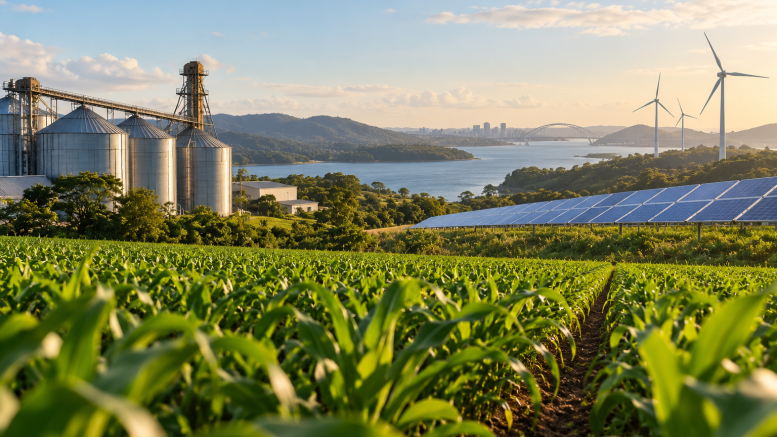
CAF – Development Bank of Latin America and the Caribbean and the National Bank of Panama signed US$ 500 million in financing for agriculture, agroindustry, renewable energy and small and medium-sized companies, mainly in rural areas. At least 50% will be allocated to agricultural and agroindustrial activities, while US$ 400 million was mobilized from international financial institutions. (CAF; Banconal)
Cox established the regional HQ for the Americas in Panama and reported an investment plan exceeding US$ 7 billion for strategic water and energy projects in Latin America. (Cox)
The Ministry of Environment and Sustainable Development of Paraguay presented the first draft of the National Carbon Markets Strategy, designed to guide the country’s participation in international markets and mechanisms under Article 6 of the Paris Agreement. The document was discussed with companies, financial institutions, public agencies and civil society. (Mades; GGGI)
In 2025, processed products accounted for 99.1% of the export volume of eucalyptus forest products from Paraguay. Exports reached a record US$ 36.2 million and 50.7 K tonnes, increases of 41% and 46%, respectively. The share of unprocessed wood decreased from 39.5% of export volume in 2015 to 0.9% in 2025. (Infona; Fepama)
Socio-environmental monitoring of the Bioceanic Corridor works in the Chaco, Paraguay, recorded 13 mammal species and 82 bird species, as well as nationally threatened tree species. Monitoring uses camera traps and transmitters to track fauna along Route PY15 and assess impacts on Chaco habitats. (Ministry of Public Works and Communications)
Yacyretá Binational Entity reported that El Niño increases the probability of above-average rainfall and additional flooding in the Paraná River basin between Argentina and Paraguay. Inflow to the hydropower plant reached 19.6 K m³/s, higher than levels recorded on 95% of September days since 1994. (Yacyretá)
The Private Investment Promotion Agency of Peru expects to award two sanitation projects totaling US$ 362 million in 2026. The US$ 123 million Cajamarca wastewater treatment project has already been awarded, while the US$ 239 million San Martín project is expected to be awarded in 4Q26. The 36-month pipeline includes 16 projects representing an estimated US$ 5.672 billion in investment. (ProInversión)
The Ministry of Livestock, Agriculture and Fisheries of Uruguay launched the Caravana Pampa and presented Juego Pampa, initiatives focused on the value, conservation, restoration and sustainable use of natural grasslands. The Caravana will bring together farmers, technical specialists and researchers at farms in Uruguay, Argentina and Brazil to exchange practices on natural grasslands and sustainable livestock production. (Ministry of Livestock, Agriculture and Fisheries)

READ MORE: